The Penn Herb Co. reopens in Northern Liberties after 3-year hiatus
Among the items in Janet Ridley's shopping cart at the Penn Herb Co. store in Philadelphia's trendy Northern Liberties neighborhood was a big pouch of chamomile tea.
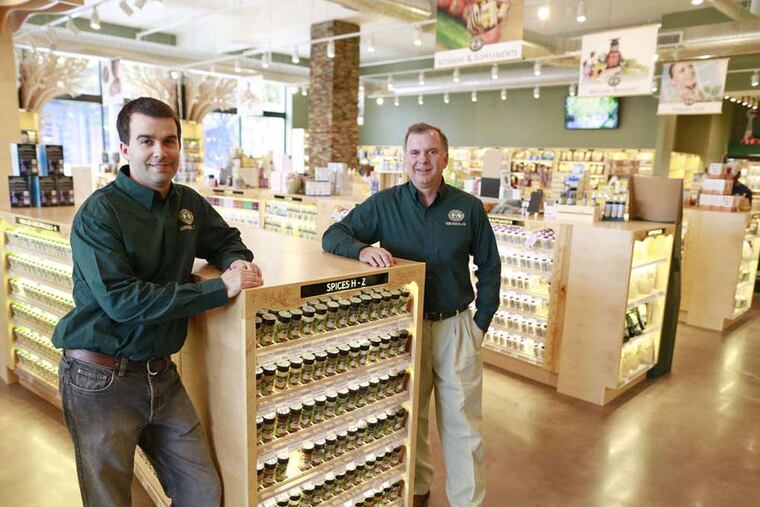
Among the items in Janet Ridley's shopping cart at the Penn Herb Co. store in Philadelphia's trendy Northern Liberties neighborhood was a big pouch of chamomile tea.
"A drink you take in the evening, so you don't have to take Valium," said the retired elementary school teacher from West Philadelphia.
If so, a steady IV drip of the brew associated with calming qualities has been in order for company executives William P. Betz Jr., his brother Ronald Betz, and William's son William P. Betz III for the last three years.
In August 2012, they boldly razed the herbs and natural-remedies store the family had operated since 1962 on the corner of Second and Green Streets. (A prior owner had operated it there since 1940.)
"That was scary. We had an established business and customers used to coming [to it]," said William Betz Jr., CEO of Penn Herb Co. Ltd., which also operates a warehouse in Northeast Philadelphia, where processing and packaging of products sold at the store and at www.pennherb.com is done.
The plan had been to reopen in Northern Liberties within a year or two, with a store more than four times the size of the one it replaced that would be topped by 14 upscale apartments. Due to myriad complications - including the demise of a company that was supposed to provide the Indiana limestone that wraps the building - it would be three years until the $5 million "Liberties Gateway" project was complete.
The 8,000-square-foot store officially opened Oct. 1.
"What I really wanted to accomplish is a brand new store and have other people pay for the building," Betz Jr., 59, of Holland, said of the residential component. The apartments, one- and two-bedroom modular units ranging from 900 square feet to 1,300 square feet, go for $1,600 to $2,395 a month, including underground parking.
William Betz III, 36, who majored in business administration at Pennsylvania State University and is Penn Herb's operations manager, made all 600 maple shelves, keeping construction costs down. Unlike the old store, the new one - outfitted with information kiosks to help guide customers on herbs and their benefits - also carries food. A coffee and tea bar is planned for early next year.
It is far less ambitious than the 10-story mixed-use stunner that the Betz family proposed 10 years ago and scrapped amid neighborhood opposition.
And it's dramatically different from the place where Betz Jr. worked as an 8-year-old, when supplies were hoisted to the fourth floor, where the milling machines were. Back then, this block of Second Street was dominated by dilapidated rowhouses and bars. Now, it's lined with hip restaurants and boutiques.
William Betz Sr., who died in January, bought the business in 1962 from its founder, Konstanty Kalkosinski, a naturopathic physician who started the company in 1924, growing herbs on his farm in Ottsville, Bucks County.
These days, most herbs that Penn Herb sells come from Europe. Since 1975, the company has been the sole U.S. importer of Olbas, a popular line of natural products originating in Switzerland. Initially supplying Olbas to mom-and-pop health-food stores, Penn Herb now also feeds Whole Foods and CVS stores, Betz Jr. said.
Declining to disclose specific revenues, he said they have steadily grown for 50 years despite increased competition, largely from the Internet, and strict oversight by the Food and Drug Administration, which forbids medical claims.
The Natural Products Association in Washington estimates U.S. sales of all dietary supplements at $30 billion to $35 billion, with steady annual growth since the mid-1990s.
"Much of it is the self-care movement," said Daniel Fabricant, the group's executive director and CEO. "People want to have control over their health and well-being."
Including Betz Jr. He takes CoQ10, Super EPA fish oil, red yeast rice, lutein, and Vitamin C, but also allows for two prescription drugs for high blood pressure.
"Probably if I wasn't doing all this, I wouldn't need it," he said of his hypertension medicine on opening day at the new store.
215-854-2466@dmastrull
