Turning the lens on inequality
The question that launched Zoe Greenberg's amazing journey was simple enough: How much is enough?
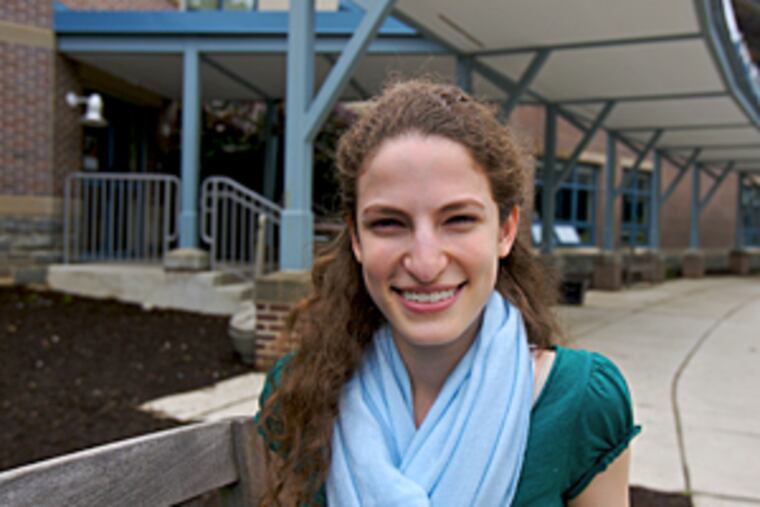
The question that launched Zoe Greenberg's amazing journey was simple enough: How much is enough?
Three years ago, Greenberg began thinking about that question as part of her bat mitzvah project. She shot hundreds of hours of film and interviewed students poor and rich, black and white, boy and girl, to probe their perceptions of wealth and class. She turned her work into an 11-minute documentary, Enough! A Kid's Perspective.
Now a sophomore at the Springside School, Greenberg's work was recently awarded the Princeton Prize for Race Relations, an award that praised the teenager's work "to promote harmony, respect and understanding among people of different races." The prize, which is in its second year, is awarded to a high school students for top efforts in furthering understanding and mutual respect among the races. The award is given through a joint effort of Princeton University and its alumni association.
That's heavy stuff for a 15-year-old, but she was uniquely positioned to dive into the subject matter.
After fifth grade, she left a Mount Airy neighborhood public school that she describes as "underfunded and overcrowded" and transferred to Springside, a private school for girls near Chestnut Hill. It was a different world for Greenberg, a scholarship student, and at first, a difficult one.
"I would go to a friend's house at Springside, and it would be this huge house," she said. "It was the difference in schools that opened my eyes. It kind of inspired me to talk about inequality."
No one, she found, was talking about the real gaps that wealth created, even in a privileged school like Springside, even among smart, motivated students.
Still, she loves her school, and realizes that it has opened doors that previously she might not have known existed: "I wish everyone could get that education," she said. "That's what's helping me think about the world in different ways."
Two mentors, one of whom is a professional filmmaker, were instrumental in Enough's genesis. But the work was all Greenberg's, from interviewing to filming to editing. And she had no previous filmmaking experience, so it was a from-the-ground-up affair.
"I didn't like the technical part of it so much, but I loved the content, the interviewing," she said. "There was a lot of sitting at a computer for five hours and fiddling with little stuff."
Still, her finished product is a slick, honest exploration of important issues, with high enough production values that it has been shown at film festivals.
Greenberg trooped all over the city and beyond to interview her subjects. Questions such as "Why are people poor?" and "What is poverty?" spurred insights.
"The five-year-old said, 'A poor person has no food and not enough money,'" Greenberg said. "The 17-year-old said, 'A poor person doesn't have enough to comfortably sustain their family.'"
She was most surprised at how people saw themselves, class-wise.
"I asked people what class they think they are, and they all said, 'Middle class.' And we can't all be middle class," Greenberg said.
Last year, Greenberg picked up the film again with some help from two Springside teachers. She re-edited it and presented it at school.
When Greenberg met with the co-director of Class Action, a national organization aimed at ending classism, Felice Yeskel felt that Greenberg's project was a terrific fit with the organization. They talked about mass-producing the film, and using it in classrooms. Greenberg has also led workshops, presented Enough at film festivals, and looks forward to the development of a curriculum around her work.
Timothy Johnson, Head of Upper School at Springside, points out that Greenberg was reluctant to put herself in the limelight when the film first came up. She was also concerned that students would watch the film, engage in a cursory discussion, and promptly forget about the topic.
"One of the things about class is that it connects to a lot," Greenberg said. "It's really relevant at an all-girls school to talk about gender inequality for instance. It's important."
To that end, Springside brought in a University of Pennsylvania professor to lead dialogue about the film's core questions. And Johnson was excited about the level of discourse.
"All the girls had questions," he said. "We talked about things we don't often talk about."
The film's effect didn't stop there. Springside's Diversity Committee will begin exploring the ways the school can incorporate class sensitivity into everyday life.
"When we get back from a spring break, and five girls are talking about their trip to Bermuda, and three of the girls say, 'Well, I didn't leave Philadelphia.' There are ways within the community that we can make everyone feel included, but be very clear that we're a microcosm of the real world. It's OK to understand where you fit in that puzzle and not to feel awkward about it," said Johnson.
Johnson has high praise for the young filmmaker.
"She's very bright," he said. "She's mature beyond her years, and she has a very gentle manner about her. She's service-oriented in her thinking, in her being; it's not something she turns on and off."
Make no mistake – Greenberg isn't some achievement robot. Her speech is peppered with "awesome" and "cool" and her high, girlish voice belies a sophisticated grasp of the world.
She loves history and drama.
"And I hang out at coffee shops with my friends," she said, giggling.
Her career plans?
"I'd like," Greenberg said, sounding very much like a teenager, "to do some activist thing."