What Cezanne saw
Author Derek Fell glories not just in the masterpieces, but in the naturalistic gardens that inspired the artist.
Derek Fell's interest in Paul Cezanne is different from most.
Of course, he delights in the great postimpressionist's penchant for painting bathers, still lifes, portraits, and landscapes, many of which can be seen in the Philadelphia Museum of Art's current exhibit, "Cezanne and Beyond."
But Fell, a well-known horticulturist, photographer, and author of 50 garden books, is especially keen on the role Cezanne's Provençal garden played in his work.
"Being in his garden, I felt like I was stepping into one of his canvases. You see images of his paintings everywhere you look," says Fell, of Pipersville, who visited Cezanne's home at Les Lauves in Aix-en-Provence, in the south of France, six times as he researched his book Cezanne's Garden (Simon & Schuster, 2004).
There, he was struck by the tapestry of trees of different heights, colors, and textures, and woodland paths leading through telescoped, leafy tunnels. He discerned bold patterns in the interlocking trunks and branches, and noted the subdued color of most plantings.
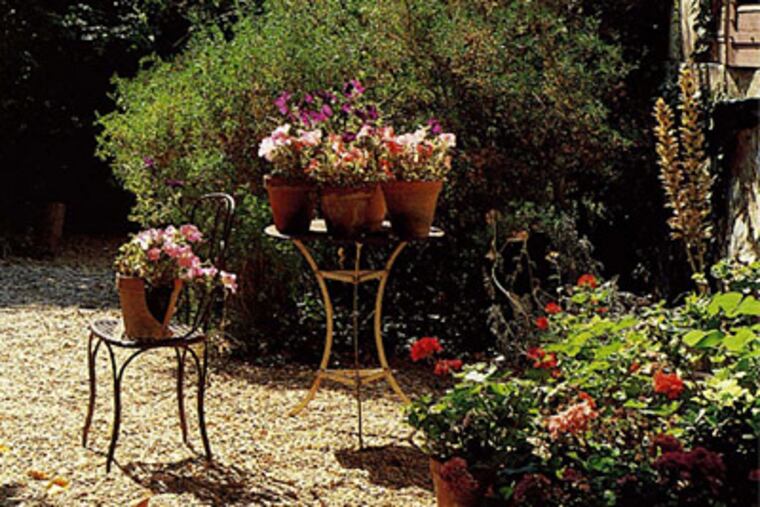
Yes, Cezanne liked bright geraniums in terra cotta pots arranged artfully on the steps and patio, a tradition continued at his atelier, or studio, today. And he once told an interviewer that his favorite flower was scabiosa, or pincushion flower, a frilly pastel perennial that undoubtedly intrigued him with its twisting stems, serrated leaves, and spiky center.
"He liked plants that twist and turn," Fell says.
But Cezanne's garden was more a celebration of green than the "riot of color" so popular in the late 19th and early 20th centuries, which Fell characterizes as "the golden age of horticulture" in Europe.
New and exotic plants were being introduced from Japan. Oil paints began coming in tubes. The snapshot camera produced realistic images, and the rotary lawnmower and rubber garden hose made trimmed lawns and well-hydrated flower beds possible.
But Cezanne preferred the naturalistic look, and Fell says he worked with his full-time gardener, Vallier, whom he also painted, to design such a garden.
From his second-floor studio, Cezanne could gaze upon the volcanolike limestone Mont Sainte-Victoire, which became a favorite subject to paint. Closer in, the view evolved into a layered mosaic, tantalizingly recalled by Fell as silvery-green olive trees and mint-green chestnuts, black-green pines, and grass-green winter wheat.
"When you're surrounded by greenery, it's like being in a cathedral or being in the womb. It's a wonderful sensation," says Fell, 69, who has created a cottage industry out of artists' horticultural sensibilities. Besides Cezanne, he's written about and photographed the colorful gardens of Claude Monet, Pierre-Auguste Renoir, and Vincent van Gogh.
Often called "the father of modern art," Cezanne was a quirky, hypersensitive, hard-working fellow who used his modest garden as an outdoor studio. He liked to walk and paint en plein air, in the open air, often heading out across the gravel courtyard into the countryside with his easel, to paint his beloved mountain.
Katherine Sachs, cocurator of the Art Museum show, says Cezanne was "all about looking for the solidity in nature, not necessarily the transitory aspect of it that the impressionists would have wanted to capture. That's the difference between the two."
Many of Cezanne's paintings are about nature, but they have "that solid quality that people associate with Cezanne.
"For him," Sachs says, "it was more about the space and his relationship to that space than capturing light as it passed over the flowers."
His paintings are "very, very green," she adds. "You won't find flowers in his landscapes, and you're as aware of the negative spaces between the lines of the branches as you are the branches."
Sachs also suggests that the placement and types of fabrics in Cezanne's studio still lifes reflect the tapestry effect in the garden.
The artist actually knew three Provençal gardens in his lifetime.
The first was on the family estate, Jas de Bouffan, a large, brooding place with a formal reflecting pool. The second, at Chateau Noir, was unfinished, with columns lying about and an ancient pistachio tree pushing up through the patio.
"Cezanne liked the idea that this garden was being taken over by the forest. He liked man's vulnerability to nature," Fell says.
For his last five years, Cezanne found inspiration in the walled garden at Les Lauves. One of his final works, a more abstract piece called The Garden at Les Lauves, so impressed Fell that he restored a ruined wall of a barn at his home to look like the one in the painting.
Fell and his wife, Carolyn, live in an 18th-century farmhouse on 20 acres, called Cedaridge Farm. They've designed a five-acre garden to incorporate elements from Cezanne's garden and those of other artists Fell has written about.
Bare native vines of fox grape snake through one section. "Very Cezanne-y," Fell says, acting as guide.
At the real Cezanne homestead, the studio is exactly as he left it, but disease and frost have destroyed most of the old olive trees in the garden. A few figs survive, along with some Aleppo pines and English ivy, whose leathery leaves Cezanne admired.
Mock orange and poison ivy have taken hold and vines grow up the house, giving a calculated, overgrown look Fell believes is meant to strike a balance between the wilderness feel of Cezanne's day - he died of pleurisy in 1906 at 67 - and proper maintenance.
About 100,000 visitors come annually to this unusual museum, which opened in 1954. The next year, one noteworthy fan wrote in the guest book: "A wonderful visit!" and signed her name: Marilyn Monroe.
If You Go
"Cezanne and Beyond" continues until May 17 at the Philadelphia Museum of Art, 26th Street and Benjamin Franklin Parkway, 215-763-8100, www.philamuseum.org. One-third of the exhibit's 150 works are Cezanne's; the others were done by 18 modern and contemporary artists influenced by him.
Derek and Carolyn Fell will open their gardens to the public - at no charge - on Mother's Day and Father's Day weekends, May 8 to 10 and June 19 to 21, from 10 a.m. to 4 p.m. Address: 53 Iron Bridge Rd., Pipersville, Pa. 18947. Information: 215-766-2858.EndText