N.J. inspectors check safety of school buses
The wheels on the bus go 'round and 'round, as every schoolchild knows. But do all the lights on the bus go flash and blink? Are the treads on the tires deep and sharp? Do the brakes work? Does the alarm sound when an emergency exit opens?
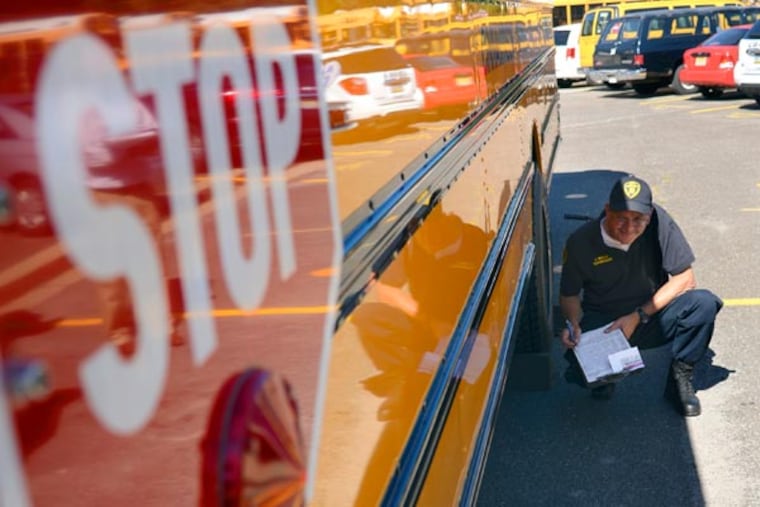
The wheels on the bus go 'round and 'round, as every schoolchild knows.
But do all the lights on the bus go flash and blink? Are the treads on the tires deep and sharp? Do the brakes work? Does the alarm sound when an emergency exit opens?
Parents make an act of faith every time they put a child on a school bus. And so, with a new school year dawning, the chairman of New Jersey's Motor Vehicle Commission was on the road this week to assure them that those big yellow boxes on wheels are safe.
"We make sure that buses make the grade," Raymond P. Martinez, the MVC's chairman and chief administrator, said Wednesday at a made-for-media demonstration in Cinnaminson of a state school bus inspection.
All of New Jersey's 24,000 school buses are scrutinized by state inspectors at least twice a year, Martinez told an outdoor news conference behind Cinnaminson High School. Since 2006, all buses have been required to have lap belts or other restraints.
Not surprisingly, the bus that Cinnaminson rolled out was brand-new and squeaky clean. The exercise was designed to demonstrate how detailed each semiannual inspection is, and Bus 55 would pass all 180 points on the checklist with flying colors.
Under normal circumstances, only half the buses statewide get a perfect score the first time around, Martinez told reporters before three inspectors scrambled through and under Bus 55.
In 48 percent of inspections, he said, examiners find a tire or light or buzzer that needs quick replacement or repair, while 13 percent of buses are given 30-day rejection stickers.
Once serviced, Martinez said, 95 percent of buses pass reinspection and are returned to service. Since a typical bus inspection lasts about 30 minutes, a state team of six inspectors may spend days or weeks examining the fleet of a large district.
After Martinez and Cinnaminson's mayor, Ben Young, and school superintendent, Salvatore J. Illuzzi, had finished their remarks, the inspection team members made their way to Bus 55 and showed off what they do.
With one man flipping switches behind the wheel and another watching out front, they honked the horn, flashed headlights, then flashed the yellow lights fore and aft that signal a bus is slowing, and then the red lights that signal it has stopped and is ready to discharge children - the message that all cars nearby must halt.
They then flipped out the flashing stop signs on each side that echo the halt message, and tested the five-foot metal arm that swings out from the bus' front bumper to ensure that children pass far enough in front that the driver can see them.
They checked for reflective tape around the emergency exits - including two on the roof - and tested their alarms.
Then they checked that the bus' ignition would not start if the rear exit was locked - a precaution needed because drivers sometimes lock a bus at the end of the day, and can forget to unlock it the next morning. And they checked the button at the rear of the bus that the driver must press at the end of a run.
Its location, inspection supervisor Steve Schoppe explained, obliges the driver to pass by all the seats and make sure no child has fallen asleep and missed his or her stop. "It happens," he said.
Later, inspector Vince Frazier, a 27-year veteran of the program, slid under the bus on a low, wheeled deck called a "creeper" and examined the undercarriage as supervisor Jim Wills checked off a list.
"Interior tread, check," Frazier called out.
"Exhaust system, check," he said.
"Engine hoses, check. Undercarriage, check."
And so it went: Body clip. Driveshaft guards. Lug nuts. "No chafing on electric lines." Rotor. No fluid leaks. Battery.
When Frazier was done, the team declared that Bus 55 had passed, but just for now. The real scheduled inspection months for Cinnaminson, Schoppe noted, is December and June.
"We'll be back," he said.
Inquirer staff writer Jonathan Lai contributed to this article.