Drexel, artists collaborate on ride to 'PROM'
Like millions of American teenagers this spring, members of the New Paradise Laboratories theater company are dressing up and heading for the prom - or, in NPL's case, PROM, the company's new production at Drexel University's Mandell Theater.
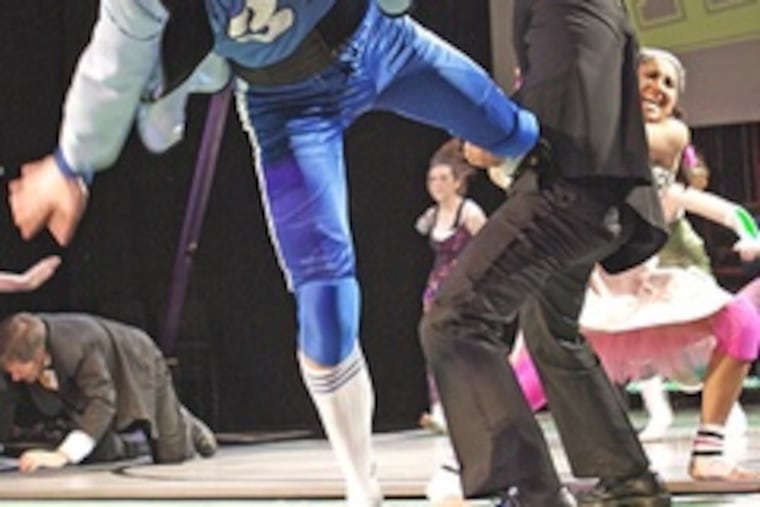
Like millions of American teenagers this spring, members of the New Paradise Laboratories theater company are dressing up and heading for the prom - or, in NPL's case,
PROM
, the company's new production at Drexel University's Mandell Theater.
However, if artistic director Whit MacLaughlin's own promgoing experience is any indication, expect things to quickly take a turn for the strange.
"I had this girlfriend," he recalls of his big night, "who was a year older than me. She had gone up to college, but had a lot of mental problems. She came home and was sleepwalking, and it turned out she had a whole multiple-personality thing going on. And so my prom was heavily influenced by what seemed like . . . grave intensities."
Those familiar with NPL's brand of dreamy, nonlinear "performance theater" probably won't be surprised by the irony of this idealized American experience finding its way into MacLaughlin's hands. After all, the company's work, like prom itself, is usually supercharged with eroticism and physicality, as well as a liberal sprinkling of humor.
Batch
- the second in NPL's planned trilogy about rites of passage, which had its Philly premiere at the 2007 Live Arts Festival - examined bachelor parties from the inside and was about as bawdy as the real thing.
"When we did
Batch
in Louisville [at the Humana Festival of New American Plays], no one under 17 was allowed in," he recalls. "And
PROM
is all about people 17 and under.
But MacLaughlin, who has a career outside the company as a director of children's theater, says he has no difficulty sliding between adult and universal themes.
"In our culture, it's not really the way you're supposed to think, but if you're a parent" - which MacLaughlin and his wife, actress Catharine Slusar, are - "you do. We're avant-garde for the multigenerational."
NPL first premiered
PROM
in a partnership with Minneapolis' Children's Theatre Company in 2004 and remounted it there in 2006, using a dozen high school students. This time, the work is being re-created as part of Drexel's Mandell Professionals in Residence Project, which pairs Drexel with artists so they can share resources and knowledge.
Project director Nick Anselmo says, "The artists can really use the talents of all these kids - they can go film in the green-screen room, somebody can edit video for them. Not only do students get to work with professionals, we get to produce something that's exciting for young people."
MacLaughlin is more pragmatic about the program's benefits: "We'd never be able to mount a production of this size on our own, and we'd never in a billion years be able to afford what we have available to us here!"
MacLaughlin "lurked" at proms around the country doing research on the piece. (Interesting facts he says he gleaned from lurking: In Los Angeles, the typical couple spend $11,000 on their prom; in Pennsylvania, he says, the figure is more like $1,500.)
He insists this
PROM
is not a retread; each production varies, as do regional prom customs. "It's all tailored to the people in it," he says. "It's not a play, it's a template."
His research led him to analyze party life. "I thought a lot about what you expect, what you want to have happen, how you want the lid to come off in an interesting way. . . . Even if it could be boring, you hope maybe something will happen, some rule will be suspended for a while."
He likens
PROM
to a football game - an apt comparison, as much of the set is taken up by an AstroTurf simulation of a football field. "Games always have certain aspects. There's a ritual: The teams enter, there are cheerleaders, they shake hands, there's a referee. The same thing is true of a prom. It all happens the same way, but how it happens and the players involved is what's interesting."
In Philadelphia,
PROM
's 20-member cast is divided into two teams: a dozen Drexel students with fresh prom memories, and local vets - including Barrymore winners Tom McCarthy and Lenny Haas - playing chaperones.
"In our culture," MacLaughlin says, "we're segregated by age. So the chaperones - the word derives from the thing hawk-handlers put on the birds' head to keep them in control - they're the men or women who hang out at parties to see that propriety is at least an issue."
While coming up with ideas to promote the show to an elusive but key demographic - audiences between the ages of 16 and 23 - MacLaughlin and Drexel's Anselmo went both guerrilla and viral.
First, they put up a
PROM
Facebook page on which cast members posted bios with a distinctly Lonelygirl16 flair. (For those who missed the Lonelygirl YouTube furor, suffice it to say that when it comes to the Internet, you can't always believe your eyes.)
Then they discovered instructions for making "LED throwies" - small multicolored magnetic lights that will stick to any ferromagnetic surface at which they are hurled - on the Web site of New York-based Graffiti Research Laboratories.
Armed with 1,000 throwies to which they had taped info about the show, they grabbed some students, headed to First Friday's gallery scene, and started, well, throwing.
The magnets attached to (among other things) cars, on which they made their way around the city. And for one magical evening, both chaperones and students gave propriety the night off.