Flashing back to the previous 7 Harry Potter movies
Daily News movie critic Gary Thompson has reviewed all 8 Harry Potter films, awarding them grades as high as A ("Deathly Hollows Part Two") and as low as B- ("The Order of the Phoenix"). Here are excerpts from a decade of Potter punditry:
Daily News
movie critic Gary Thompson has reviewed all 8 Harry Potter films, awarding them grades as high as A ("Deathly Hollows Part Two") and as low as B- ("The Order of the Phoenix"). Here are excerpts from a decade of Potter punditry:
HARRY POTTER AND THE SORCERER'S STONE (2001): B
"Harry Potter and the Sorcerer's Stone" is loyal and faithful and true, and if movies were dogs, this would be best in show.
The $125 million production doesn't preserve everything from J.K. Rowling's beloved book, but it preserves an impressive amount, so much that its legions of devoted young readers will scarcely experience a bump or jolt along the way.
. . . What fans of the "Harry Potter" books love is the encounter with a work of inspiration, one that produces its own kind of magic. The movie, by comparison, is a careful facsimile, painstaking and technologically marvelous, but far too dutiful to create the kind of wonderment that attends each new Rowling story.
HARRY POTTER AND THE CHAMBER
OF SECRETS (2002) B:
. . . We're back at Hogwarts school, full of students in the throes of puberty, and the plot has something to do with a giant snake that lives in a "chamber of secrets." Paging Dr. Freud!
Fear not, though - Brittany Murphy does not show up to put the moves on Harry, and "Chamber" is safely PG. It's also, I'm happy to report, a lot more nimble than the first movie, which was often bogged down by lumpen, introductory material. The sequel jumps right into the story and barely stops to breathe for the next 2 hours and 40 minutes.
They say this one is "darker" than the first, and that's marginally true, but it's also lighter in spots, and funnier. The darkness comes from a monster that's loose in the school, the comic relief comes from Kenneth Branagh in the role of a self-promoting blowhard who joins the Hogwarts faculty, and Dobby, a digitally created elf whose efforts to help Harry do more harm than good.
. . . As for the young actors, well, they're still not exceptional. If (Daniel) Radcliffe were to stare into the eyes of the basilisk and become petrified, he'd be delivering his usual performance.
HARRY POTTER AND THE PRISONER
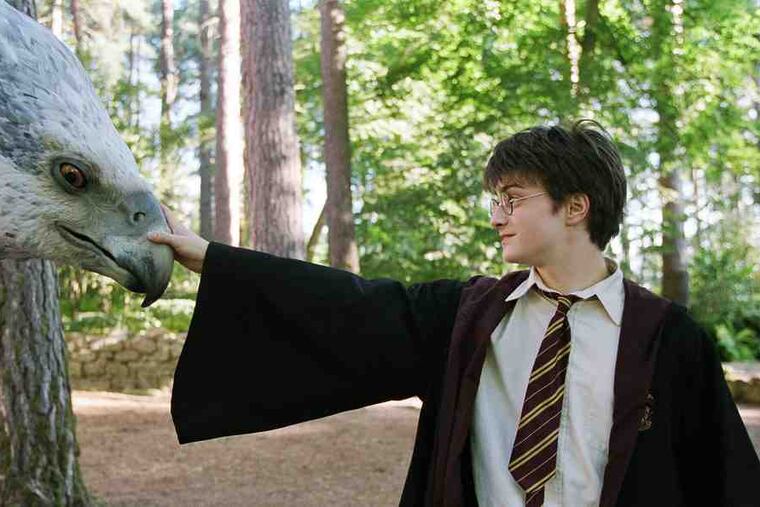
OF AZKABAN (2004) B
One of the nice things about the Harry Potter movie series is that while the books keep getting longer, the movies do not.
"Harry Potter and the Prisoner of Azkaban" clocks in at a (relatively) tight 2 hours and 20 minutes, even though J.K. Rowling's "Azkaban" tome is big enough to sink a canoe.
. . . "Azkaban" in general is pitched to an older crowd. Harry's a hothead - the more he learns of his parents' death, the more morose and vengeful he becomes. The world takes on darker tones - Hogwarts' less sunny (literally) than ever.
. . . I look forward to seeing how the series shepherds Harry and company through puberty - Hermione and Ron are already getting chummy.
What are they going to be like at 16 or 17?
Rowling should make sure she visits the set, lest the sequel arrive as an "R."
HARRY POTTER AND THE GOBLET
OF FIRE (2005) B
. . . The kids are older now, and their feelings sharper and more lasting (therefore more dangerous). "Goblet of Fire" is very much about the intensity of their emotions, and consequently, the drama centers on the students more so than previous installments (there are not so many venerable British guest stars on hand to carry the narrative load).
The kids deliver, when given a chance. The most exciting moments in the story occur not during the Tri-Wizard Tourney, but during the big Yule dance, when Harry, Ron and Hermione muster the courage to deliver, or finagle, an invitation.
Adolescence has thrown gasoline on everyone's feelings - Ron is pretending he doesn't like Hermione, which enrages her, and Harry is slow to act on his crush for another girl.
. . . In "Goblet of Fire," all is pictured and revealed, even, alas, the evil nemesis Lord Voldemort (Ralph Fiennes), looking like Uncle Fester with bulimia and a bad nose job. Like a lot of monsters, he was scarier when you couldn't see him.
He and Harry have a magic wand duel that looks like something out of "Ghostbusters" (don't cross the streams!) and it's hard to take it seriously, even though Rowling ups the ante by killing off a human character. The casualties don't make the narrative any more deeply felt.
HARRY POTTER AND THE
ORDER OF THE PHOENIX" (2007) B-
. . . "The Order of the Phoenix" is J.K. Rowling's treatise on the dangers of state control. Through Umbridge, she shows how authoritarians can take hold in an atmosphere of gnawing fear, the kind that's consuming Hogwarts. Umbridge targets Harry because his claims regarding Voldemort threaten the status quo, but the anxious piling up of rules is really a tacit acknowledgment of what Harry has been trying to tell everyone - that Voldemort has returned.
To fans, this isn't exactly a news flash. We've been hip to the dark lord since the first book, and so there isn't a great deal of drama in official recognition of his presence.
. . . The psychological struggle between Harry and his nemesis - riveting on the page - is less so on screen. It's one guy shooting a magic beam at another guy, by now a pretty moldy effect in motion pictures.
All of this is further evidence that, in the end, the Potter franchise will be regarded as a literary one. The movies are mere supplements.
HARRY POTTER AND THE HALF-BLOOD
PRINCE (2009) B
The new "Harry Potter and the Half-Blood Prince" resolves a couple of mysteries, like how Voldemort invades Hogwarts, and how he attacks some of Harry's key allies.
It also resolves an even more puzzling mystery: how the franchise could be permitted to drag on this long without providing employment to Jim Broadbent, one of his country's best actors yet one of the few Brits yet to receive a Warner Bros. cheque.
Broadbent finally gets his Potter dividend here, filling the key role of Professor Horace Slughorn, returning to Hogwarts Magic Academy to mentor Harry, much as he once doted on a protege named Thomas Riddle, who grew up to be the evil Lord Voldemort.
. . . Hogwarts on the whole seems a more pleasant place, but maybe I just have a soft spot for a community wherein there are no laptops, no Internet and no BlackBerries, where everybody gets the news from the same yellowed newspaper.
A magical place indeed.
HARRY POTTER AND THE DEATHLY HOLLOWS: PART I (2010) B
. . . In "Deathly Hollows" the headlines are ablaze with news of a sinister changing of the guard - Hogwarts' headmaster is dead and gone, changes are afoot at the ministry of magic, where authoritarians obsessed with wizard-witch racial purity are taking over.
. . . There is only the barest of story lines. Harry and friends (Dan Radcliffe, Rupert Grint, Emma Watson) combat Voldemort by destroying objects alleged to contains portions of his malevolent mojo, but it's an abstract process that's so slow, even the characters joke about its languor.
For book outsiders like me, there are big narrative problems with this. One is that nothing much happens ("Unstoppable" it ain't). Another is that Voldemort stipulates early and often that no one but he is to kill Harry, so for all of "Hallows" ominous mood, there's no urgent sense that anything decisive will happen.
. . . "Hallows," much more than the previous installments, is a readers-only affair. And that's smart, commercially. At this point, almost no one is going to walk in cold to part seven of the Potter franchise, and certainly no one would expect it to make stand-alone sense.
. . . Warner's is obviously keen to maximize its investment, splitting the "finale" in two. If you're the sort of fan who shows up to "Hallows" in a sorting hat and a robe, you'll have no complaints. For the unconverted, it's a bit of a chore.