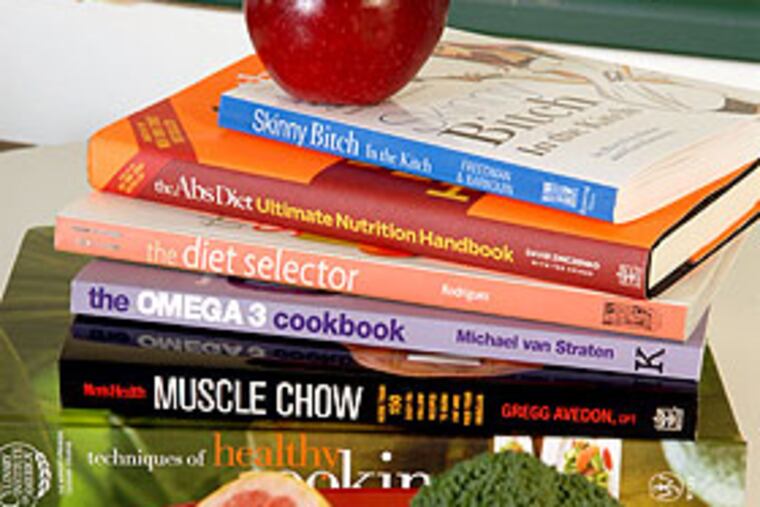
If you've come to think of January as the start of diet season, you could be among the thousands, possibly millions, who qualify as yo-yo dieters.
Gain some, lose some, gain more. Up and down.
About 40 percent of women and 20 of men are on a special diet at any given time, while three of four women and half the men say they have dieted for weight loss or for health reasons at some time in their lives.
Meanwhile, the level of satisfaction with those diets hovers around 17 percent, a figure low enough to suggest repeated failure.
But that doesn't stop dieters, or publishers, from trying again in January.
This season, among the new crop of diet books, the trend is to downplay fad fare such as grapefruit, peanut butter and cabbage-soup diets in favor of health/nutrition education and sustainable "diets" maintained for a lifetime.
Many of the new books share a consensus that reducing carbs to a moderate level (not necessarily low-carb) is good. So too, cutting down sharply on sugars - especially refined sugar and high-fructose corn syrup. The goal: a "balanced" diet of wholesome fresh foods.
On the health side, nutritional healing has gone mainstream as research supports the role certain foods and nutrients play not just in weight control but also in preventing, managing, even reversing health conditions such as high cholesterol, high blood pressure, arthritis, and more. Notable offerings include:
Joy Bauer's Food Cures: Easy 4-Step Nutrition Programs for Improving Your Body (Rodale), a guidebook for using food as medicine in the format of personal consultations.
The Omega-3 Cookbook: Over 100 Smart Recipes for Body and Brain by Michael van Straten (Kyle) goes beyond cod liver oil and canned salmon to make more of this beneficial oil-based nutrient (abundant in fish) available even in vegetarian diets.
Diet regimens come at us from all sides - from South Beach, Sonoma, New York and Beverly Hills, from Drs. Weil, Pritikin, Ornish, Atkins, and Phil.
That's why The Diet Selector: How to Choose a Diet Perfectly Tailored to Your Needs by dietitian Judith C. Rodriguez (Running Press) is a treasure that may be the last, or next to last, diet book you'll ever need.
From the three-apple-a-day, abs and Atkins diets to vegan, Volumetrics, Weight Watchers and Zone, 75 different weight-loss or health-motive diets are explained and rated based on their level of difficulty (easy to punishing), duration (quick fix to lifetime routine), and cost (supermarket fare or special order). Each synopsis/review offers pros and cons on why a diet may or may not be right for you.
But it seems the title and concept of a diet book often are what appeal: A current hot number is Skinny Bitch in the Kitch: Kick-Ass Recipes for Hungry Girls Who Want to Stop Cooking Crap (and Start Looking Hot!) by Rory Freedman and Kim Barnouin (Running Press). A combination of healthy food and de facto diet (oven-baked "fries" and vegan recipes), it is a companion cookbook for Skinny Bitch, their best-selling vegan manifesto.
A year ago, the "must read" dieter's delight was French Women Don't Get Fat.
Unfortunately, it seems that the more diet options Americans have, the heavier we get.
According to the 2006 National Health and Nutrition Estimates Survey, 66 percent of U.S. adults are overweight to obese, a figure "statistically unchanged" though up slightly since 2004.
Those full figures are supported by the World Health Organization (WHO), which estimates that the number of overweight and obese adults in the United States could reach 70 percent in 2009.
Excess weight is fast becoming a global issue, with more than one billion overweight people worldwide, including 300 million who are obese.
Countering that trend could require custom diets based on an understanding of good carbs/bad carbs, good fats/bad fats with your personal mix of foods you love but limit because they are not good for you, balanced with lots of your next-best choices from a healthy foods list.
Among the newest offerings of diet and healthy-eating cookbooks, out this month, are:
The Super Foods Rx Diet: Lose Weight With the Power of SuperNutrients by registered dietitian Wendy Bazilian and physician Steven Pratt, with Kathy Matthews (Rodale). A guide to good eating with flexible menu plans, shopping lists, and recipes based on the 14 micronutrient-rich foods discussed in Pratt's best-selling SuperFoodsRx.
Dr. Gott's No Flour, No Sugar Cookbook: Over 175 Delicious Recipes by Peter H. Gott (Wellness Central). The syndicated medical columnist's follow-up to Dr. Gott's No Flour, No Sugar Diet has recipes that replace high-calorie/low-nutrient (refined) carbs with low-calorie/nutrient-rich vegetables.
For proof that, in general at least, men and women differ when it comes to dieting, we have:
Men's Health Muscle Chow: More Than 150 Easy-to-Follow Recipes to Burn Fat and Feed Your Muscles by Gregg Avedon (Rodale). The magazine's Muscle Chow columnist emphasizes high-protein foods, carbs at the low end of the glycemic index, and alternative sweeteners such as stevia.
Women's Health Perfect Body Diet: The Ultimate Weight Loss and Workout Plan to Drop Stubborn Pounds and Get Fit for Life! by Cassandra Forsythe (Rodale). Menu plans (with cheating options), recipes, and targeted exercise routines for an eight-week program customized to body type and designed to raise metabolism.
And for dieters who eat out or order in:
Eat This, Not That: Thousands of Simple Food Swaps That Can Save You 10, 20, 30 Pounds - or More by David Zinczenko (Rodale). Informed choices to help you lose weight dining on prepared foods from restaurants and supermarkets.
Consumer Reports magazine evaluated several prominent diet plans for overall health merit in the summer and cited Volumetrics, a plan proposed by Pennsylvania State University nutrition professor Barbara Rolls, as the best-researched diet.
Her book, The Volumetrics Eating Plan: Techniques and Recipes for Feeling Full on Fewer Calories, is based on her earlier Volumetrics Weight-Control Plan: Feel Full on Fewer Calories. By adding menu plans, healthy food choices, and recipes, she has simplified a commonsense plan for controlling hunger while losing weight by eating more low-calorie foods.
CR chose The Best Life Diet by Bob Greene (Simon & Schuster) as top diet book for its lifetime weight-loss plan, balancing diet and exercise.
Also getting high marks: Eat, Drink & Weigh Less by Mollie Katzen and physician Walter Willett (Hyperion) and You, On a Diet by physicians Michael F. Roizen and Mehmet C. Oz (Simon & Schuster).