Ardmore renewal goes to Carl Dranoff
In the end, it was not Carl Dranoff's bulging portfolio of urban redevelopment projects that won him the job late Wednesday of reviving Ardmore's well-worn business district.
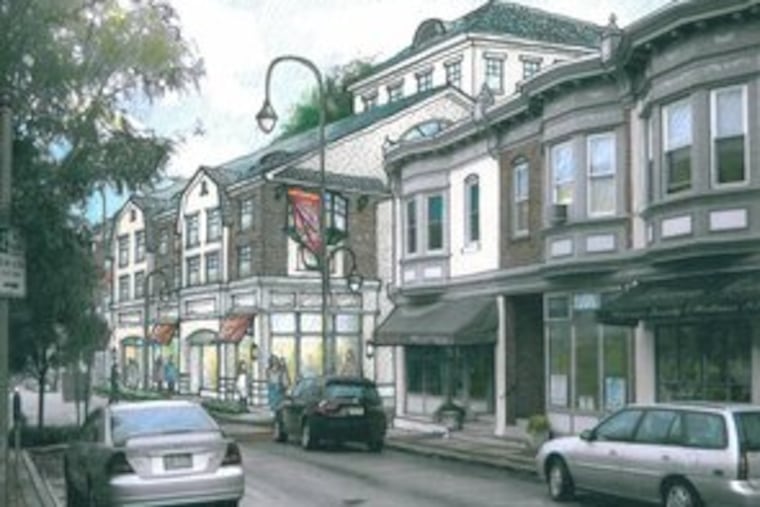
In the end, it was not Carl Dranoff's bulging portfolio of urban redevelopment projects that won him the job late Wednesday of reviving Ardmore's well-worn business district.
It was the outsize ambition of a competitor.
Edward Lipkin had proposed a $300 million makeover of the Main Line village's downtown, replete with a six-story hotel and office tower straddling the railroad tracks. But on March 4, just eight weeks after Lower Merion Township commissioners selected him to lead the transformation, Lipkin bailed out of the project, citing uncertainty about amassing the necessary financing in a tight credit market.
At first, residents and business owners said they were shocked. Then they expressed relief at the prospect of a do-over, complaining that Lipkin's vision for the Lancaster Avenue commercial corridor and adjacent train station area was excessive and out of character for a historic village setting.
Ultimately, the commissioners agreed. In an 11-0 vote close to midnight Wednesday, the board picked Dranoff's far more modest $150 million proposal for a mix of stores, offices and apartments. He described himself as elated at getting a second "bite of the apple."
Along with three other developers, Dranoff lost out to Lipkin on the first go-round in January. But when the victor withdrew, Dranoff wasted no time in trying to reposition himself as the heir apparent in Ardmore's renaissance - his first suburban revitalization effort.
That meant winning the hearts of the locals, said Dranoff, like Lipkin a Lower Merion resident.
With "an army" of architects, artists, engineers and financial advisers, Dranoff visited shopkeepers and civic leaders, homeowners and commissioners to solicit their opinions on the Lipkin plan - and how he could avoid the same mistakes. He said he heard the words "village, feel, historic, context."
"We learned that bigger is not always better, that grandiose and overreaching create insurmountable obstacles," Dranoff said yesterday as he prepared for contract talks with Lower Merion.
The Dranoff team went back to the drafting table, "pretty firm in sticking to our basic plan" but eager to demonstrate, "We do listen carefully."
First to be changed was the project name, from Ardmore Town Center to Ardmore Station, "because we felt the [town's] true identity is the transit stop," Dranoff said. In response to criticism that the architecture he proposed was too contemporary, he switched to more brick and stone.
Dranoff also scaled back the height of some buildings and added more pedestrian-friendly features to lure shoppers from Suburban Square across the tracks to patronize stores and restaurants on Lancaster Avenue. Residents called for more public space, so he accommodated them with an amphitheater.
By the time the commissioners convened the public meeting Wednesday night to replace Lipkin's EBL&S Development, Dranoff had won over two influential groups: the Ardmore Business Association and the Ardmore Initiative, a business district authority.
Their representatives urged the commissioners to open negotiations with Dranoff for Ardmore's revitalization, debated for more than five years.
Before voting, the commissioners praised similar outreach and fine-tuning by two other developers - out of an original five - who had vied for the job: Strategic Realty and BET Investments Inc., whose principal is Bruce E. Toll, chairman of Philadelphia Media Holdings L.L.C., owner of The Inquirer.
Saying the post-Lipkin scramble had resulted in the production of "three fine plans," Commissioner Brian Gordon added, "The winner of this process is truly the community."
Commissioner Lewis F. Gould Jr. did not share that view and did not cast a vote. The ultimate cost of Ardmore's redevelopment to township taxpayers, he said at the meeting, is not known. Given the sobering economic times, Gould said, he could only support the renovation of the train station, for which the township and SEPTA have secured a $5.8 million grant from the Federal Transit Administration; it is set to expire Sept. 30.
Not long ago, any talk of delaying the controversial project - which at one point included the threat of property seizures through eminent domain - would have triggered a standing ovation. Instead, Gould's protest was met with silence from the audience and the board.
In an interview yesterday, Commissioners Chairman Bruce D. Reed said that limiting the work to the train station "carries the . . . risk of further delaying or denying the rejuvenation of Ardmore's business district."
When the redevelopment is complete, in an estimated five years, it is to feature 335 apartments, 60,000 square feet of retail and restaurant space, 12,000 square feet of office space, 1,150 parking spaces, and a 95-foot-tall clock tower.
The prospect of a reinvigorated Ardmore inspired Nancy Gold to hug and kiss every commissioner and Dranoff associate she could corner on Wednesday night.
She had moved her King's Collar shirtmaking shop to Ardmore from Center City in 2000, only to see three prominent stores and a movie theater move out and a stream of nail salons move in.
That's when she started an unrelenting push for revitalization.
"I took a stand for this town," she said Wednesday night in mid-celebration. "Now I'm just going to go for the ride."
Dranoff's Proposed Ardmore Station
Cost:
$150 million.
Apartments:
335, with 10 percent of them below market rate.
Stores and restaurants:
60,000 square feet.
Office space:
12,000 square feet.
Entertainment:
Landscaped amphitheater at Schauffele Plaza.
Parking:
650 public spaces, 500 private spaces.
Privately owned land to be used:
None.
Time line:
To be built in four phases over five years, starting with a 300-space parking garage on the east edge of Ardmore on the township-owned Bernicker lot, followed by the train station renovation, then working along Cricket Avenue and finally the Ardmore West area.