Plan for Dilworth Plaza gets presentation
Center City District president and CEO Paul Levy presented the district's plan for the transformation of Dilworth Plaza, on the western side of City Hall, to a joint meeting Monday of the Center City Residents and Logan Square Neighborhood Associations at the Franklin Institute.
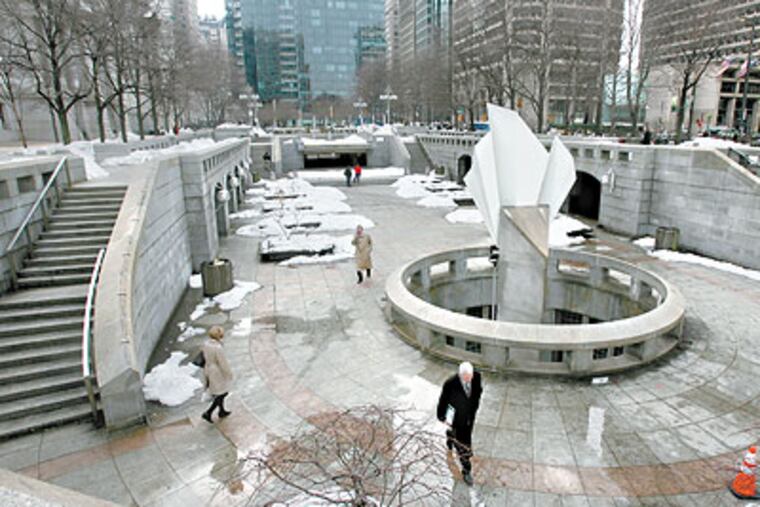
Center City District president and CEO Paul Levy presented the district's plan for the transformation of Dilworth Plaza, on the western side of City Hall, to a joint meeting Monday of the Center City Residents and Logan Square Neighborhood Associations at the Franklin Institute.
After his presentation, the two groups discussed the plans for the fountain, public art installation, lawn, and two transportation head houses.
"I love it. I'm a product designer, and I can see a lot of good thought went into the design," Center City resident Heather McComb, 64, said of the plan. The public art installation will be headed by artist Janet Echelman. "It will really put some soul into that place," McComb said.
After the presentation, Levy answered questions ranging from public restrooms (which will be available only in the proposed cafe) to the practicality of having movable chairs in a public park. Many residents also asked about the enforcement of anti-skateboarding laws and homeless people sleeping in parks. Levy emphasized that the space would be "a managed place. If the area is active and well-maintained, these people don't come in."
The Center City District (CCD) concept for Dilworth Plaza has already received approval from the Philadelphia Historical Commission and the Philadelphia Art Commission.
More than 185,000 people are within a 10-minute walk of Dilworth Plaza every day, 50,000 of whom work in nearby office buildings, according to the CCD. The plan estimates that the renovation will cost $50 million over 30 months and create 10,060 jobs and almost $40 million in wages.
The plan includes a proposed statue of Octavius Valentine Catto, a 19th-century civil rights activist, on the southwest corner.
The project already has federal and state grants totaling $30.5 million. The CCD plan anticipates the rest coming from SEPTA, the city, foundations, and $20 million in a tax-exempt bank loan.