Pa. budgets $40M for food banks, farmers’ market coupons, and other aid amid a growing ‘hunger crisis’
Money for the State Food Purchase Program and the Pennsylvania Agricultural Surplus System will allow food banks to purchase food for those in need.
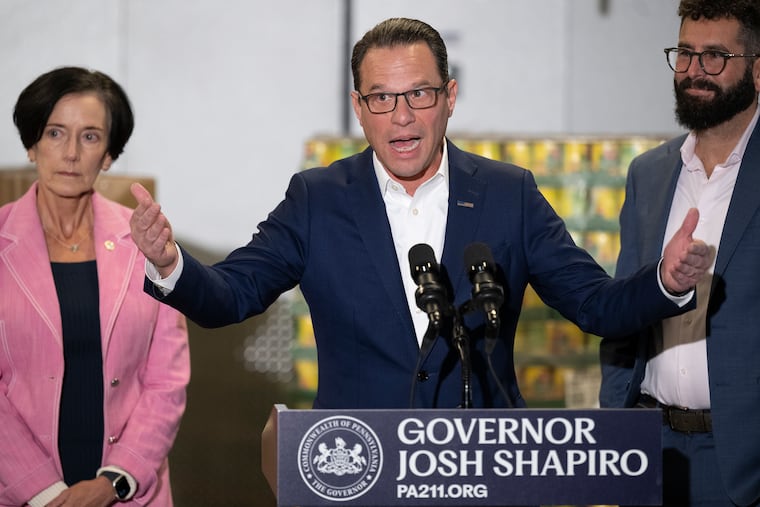
Pennsylvania’s spending on anti-hunger programs increased by 38% in the state budget passed Wednesday, an $11 million boost over last year to more than $40 million.
Of that amount, $5 million will go to food banks throughout the state, Gov. Josh Shapiro’s office announced. In the Philadelphia area, Share Food Program and Philabundance, which supply food to local food pantries, are among the groups to receive funds.
The allocation is part of a nearly $50.1 billion state budget that Shapiro signed into law after a 135-day impasse.
The extra money follows an unprecedented disruption to the federal Supplemental Nutrition Assistance Program, or SNAP, which, according to the state, helps nearly one in eight Pennsylvanians buy food. With the shutdown now over, SNAP benefits were expected to be issued by the weekend, according to officials from the Pennsylvania Department of Human Services.
“Despite the chaos coming from the federal government, we’re proving that we can still bring people together to get stuff done here in Pennsylvania,” Shapiro said.
In a statement about the budget, Shapiro said that “making sure Pennsylvanians have enough to eat is one of the most important things we can do as elected leaders.”
He added that the funding increase will “connect our farms with our food banks and help hungry Pennsylvanians put food on the table.”
While the government was closed, SNAP benefits were paused, and the Trump administration went to the Supreme Court to fight orders by federal judges to release the funding that goes to 2 million Pennsylvanians in need. The court allowed the administration to block SNAP payments Tuesday, in anticipation of the program’s imminent resumption.
Where will the $40 million in anti-hunger funds go?
In the new budget, funding for the State Food Purchase Program (SFPP) increased from $26.6 million in 2024-25 to $30.6 million, a gain of $4 million. This includes an increase to the Pennsylvania Agricultural Surplus System (PASS) of $1 million, going from $5.5 million to $6.5 million.
The SFPP allows food banks to purchase food wherever they can, according to George Matysik, Share’s executive director. The PASS program stipulates that food banks must purchase products from Pennsylvania farmers, he added.
The budget also increased funding for farmers’ market food coupons, growing from $2.5 million to $9.5 million, an increase of $7 million that includes the $5 million set aside for food banks, according to the Shapiro administration.
The other $2 million goes toward the State Food Bucks program that supplements SNAP benefits and encourages healthy eating by providing a $2 coupon for every $5 spent at participating locations.
While the budget allotment cannot come close to matching federal SNAP benefits, “we need to pull resources from wherever we can,” Matysik said.
“The Shapiro administration and our state elected officials have stepped up to pass a budget that helps support Pennsylvanians,” he added.
‘We are still in a hunger crisis’
The money could not have come at a better time, said Stuart Haniff, executive director of Hunger-Free Pennsylvania, a statewide network of 18 food banks, including Share and Philabundance.
“It certainly gives us breathing room, but make no mistake: We are still in a hunger crisis, seeing unprecedented demand at food banks.”
As much as food banks help, Haniff said, they can supply just one meal for every nine SNAP benefits produce.
“No food bank was ever meant to carry the burden of hunger by itself,” he added.
Even before SNAP benefits had been paused, Matysik said, Share saw a 120% increase in food need over the last three years.
That was evident last week at Feast of Justice food pantry in Northeast Philadelphia, one of the city’s largest, which is supplied both by Share and by Philabundance.
On Tuesday, dozens of people crammed the building, waiting their turn to pick up the monthly supply of 35 to 40 pounds of food they were entitled to have — an amount pantry leaders acknowledged is woefully insufficient to sustain a household over 30 days.
“Anxiety is so high here,” said Pastor Tricia Neale, the pantry’s executive director. “We get phone calls all day, emails, people knocking on the door at all hours, all from people looking for food.”