Simple, not easy
Architect Tony Weber set out to build his International-style dream house in the Poconos. It took nearly five years.
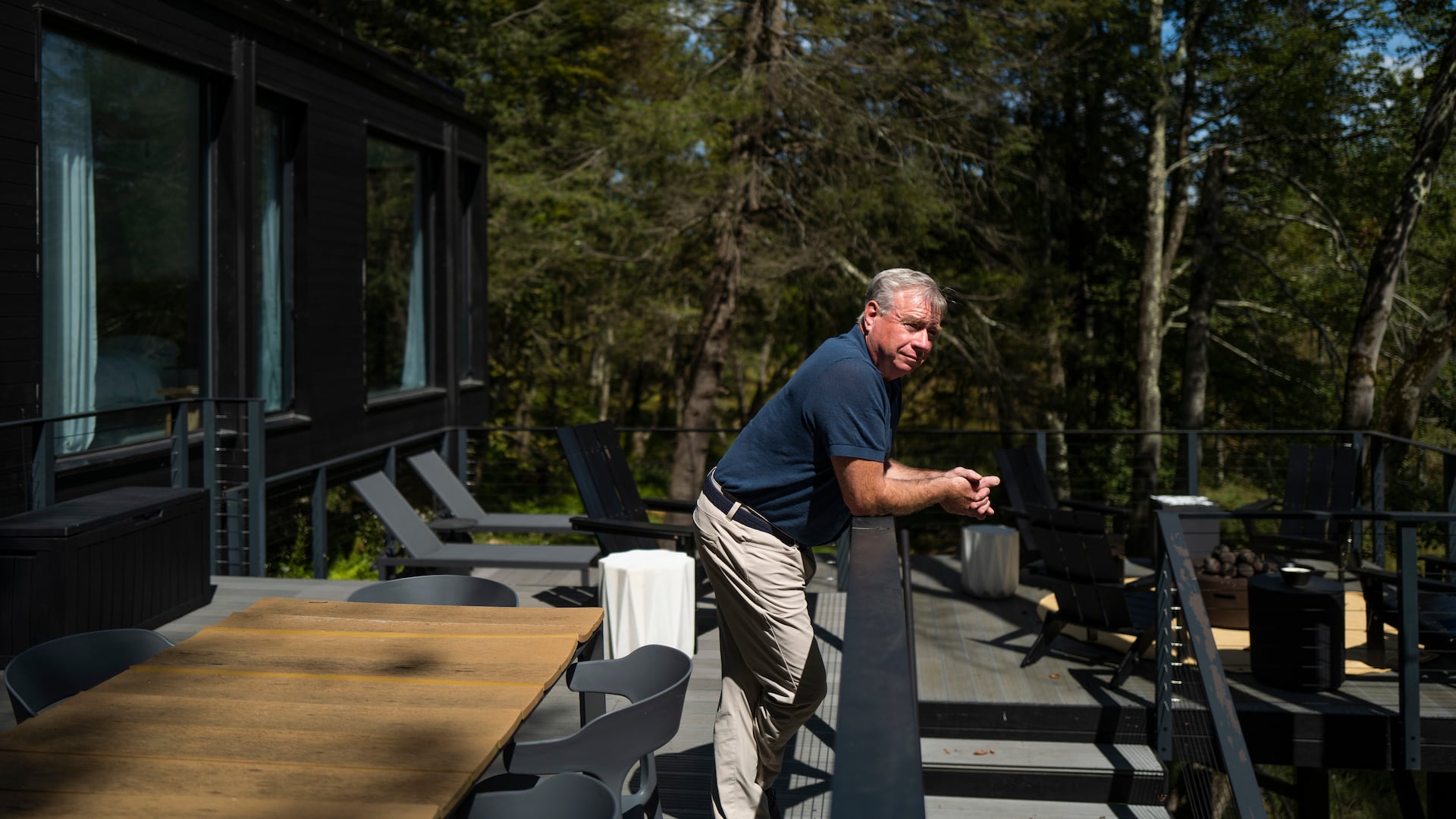
When his wife died almost six years ago, architect Tony Weber never suspected that his quest for a vacation home would set him off on an exhausting architectural venture that would last years.
Weber, whose practice is based in Center City, had always vacationed with his wife and two children on Cape Cod or in the Adirondacks. He liked mountains and lakes, but he wanted a place closer to home.
A search, including Airbnbs, yielded nothing. So, he thought, why not build in the Poconos?
“I wanted something on a lake, remote,” said Weber, 66. He pictured “something floating on the landscape, raised off the ground.”
In 2020 he found what he thought was the perfect spot: a three-quarter-acre plot in Greentowne Township, Pike County. There, he would build his ideal mountain house from scratch.
While the house is surrounded by towering trees, the property runs along the edge of Wilson Creek and Wilson Creek Lake. That sweetened the deal for Weber, a Kentucky native who grew up along the Ohio River, and is now active in the Philadelphia rowing scene. “I always had a thing for water,” he says.
He built a small dock near the house.
The views were magnificent and seemed likely to remain pristine because the owner of the surrounding land said he had no intention of building on it. Promised Land State Park is also nearby.
So he put together plans for an International-style house, with floor-to-ceiling windows looking out over the lush landscape surrounding it, and ample outdoor living space.
A major influence was the Farnsworth House outside Chicago, designed by Ludwig Mies van der Rohe, with a floor plate that seemed to hover and glass walls that seemed to dissolve. It was completed in 1951.
Then, as he began building, the downsides became apparent.
The property was on a gravel road, 2½ miles from the nearest highway, and the narrow path from there was downhill. So trucking heavy construction materials was an ordeal.
Some of the materials Weber wanted to use were imported from Germany, including 1½-inch-thick glass panels.
Meanwhile, skilled craftspeople were in short supply in that part of the Poconos.
What Weber had envisioned as a nine-month process stretched to almost five years. He never could find the right general contractor and ended up doing a lot of the work himself, learning along the way about roofing, insulation, heating, timber framing, and drywall installation and finishing.
“What I learned was that something simple isn’t always easy,” Weber said.
And he found that it was tough to find people with his level of attention to detail.
He did manage to bring in commercial glaziers from Manhattan. They were vital because some of the panels — each of which weighed almost a ton — broke and had to be replaced.
The result was a three-bedroom, two-bathroom, 1,500-square-foot house built mostly of thermally treated wood cladding from Finland, with simple post and beam construction.
He named it “Camp Double Oak” after his favorite Kentucky bourbon.
Weber’s architectural education has stressed mid-century modernism. He studied in Florence, where he also worked with a yacht maker.
Weber designed his Poconos house to be user-friendly, with doors more like moveable walls and toilets hung from the walls for easy bathroom cleaning. The roof used load-bearing trusses to handle heavy snow.
He frequently makes the drive from his home in Queen Village to the Poconos house, which takes about two hours and 20 minutes.
But he doesn’t call his creation his dream house — that feels too final, he said.
“Architecture, for me, is an ongoing dialogue between structure and landscape, memory and light,” said Weber. “Camp Double Oak is simply one moment in that conversation — a reflection of its time and place."
Is your house a Haven? Nominate your home by email (and send some digital photographs) at properties@inquirer.com.