At Michener Art Museum, art that engulfs you in its shadows
Artist Anila Quayyum Agha brings together Pakistani crafts and textiles and uses them to grapple with hot button issues like immigration and climate change.
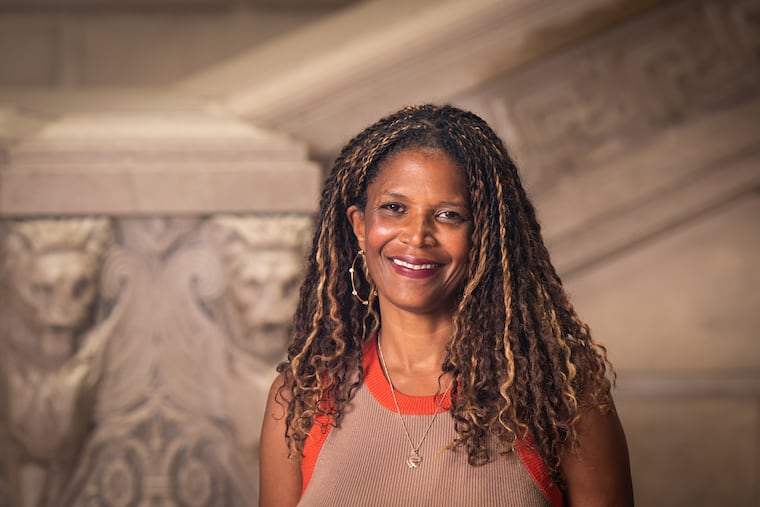
Anila Quayyum Agha was born to be an artist, and she knew it while still in elementary school in Murree, Pakistan.
“I was looking at the big picture window in my classroom,” said the artist, “the hills looked all the way down to Islamabad, and I painted that in watercolor. And the teacher had this strange look on her face and she said to me, ‘Anila, I think you’re going to be an artist.’”
Her midcareer retrospective, “Interwoven,” runs through Jan. 11 at the Michener Art Museum in Doylestown after debuting at Greensburg’s Westmoreland Museum of American Art.
Agha studied textile design at the National College of Arts in Lahore — at her mother’s urging, who told her she wouldn’t find work with a fine arts degree — and fiber arts at the University of North Texas. That was in the early 2000s when the art market labeled her a “craft artist,” several notches below an “actual” artist.
“Of course it’s all very gendered,” she said. “Often people say during critiques, ‘This looks very crafty. It looks like a hobbyist work.’ Fiber arts were considered less important.”
But it gave Agha an artistic superpower. The ability to work with a variety of mediums.
“I was able to utilize the textile processes that were looked down upon, to be my ally. I already had a lot of experience with surface design,” she said.
That experience and expertise blooms in her large-scale, laser-cut steel light installations, whose patterns are reminiscent of South Asian textile patterns — memories of a dupatta or the border of a red wedding sari.
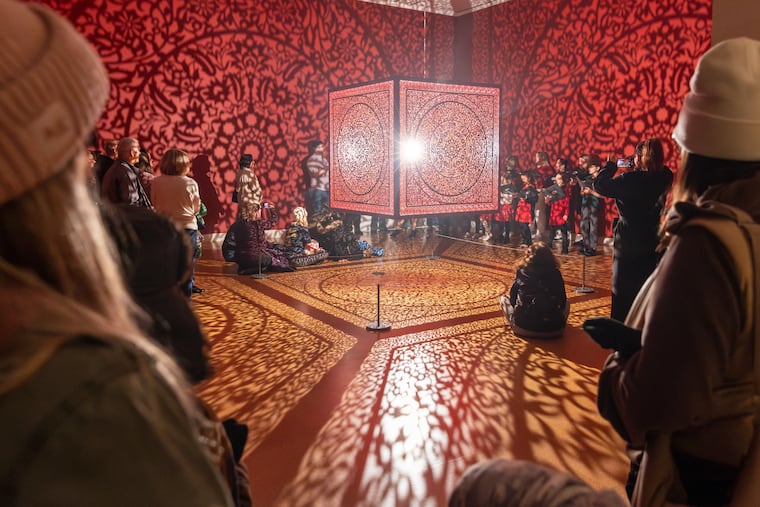
All the Flowers Are For Me (2016) is a deep red 60-by-60-by-60-inch steel cube, which is suspended from the ceiling, and whose sides are decked in ornate laser cuts. A lightbulb inside casts mesmerizing shadows on the surrounding walls, ceiling, and floor. Those watching are enveloped in these patterned shadows and become, at once, a spectator and participant of the art.
The piece, with its shadows, is spellbinding and is undoubtedly going to be a hit for Instagram selfies and posts.
“When people approach the work, they see something really beautiful and captivating. But Anila is also hoping that visitors will go beyond that and ask questions about identity, and how to help others feel welcome within a space,” said Laura Igoe, the chief curator of the museum.
“It’s political but without hitting you over the head with that message. It’s unfortunate today that creating work that’s about belonging and finding a home in a new place has to be controversial,” she said.
The light installations, Agha said, helps her — an immigrant woman from South Asia — to occupy space, something that is systemically denied to women both in her native Pakistan and her now-home of the U.S.
“I take up and occupy this big space, it was a way to push back and say, ‘I’m brown, I’m female. I use patterns that come from textiles, carpets, architecture, and I’m occupying the biggest space I can possibly get. It’s vindication in some ways,” she said.
“The Michener has a really strong craft collection, which is very important to the region. Anila’s work is also very much grounded in craft, but she’s pushing at the boundaries of craft and fine art,” Igoe said. “And elevating women’s work of working in textiles and embroidery with many of her pieces, and that’s something we’re also interested in at the Michener.”
Among the 40 pieces in the show, Agha is the proudest of A Flood of Tears (Gathering Storms) (2010/2023). It measures 12 by 12 by 16 feet and is made of upholstery needles, bugle, and hematite beads, and braided cotton — again a harking back to the crafts.
A cascade of bugle beads strung in straight lines hang in the air, buoyed by needles at one end. Because of the black glass floor, the chrome needles seem to disappear. They’re all still there, sharp and pointed, but we just don’t see them.
“Ten years ago, I started becoming very concerned about how the countries that had already paid the price for being colonized and having their resources stolen, like India, Pakistan, Bangladesh, are now paying the price for climate change,” said Agha. “So this piece is just like how climate change is enveloping us, but we’re perhaps not aware of the changes, but they’re affecting us on a very deep level.”
The pieces in the show date to work created in 2004 and encompass 20 years of her career here in the U.S.
“It occurred to me when I saw it all together,” said Agha, “I was like, ‘Damn girl! You made all that!’ Absolutely, of course, nothing would’ve happened without so many people who helped me. You’re always surrounded by supporters who raise you. I mean, I never really thought I’d be able to do this. I feel like an impostor quite often.”
“Anila Quayyum Agha: Interwoven”
📅 Through Jan. 11,📍 Michener Art Museum, 138 S. Pine St., Doylestown, 🌐 michenerartmuseum.org