Anthony Roth Costanzo, Opera Philadelphia chief, stuns as Maria Callas
Charles Ludlam's 'Galas' is being staged at New York's Little Island with Roth Costanzo taking on a dream role and going far beyond being a drag artist.
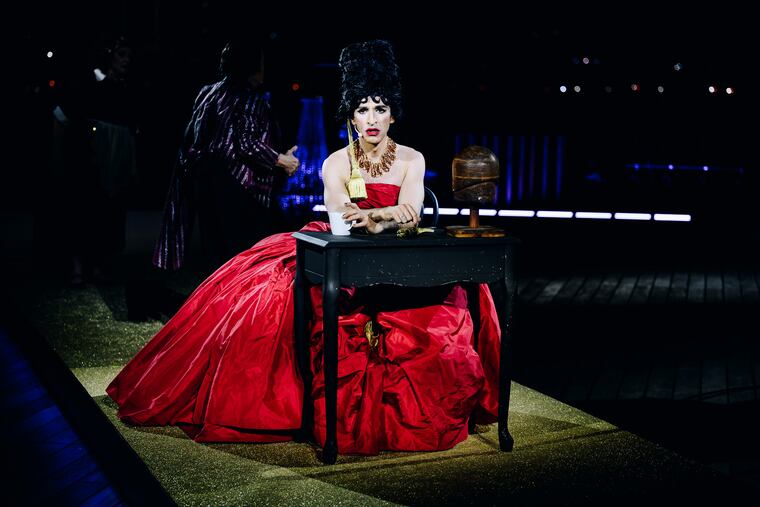
NEW YORK — For the second consecutive year, Anthony Roth Costanzo is in the thick of a virtuosically comic star vehicle (operatic, of course), this time playing Maria Callas in the 1983 play Galas.
Once again, the performances on Manhattan’s Little Island, running through Sept. 28, are sold out before the official opening.
Galas, in this current production, is unquestionably a crowd-pleaser. Its knockabout humor-with-an-edge portrayal of Callas’ world (imagine comic book characters with a soul) stands as a needed antidote to last year’s morose, muted Maria biopic that starred Angelina Jolie.
Galas gives Costanzo an idiosyncratic dream role, a comedy with myriad psychological details relating to the building of an artist mentality and the cost of maintaining it. The Callas story (1923-1977) arrives in episodes, from her initial rise, her life-changing, career-wrecking association with Aristotle Onassis, and her lonely, final years.
Given the play’s age and the rise of Callas’ posthumous legend, Galas can seem at times like old biographical news, but mostly survives well. Some secondary characters take up more time than warranted — perhaps to accommodate the special comic gifts of the original 1983 cast.
Then, the star was the author, the brilliant Charles Ludlam (1943-1977) at his Ridiculous Theatrical Company in a small basement theater in the West Village, painted in extravagant swirls of psychedelic colors. It was the epitome of insider chic. (One person who admits to seeing the original is now-Metropolitan Opera chief Peter Gelb.)
In contrast to the serious plays now mounted in that space by Axis Theatre Company, the Ridiculous had cheerfully jerry-rigged productions that had Galas, the protagonist, making her entrance on a train that defied space and budget limitations.
At the Little Island Amphitheater, this higher-budget Galas operated on a moveable runway and aerial platforms on both sides of the stage. Perched on one of them, Costanzo sang key arias — and doing so quite well — such as the famous “Casta Diva” from Norma, and dressed in a replica of Callas’ red concert gown worn at her Paris debut.
Ludlam — known for his role in the film The Big Easy but memorialized in a published volume of his plays, plus a major biography — reportedly lip-synched arias from recordings, and also went far beyond being a drag artist. He was more of a multigender actor. And that is the basic approach taken by Costanzo.
Callas’ famous grandeur, hauteur, and fiery temper lend themselves to broad outbursts that Costanzo delivered on Friday, pivoting between extreme emotions in split seconds. But the play’s best humor comes from candid admissions that the real-life characters would certainly have thought but would not have admitted. Galas scoffs at the thought that she would have any interests outside of music. Her inner emotions — often those of revenge — were maybe more intense than the opera characters she plays.
Costanzo’s Galas would only be half as brilliant without the great character actress Mary Testa as Bruna, the Sybil-like maid whose devastating observations reflect her own failed singing career. Caleb Eberhardt is much sexier than the real-life Aristotle Onassis — giving extra motivation for why Galas is so taken in by him. The party scenes on his yacht went on a bit long, but that was a minor problem in light of how director Eric Ting kept the stage so buoyantly alive.
My favorite effect: When Galas retreats to her bubble bath after contentious negotiations with La Scala execs. Yes, the amphitheater was suddenly filled with bubbles.
Ludlam was known to grow serious at the end of his plays, cutting the comedy and getting to the heart of the character. In that spirit, Costanzo played the final scene — where Galas admits that without her career, she has nothing — taking off his wig, dropping Galas’ cultivated accent and speaking in his own voice.
The lesson (worth relearning) is that celebrities who command our attention warrant all the compassion that one can muster, partly because they’re genuine people, partly because they stand to change the world’s perception of itself, often for generations to come.
The remaining performances of “Galas,” through Sept. 28, are sold out. littleisland.org