After more than a century abroad and nearly 50 years in Philadelphia, a 1,000-plus-pound First Nations house post is finally headed home
The 176-year-old wooden artifact has travelled from British Columbia, to New York, to Germany, to Philadelphia’s Penn’s Landing. It’s on view for one last time.
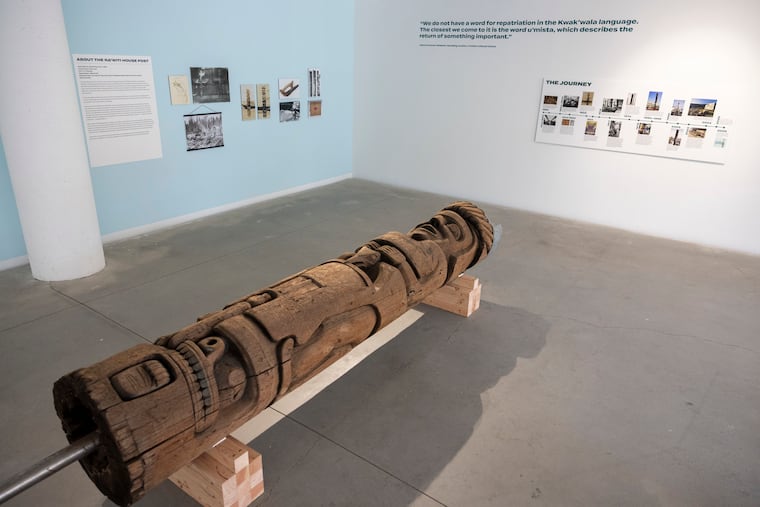
A 176-year-old wooden artifact that has traveled the world, from Vancouver Island to New York to Germany, only to land in Philadelphia, will soon embark on the 3,200-mile journey home.
The House Post, crafted from cedar wood around 1850 by an unknown Kwakwa̱ka̱ʼwakw First Nations artist in what is now British Columbia, Canada, once towered over the International Sculpture Garden at Penn’s Landing as part of the Association for Public Art’s collection. It has spent the last 28 years in storage in the Philadelphia region, cared for and conserved, without much known about its origin.
Over the past weekend, House Post emerged for one final appearance — on view at Atelier Gallery through May 31 — before the aPA will repatriate the object to the U’mista Cultural Centre, where it will reunite with a collection of stolen artifacts and artworks that have been returned to the Kwakwa̱ka̱ʼwakw people.
“We see it as a living piece of history. It will be displayed in the center, and that allows it to be reconnected to the people and place from which it was taken,” said Juanita Johnston, executive director of the U’mista Cultural Centre. “It’s almost a concrete expression of what repatriation and reconciliation can look like. Repatriation was a dirty word when we started, [now] to us it seems like a sign that times are changing … It’s hard to describe the feeling when something comes home. It’s definitely emotional.”
Piecing together history
Nearly 13 feet tall and weighing half a ton, the cedar wood post was designed as one of a pair used to support a longhouse where the Kwakwa̱ka̱ʼwakw lived. The carvings picture a figure with a large face at the top, where the post is concave to hold the house’s long beam, and features a bird and other faces below. Johnston said the post depicts an unidentified family’s crest and lineage.
“Each of our villages have a main origin story. We all became known as Kwakiutl because we all spoke the same language or dialect of the same language,” Johnston said. “Your family crest derived from your origin stories, and those get transferred through marriage, so that determines what goes on [your house post], your blanket, and the aprons. Those all had significance.”
Collections experts and historians are still piecing together the post’s provenance, but in the 1890s, both house posts were collected by Capt. Dorr F. Tozier of the U.S. Revenue Cutter Service, which later became the Coast Guard. Tozier notoriously stole the majority of his large collection from First Nation tribes along the coast of the Pacific Northwest.
His collection went on display at the Ferry Museum in Tacoma, Wash., around 1900 and was later purchased by the Washington State Art Association for a museum that never opened. Eventually, the association defaulted on its payments to Tozier and the collection’s ownership changed again.
By 1917, all of the works were sold to the nascent Museum of the American Indian and moved to New York.
When the house posts joined the collection of what later became the Smithsonian’s National Museum of the American Indian, they wound up in familiar company: NMAI founder George Gustav Heye — who amassed nearly a million pieces of artwork and objects from Indigenous communities across the Western Hemisphere — had also acquired about 30 masks, regalia, and ceremonial objects from the Kwakwa̱ka̱ʼwakw.
The Kwakwa̱ka̱ʼwakw surrendered those items under duress, Johnston said, after the Canadian government outlawed the practice of the potlatch, a ceremony of theatrical dance and storytelling that marked important milestones, like weddings, births, deaths, and name-giving.
In 1921, Canadian officers arrested 45 people for dancing, singing, bringing gifts, and making speeches at a potlatch gathering. They stipulated that those arrested could avoid jail time if they gave up their regalia, and three villages complied. The Potlatch Collection is the focus of the repatriated collection at the U’mista Cultural Centre, which opened in 1980 with the goal of reuniting the cultural objects that were taken and later found primarily in Canadian museums.
By 1970, the house posts at NMAI were separated due to financial constraints; one was shipped to Cologne, Germany, while the other remained in the NMAI collection.
The house post that traveled to Europe eventually returned to the U.S. — though the timeline is unclear — in the ‘70s. In 1978, aPA purchased it from New York’s Bayard Gallery for the outdoor sculpture garden in Philadelphia meant to display diverse cultures of the American experience as the city celebrated the nation’s bicentennial.
A treasure rediscovered in Philly
Philadelphians may recall seeing House Post at Penn’s Landing, where it was perched atop a stainless steel beam for 18 years before coming down in 1998 to make way for redevelopment around the Delaware River waterfront.
Subsequently, the aPA sought to restore House Post and other artworks from the International Sculpture Garden to public view but finding another location and the resources to remount everything proved difficult.
“It became clear that was just really too high a hill to climb, if you will, in terms of looking for that kind of open space that was available and affordable, and that we could manage as a very small organization,” said Charlotte Cohen, executive director of aPA. “Once the decision was made not to continue the sculpture garden, then [we considered] what to do with the objects.”
In 2023, a conservator at NMAI contacted aPA and alerted them to the other house post from the pair, which is still in D.C. (Johnston said they have not discussed potential repatriation for the sister house post with NMAI, and that for now, U’Mista is primarily focused on repatriating remaining items from the Potlatch Collection.) This kick-started conversations between the organizations.
It’s the first time in aPA’s history that the organization has repatriated an object in its collection.
“We were not aware that it was one of a pair … we shared information about the provenance of our piece that we were aware of, and [they] filled us in with information that predated our purchase of the work,” said Laura Griffith, deputy director of aPA. “We also expressed our interest in getting in touch with the Kwakwa̱ka̱ʼwakw community.”
The association connected with Johnston in 2024 and worked with her and the board of the U’mista Cultural Centre to determine a plan for repatriating the Philadelphia house post — not an easy feat given the distance and the heft of the wooden artifact. The aPA offered to donate House Post to the Culture Centre and cover the high costs of shipping it to the village of Alert Bay, where the center is located, with an art handling company.
“Shipping is exorbitant. The Association for Public Art found some funds to pay for that,” said Johnston, adding that otherwise “we would have said no, because very often it is the shipping that kills [the artifacts].”
With permission and guidance from the center, the aPA has now organized an exhibit as a send-off to the artwork that has been in Philadelphia for nearly half a century. It focuses on the Kwakwa̱ka̱ʼwakw people and the history of the house post, which will be displayed on its back, not upright.
“That’s the respectful way to encounter the work when it’s not on the Kwakwa̱ka̱ʼwakw property. It’s not home, it’s in a foreign land, as it has been for so many years,” said Cohen. “You can get a really good look at it up close, it’s so impressive in a way that is really difficult to understand until you’re in its presence.”
The aPA wasn’t able to share details on shipping costs immediately.
Johnston hasn’t seen the house post in person yet, but she looks forward to welcoming it home later this year. She says she feels enormous gratitude for its return, especially because, in this case, “we didn’t have to fight.”
“Homecoming: The Journey of a Kwakwaka’wakw Na’wit House Post” is on view on weekends through May 31 on at Atelier Gallery, 1301 N. 31st St., Suite 2, Philadelphia, atelierfas.com.