Connie Schultz’s ‘The Daughters of Erietown’ follows four generations of women in an Ohio town | Book review
Schultz's debut novel captures the rhythms of daily life in this blue-collar community, weaving in the history of the world beyond it.
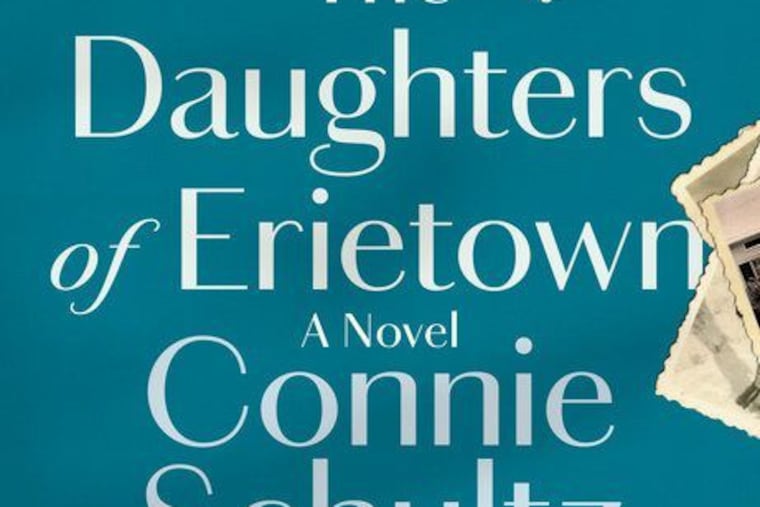
The Daughters of Erietown
By Connie Schultz
Random House, 466 pp. $28
Reviewed by Susan Coll
Everything changes for 12-year-old Samantha McGinty in the summer of 1969. Her father, Brick, stops fussing over his Chevy each weekend, no longer spritzing the windows with water and vinegar and wiping them clean with old pages of the Erietown Times. This small change to the routine flags a more painful development set in motion four years earlier, when Brick made a wrong turn and headed into "the biggest regret of his life."
The Daughters of Erietown, Connie Schultz’s absorbing debut novel, begins in the mid-1940s and hopscotches through the century, tracking four generations of women in a hardscrabble northeast Ohio town. Schultz captures the rhythms of daily life in this blue-collar community, weaving in standard historical punctuation marks: the 1963 Kennedy assassination, the 1970 shootings at Kent State University, and the burgeoning women’s movement. It’s territory she knows well from her longtime career at the Cleveland Plain Dealer, where she won a Pulitzer Prize for commentary. She is also an alumna of Kent State, and is married to Sen. Sherrod Brown (D., Ohio) adding to her Ohio cred.
At times, this closely observed family saga reads like comfort food, peppered with nostalgic references to such products as Lawson’s French onion dip and Toni home perms, as well as occasional feel-good homilies, such as “you should always be able to feel proud of the girl you see in that mirror.” But this quiet, Anne Tyler-esque novel is also a reminder that gentler times were not always gentle, that life is filled with hardship even without existential threats.
Choice — and the lack thereof — is among the novel’s themes. Samantha’s mother, Ellie McGinty, had dreamed of becoming a nurse before an unplanned pregnancy kept her from graduating high school. Instead she finds herself a midcentury housewife, “a cute little thing with a big beehive,” a mother of two who is trapped in a complicated marriage and a life of chicken casseroles, laundry, laundry, and more laundry. “Everybody starts out as one kind of person and ends up being somebody else,” she reflects. “Even when you don’t notice it, life is rearranging you.”
Life isn’t what she’d hoped for, but she is the beneficiary of a gradual awakening when her teenage daughter shares books like The Feminine Mystique and The Women’s Room, and chides her for packing her husband’s lunch each day. Ellie surreptitiously begins to look for a job, hiding the want ads from the paper under a sofa cushion.
As the title implies, this is a novel about the women of Erietown, but the most complex and tragic character might be Ellie's husband, Brick. His dreams of playing college basketball are dashed when Ellie becomes pregnant, and he signs on for a lifelong career at Erietown Electric. While the country is in the midst of sweeping change that will begin to open doors for women and minorities, his life seems to constrict. He sees a "world that was turning his wife against him and every union meeting into a Martin Luther King rally." He's not sure if it's the weather or his mood, but "he was simmering all the time lately."
Brick’s chief outlets involve baseball, beer, and women. The wrong turn he takes in 1965 sets in motion a series of heartbreaking events that ripple through his family and claim a life.
Brick wants better for his children than he’s had, including college.
Although he won’t let Sam accept a full scholarship to Smith — he sees that as charity — she’s allowed to attend state college and have a career.
“Don’t let your roots become your excuse to be stuck,” he advises. But with Erietown in her DNA, location might be beside the point. As Sam’s friend puts it: “We’re people in transition, no matter where we are.”
Coll is a novelist whose most recent book is “The Stager.” She wrote this for the Washington Post.