Meet the journalist-turned-poet chronicling her Cherry Hill childhood in her debut book
Jia-Rui Cook's first poetry collection, “Soft Beasts,” is set to publish in fall 2027.
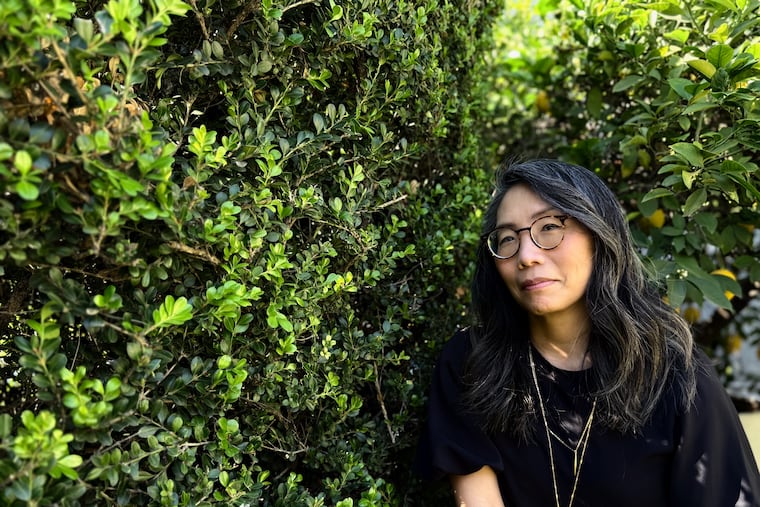
In her poem, "To the Chimeras of South Jersey," Jia-Rui Cook writes of teenage heartache, ’80s movies, and the gulf between her American childhood and the world of her parents, immigrants from China by way of Taiwan and Singapore.
“acing / honors English but flunking Saturday / Chinese School: double cherries that ripen / when summer sun runs hot. This world / will feel less than whole for many years”
The Cherry Hill-bred and Los Angeles-based writer is set to release her debut poetry collection, Soft Beasts, next year. The book explores Cook’s upbringing in South Jersey, her coming of age in Los Angeles, and the various bodies we inhabit in our ever-changing world. Cook is the 2025 winner of the Philip Levine Prize for Poetry, a national prize out of Fresno State University that awards one writer $2,000 and the publication and distribution of a book.
As she prepares for the release of Soft Beasts, Cook reflected on her formative years in Cherry Hill, which shaped her career as a writer and figure prominently in her poetry. Cherry Hill “was kind of an amazing incubator” for young writers like herself, Cook said.
Cook’s parents settled in Cherry Hill when she was a toddler and sent her to James H. Johnson Elementary School, Henry C. Beck Middle School, and Cherry Hill High School East. At East, Cook played lacrosse, worked on the yearbook, participated in the All-South Jersey band, and wrote for the student newspaper. Cook took an early interest in playing with words (her parents had an Inquirer subscription, and Cook was a habitual reader of the crosswords and comics page). A 1995 Inquirer story profiled Cook (whose maiden name is Chong) and her classmate Gina Kang, both star lacrosse players who were headed to Harvard University.
In Cook’s high school yearbook, she wrote that it was her goal “to write good poetry.”
Cook studied American history and literature at Harvard, joining the poetry board and studying under writers Seamus Heaney and Helen Vendler. She wrote a thesis on Moby Dick.
Cook always wanted to be a writer but didn’t know if she could make a living out of poetry. After college, she ventured into another form of storytelling — journalism. Cook spent six years at the Los Angeles Times, covering everything from medical research to Asian American life in the city. She left journalism in 2009 and has worked in science and health communications since, including a stint at NASA’s Jet Propulsion Laboratory.
Reporting and science writing are grounded in third-person observation and objectivity, Cook said, and as she was writing about rocket launches and research breakthroughs, she missed the creativity that drew her to writing in the first place.
She wrote a few poems in the mid-2010s, and won the Zócalo Public Square Poetry Prize in 2013, but life quickly became busy with parenthood and work (Cook and her husband, Bryan, who is from the Main Line, have two daughters). It wasn’t until 2021 that Cook felt like she could pick up the pen again.
“You get on this roller coaster of going, going, going, and then when you suddenly stop, you think, ‘Wow, actually, maybe I’ve learned some things. I have some things to share,’” she said, recalling how it felt to return to poetry five years ago.
So Cook began to write again — about people, animals, her childhood in Cherry Hill, the subtleties of the Chinese American experience she came to understand while living in and writing about Los Angeles.
“I had to really step away and experience the world for a bit,” she said. “I had to go out and experience the world and to see it, and maybe try to tell other people’s stories for a while before I really understood, ‘What story did I want to tell about my own life?’”
Anagrams (words or phrases made by rearranging the letters of a different word) figure prominently in her work.
In her poem “Anagram No. 2,” Cook anagrams “Cherry Hill, New Jersey,” rearranging the letters to make sentences that resemble English, but don’t precisely follow its conventions. English was not Cook’s parents’ first language, and “there was always this kind of slipperiness with the language” in her house, she said.
“Anagram No. 2” is “playing around with the English language” in a way that echos the experience of learning it.
In January, Cook became a fellow with the Periplus collective, a mentorship program for writers of color. In February, she won the Levine Prize. Jake Skeets, the Levine Prize’s final judge, called Cook’s poetry “both wonder and wander,” holding “stark, living images of place” and teachings on how “to be alive in the present moment.”
For Cook, publishing poetry has been an opportunity to “create something meaningful” in a world that “feels under siege.” The immigration crackdown that overtook Los Angeles last summer weighed heavily on her as the child of immigrants.
“It just was really wonderful and incredibly meaningful to feel like I’ve been creating these little, tiny bits of beauty where I can in the world,” she said.
Winning Fresno State’s Levine Prize is poignant for Cook. Fresno State was the first place Cook’s mother landed when she arrived in the U.S. and was where she learned English. Decades later, the university is helping to publish Cook’s first book.
“It felt like a full-circle moment,” Cook said.
Though California has been her residence for decades (and Cook says she has decidedly fallen in love with Los Angeles), she still considers South Jersey home. It’s the place where she became a writer and where her journey of self-understanding began.
“It has to start somewhere,” she said of her book. “So it really does start in Cherry Hill.”

Inquirer Cherry Hill
This suburban content is produced with support from the Leslie Miller and Richard Worley Foundation and The Lenfest Institute for Journalism. Editorial content is created independently of the project donors. Gifts to support The Inquirer’s high-impact journalism can be made at inquirer.com/donate. A list of Lenfest Institute donors can be found at lenfestinstitute.org/supporters.