Brandywine Conservancy & Museum of Art unveils $100 million campus expansion plans to add second building and nature preserve
A Tokyo-based architecture firm will help create a 325-acre campus that "pairs humility with extraordinary beauty." It'll include new galleries of art, a nature preserve, and more.
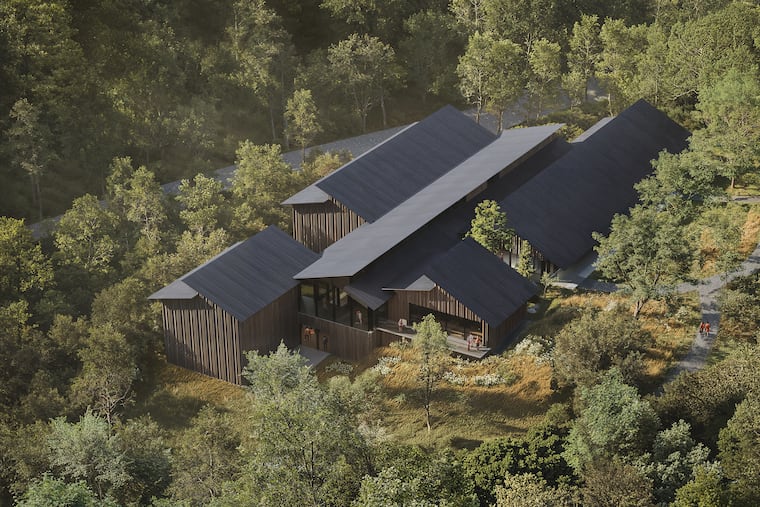
The Brandywine Conservancy & Museum of Art on Wednesday announced a $100 million expansion plan to open a second museum building, create a 325-acre campus, and a nature preserve with 10 miles of trails.
Expected to open in the fall of 2029, the renovated campus in Chadds Ford will unite the historic grist mill, within which the museum currently operates, with a new 40,000-square-foot building comprising five galleries, inspired by Pennsylvania’s bank barns and designed by renowned Japanese architecture firm Kengo Kuma & Associates.
The Brandywine Museum of Art will become one arts institution across two buildings.
The nature preserve, featuring walking trails, will link both buildings with the nearby studios of legendary American painters N.C. and Andrew Wyeth, signature stars of the Brandywine’s collection.
The landscape design comes from Field Operations, the Philadelphia-founded firm behind New York City’s High Line, as well as local redevelopment projects including the Navy Yard and Race Street Pier.
It will be the most ambitious expansion project for the nearly 60-year-old conservation organization that runs both a land trust and art museum.
At this stage, the Brandywine Conservancy & Museum of Art has secured almost $50 million from undisclosed funders, and it plans to seek additional funding through Pennsylvania’s Redevelopment Assistance Capital Program and other sources.
“This [expansion] will allow us to give that richness, where people are walking in landscapes that look pretty much as they did when those Wyeth artists were working and living there — and then see their works of art, all in one day,” said Virginia A. Logan, the Frolic Weymouth executive director and CEO of the Brandywine Conservancy & Museum of Art.
“It’s an unparalleled experience,” Logan said. “Bringing all of these different elements of the landscape together and making it a preserve, we will create opportunities for everything from serene moments of quiet reflection to opportunities to learn.”
A historic flood
Since opening in 1971 as the Brandywine River Museum, the building has faced dozens of floods, but nothing came close to the devastation following 2021’s Hurricane Ida, which struck during the organization’s 50th anniversary year.
It was a historic disaster worthy of a landscape painting: A record-shattering flood that could only occur once in 800 years brought floodwaters two stories high, smashing into the roughly 160-year-old mill on the banks of the Brandywine Creek.
None of the precious artwork was harmed, but the flood hit 10 buildings on the Brandywine site and caused more than $10 million in damage. The museum closed for three months as the lower level of the building — about 12,800 square feet that held an event space, classrooms, and offices — required significant repairs. Those rooms are now permanently closed to the public.
“By contemporary flood code and, indeed, prudence, we can no longer use those spaces for any kind of occupancy, so all of that has been sealed and made as structurally sound and impermeable as a submarine,” Logan said.
The hurricane also interrupted major plans that Brandywine leadership had been pursuing for an addition to the existing museum building to increase gallery and programming space. In the wake of the flood, Logan had to pivot and come up with a creative solution that could still address Brandywine’s need for a larger footprint — ideally, on higher ground.
It led the leadership to think bigger, and consider how to make better use of their stunning surroundings. Key to the vision was a holistic effort to connect art and nature, both in the architecture and landscape, in a way that mirrors the organization’s unique identity as a combined conservancy and art museum.
‘A muted icon’
After narrowing down from an initial pool of 31 architects who built new museums in the past decade, Brandywine leadership met three candidates (all were combined teams of architecture and landscape firms) for in-person interviews.
To prepare, the teams from Kengo Kuma & Associates and Field Operations did something unusual: They collected buckets of foliage, pebbles, bark, pine needles, dried flowers, moss, and more items from the site.
“I said, ‘Guys, this is loopy, but let’s collect our favorite things from the site and show them that they’ve already got treasure here,’” said partner and executive vice president of Kengo Kuma & Associates Balázs Bognar, who was raised in Illinois and moved to Tokyo 19 years ago to pursue architecture.
“I grew up on Calvin and Hobbes, and there’s a beautiful compendium that Bill Watterson put together called There’s Treasure Everywhere, and that was the spirit inside me,” Bognar said.
They laid out the organic spread onto the table and delivered a winning presentation.
“It was so evident and unanimous to everyone on the selection team, from Brandywine’s board and staff alike, that their understanding of who we are and what we wanted — something that pairs humility with extraordinary beauty — was the essence of what we were looking for,” Logan said.
One phrase from Kuma’s proposal stuck with the group because it best described their shared vision: to create a muted icon.
This project marks the first museum that Kengo Kuma & Associates will design in the United States. The artistic architect Kuma — whose innovative work has been exhibited at the Museum of Modern Art and elsewhere — is renowned for sunlight-filled structures that dynamically blend indoor and outdoor spaces, like semi-open courtyards or covered interiors that make visitors feel like they’re outside.
“We felt there was a huge opportunity to present the rather unusual undercurrent, or this hidden aspect, that, in fact, the landscape is the museum,” Bognar said. “That was the mentality that we carried forward, that in the U.S., for example, a house has a garden, but in Japan, a garden has a house. It’s the other way around.”
The building, designed in association with the Boston-based Schwartz/Silver Architects Inc., features a series of interconnected wings with gable rooftops and views looking out in multiple directions. Located on a hillside near the original museum, it will sit 60 feet higher in elevation than the mill.
A new home for masterpieces
Five galleries will spotlight parts of the Brandywine collection that haven’t been showcased fully at the current museum because of space constraints. Masterpieces by three generations of Wyeth artists will take center stage in a new 4,000 square-foot gallery spotlighting the family’s five notable artists: N.C.; children Andrew, Carolyn, and Henriette; and Andrew’s son Jamie Wyeth, who will turn 80 in July. (Jamie Wyeth took the design teams on a tour of the Brandywine grounds and has remained close to the expansion project.)
Another smaller gallery will focus specifically on Andrew Wyeth’s works.
“We’re very excited about being able to really immerse visitors in what will be about 135 years of art making by this one family, to show all five of the Wyeth artists and see some of their shared investigations,” said Thomas Padon, the James H. Duff director of the museum. “I think that will be one of the reasons why Brandywine will be an international destination.”
Two galleries will host special exhibitions and temporary shows, while another 4,000-square-foot gallery will be devoted to the museum’s stellar holdings of American landscape paintings. With the expansion, the Brandywine will increase its current exhibit space by 80% to present almost 20,000 square feet of artwork across both buildings.
The mill, meanwhile, will see some other changes, like adding a new studio art classroom and an interactive exhibit focused on the Conservancy’s work. It will remain open during construction, which is expected to begin in the spring of 2027.
“We didn’t want to build a large building because we hear from our visitors all the time that what they really like about Brandywine is that intimacy, and it’s not a huge museum where you feel like it’s this daunting experience,” Padon said. “It’s not an overwhelming building, but it will interact with nature in a really beautiful way.”
Philadelphia roots
For the landscape designers, the Brandywine project isn’t just special, it’s personal — both Field Operations partner Sarah Weidner Astheimer and director Aaron Kelley grew up in and around Philadelphia. Brandywine was the first museum Kelley visited as a kid, and Astheimer’s grandfather was a major Wyeth fan who hung many landscape prints in his home.
They’ll lead the transformation of the Brandywine Conservancy & Museum of Art’s current 15-acre campus with five trails to a whopping 325-acre campus featuring 10 trails.
“We are really looking carefully at the site itself and its latent characteristics and qualities, looking at what’s beautiful about it today and just trying to amplify that,” Astheimer said.
“The High Line, for instance, that’s the classic and original [project], and it was really all about, ‘How can you make a simple garden walk in a city just be extraordinary and lean into the history of it?’ [That] is part of our approach to every project. It is especially important here, where we’ve got amazing plant communities [and] a client whose mission is land stewardship,” Astheimer said.
The expanded campus map features three circular paths that loop visitors around the mill building, the Wyeth studios, and the Brandywine Creek. The preserve will be open and accessible to the public, even if they don’t pay museum admission. A future phase of the landscape design will eventually connect to SEPTA’s Wawa Regional Rail station.
Not everything is brand new, though — when it came to environmentally friendly infrastructure to handle stormwater running off the forthcoming building, Kelley said they looked to the Conservancy’s own history as “one of the vanguards in stormwater infrastructure in the 1970s.”
Water collected off the roofs and roads will be “funneled down through the meadows and into this series of stormwater ponds that are more or less going to become a cypress grove, like a wetland — something that you can walk through and experience something that almost feels like a new landscape or a new garden,” Kelley said.
Ultimately, the plan is for everyone to enjoy the lush landscapes that have inspired artists for decades. Brandywine hopes this expansion will pave the way to continue inspiring artists of future generations.
Correction: An earlier version of the article misstated the new building’s elevation. It will be 60 feet.