The 1873 painting that is being seen for the first time in 152 years
When a railway magnate wanted to celebrate his control of the Erie Railway, he commissioned Jasper Francis Cropsey to create a painting which has barely ever been seen. Until now.
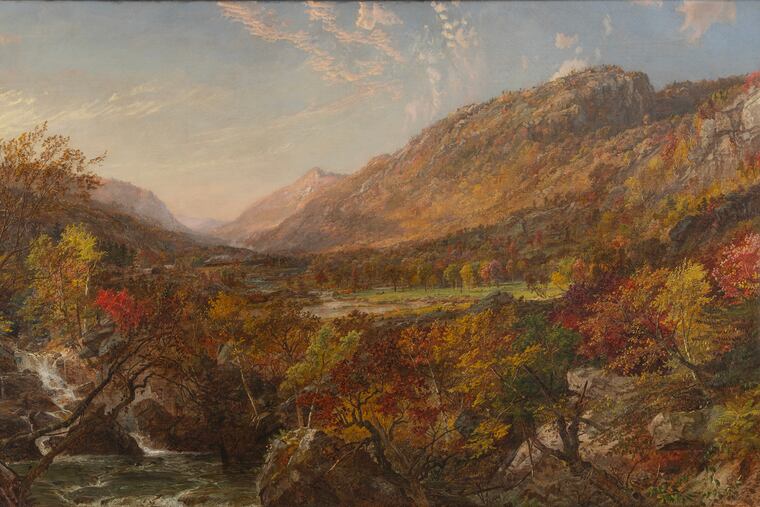
Back in September 1873, the New York Herald announced that the Hudson River School painter Jasper Francis Cropsey had a new painting. Autumn in the Ramapo Valley, Erie Railway, which would be open to public viewing for “only a day or two longer” at the Wall Street office of Charles Day, the article said.
The painting was commissioned by investor James McHenry, who, with Day, was director of Erie Railway. McHenry, who had been a director of the Atlantic and Great Western Railway before that, had his eye set on the Erie Railway, which was founded in 1832.
In 1872, in what is best described as a corporate coup, McHenry ousted the railroad magnate Jay Gould and took full control over Erie Railway. In celebration, he commissioned the Cropsey painting, which, after those few days on Wall Street, made its way to McHenry’s home in London and remained in private collections, away from the public eye since.
Until now.
In 2024, philanthropists J. Jeffrey and Ann Marie Fox, who live in Bucks County, bought the painting and brought it back to the United States. It is on view at the Brandywine Museum of Art, some 150 miles away from the original setting of the painting, where flatlands west of the Hudson River meet steep hills near the town of Sloatsburg, N.Y.
Here, it can be seen by an American audience for the first time in 152 years.
The Foxes and American art
J. Jeffrey Fox has built a successful career in finance and education and his wife, Ann Marie, has worked with several nonprofits, often focusing on children with special needs. Together, in 2024, they made a $20 million gift to endow the J. Jeffrey and Ann Marie Fox Graduate School at Pennsylvania State University.
The couple, said Jeffrey Fox, have always been interested in American history.
“We used to collect art as souvenirs. We would go to estate sales and garage sales and sometimes buy a piece of art,” he said. “It wasn’t a collection that was of any significance. So once we got a little bit more money, we wanted to buy one painting that’ll be the centerpiece for the rest of our collection.”
They bought Frederick Childe Hassam’s The Cove, Isles of Shoals (1901) at an auction in 2015.
The discerning eye in the couple has always been Ann Marie’s. She spent 15 years volunteering at the Walters Art Museum in Baltimore, and when the couple lived in Annapolis, Md., she took classes under Matt Herban, a retired professor of art from Ohio State University.
After that first Hassam, the couple wanted a Cropsey. But not just any Cropsey.
“We went to the National Gallery and they had a fabulous Cropsey [Autumn — On the Hudson River (1860)]. It just took our breath away. And we were like, ‘Wow, how could we ever get something that good.’ That’s why it took us this long,” said Ann Marie.
“We were very picky. Every artist has great days, and every artist has OK days. We wanted Cropsey on a great day,” her husband said.
Finding Cropsey on a great day
Last year, the Foxes’ art adviser came to know from a friend in Europe that Autumn in the Ramapo Valley was coming up for auction in London in September. Believing that the painting was best sold to an American buyer, this friend approached the adviser before the painting went under the hammer.
The Foxes had 48 hours to make a decision to buy, never having seen the painting, aided only by a high-quality photograph and a condition report.
Cropsey’s catalog raisonné, put together by the Newington Cropsey Foundation in Hastings-on-Hudson, N.Y., says the painting left the country in September 1873. Documents said the painting has been in an undisclosed buyer’s family since the 1950s.
McHenry died in 1891 and “we don’t really know what happened from 1891 to the mid-’50s, but we do know that it never left England,” Jeffrey said. “And we don’t think it was ever shown in England. There are no records that we were able to find.”
Ann Marie said yes, and the couple wrote up a letter of intent.
“We were a bit concerned,” said Jeffrey. Another Cropsey — Richmond Hill in summer of 1862, also owned by McHenry — that came up in an auction in 2013 was deemed a “national treasure” by the U.K. and was not allowed to leave the country.
The clearance for Autumn in Ramapo to leave England took a little over three months.
“The English let that out of England because it was an American artist, and an American scene,” Jeffrey said.
The couple bought the painting in January 2025. Once the artwork arrived in the United States, a restorer found it to be in exceptional condition, exactly as advertised. In March, the conservator finished assessing the painting, and the Foxes traveled to New York to see it in real life.
“It just displayed so much grandeur. I thought it was wonderful,” Anne Marie said. “The autumn colors … just stunning. And the size of it is amazing. The first thing I said when I saw it was, ‘It can’t come to my house. It’s going to tear down my wall.”
Including the frame, the artwork measures 4.75 feet by 7.16 feet.
“Our house isn’t that big, we probably couldn’t get through the door,” Jeffrey said.
The couple couldn’t ship it to their foundation office, either. “We needed a museum that would be willing to show it and buy into the story, because it’s a phenomenal story,” Jeffrey said.
That museum was the Brandywine.
The painting and the painter
It’s easy to miss the “Erie Railway” part in Autumn in the Ramapo Valley, Erie Railway. Cropsey paints an idyllic fall scene with the Ramapo Valley bathed in yellow, red, and, orange foliage. Bits of green peep out, the sky is clear and a light blue, a waterfall flows gently on the left, the Ramapo River sits still.
The smoke-billowing train chugs through the valley in the distance, but in the center of the painting. Black rails of the railway bridge run parallel to the river and disappear into the leaves.
The setting of the painting falls between what is New York’s Orange and Rockland County, on the western side of the Hudson River, and north of Suffern.
“This painting … really helps in telling a fuller story of the history of American art, and particularly, this brief moment, in the third quarter of the 19th century, when huge sums were being spent on huge paintings,” said William L. Coleman, curator at the Wyeth Foundation and director of the Andrew & Betsy Wyeth Study Center.
“This is part of a larger story with artists like Frederic Church, Albert Bierstadt, and Thomas Moran.”
Cropsey, an architect who had designed several railway stations himself, was part of a line of artists who “engaged with the new fortunes being made from the transportation industry, making images of new railroads traveling through the landscapes,” Coleman said.
The artists enjoyed generous patronage and lived well. Cropsey lived in a mansion he built, called Aladdin, less than 10 miles away from the site of the painting. Here he built himself a studio that doubled as a gallery and art marketplace.
The Philadelphia story
Cropsey’s patron James McHenry was born in Ireland in 1817 and was raised in Philadelphia. He moved back to England, living primarily in London, where he made a fortune raising money and investing it in developing railways in America.
His sister remained in Philadelphia until her death.
Jeffrey Fox calls McHenry “notorious,” adding that he often worked against other equally infamous “robber barons” like Cornelius Vanderbilt and Gould.
“He paid $25,000 on a Bierstadt painting in 1865, so he was quite an art collector himself,” Jeffrey said. McHenry, who already owned Richmond Hill in Summer of 1862, perhaps had gotten acquainted with Cropsey when the artist visited England in 1856.
Cropsey had already made a name for himself painting Starrucca Viaduct, Pennsylvania (1865) —where, too, a distant train almost merges into the green slopes of the mountain behind it — when McHenry wanted an artist to commemorate his pushing Gould out of the Erie Railroad directorship in 1873.
“He had already gotten a national reputation for painting part of this exact railroad, and so James McHenry went to the railroad guy,” said Coleman, “and commissioned Autumn in Ramapo.”
Artists like Bierstadt and Sanford Robinson Gifford were also working on similar railroad commissions at the time.
“Most of their stock and trade are images that make use of the aesthetic value of the sublime, the power of the natural world against the small scale of human existence. So they give us that feeling of awe, of wonder,” Coleman said.
Landscape paintings, he said, “tell stories about belonging, about ownership, about your place in a wider society. … And they often risk being underestimated. These are pleasant, old pictures that we see on calendars and postage stamps, but they have a lot to tell us about how we became the nation we are today.”
An irrelevant cost
At Brandywine, Cropsey’s train speaks to the museum’s beloved holiday train display, posing questions of tradition and modernity as the nation enters its 250th year.
It will stay at the museum through May and then travel to the Dixon Museum in Memphis, Tenn. Then it heads to the Seed Art Museum in Louisville, Ky.;, Rockwell Museum in Corning, N.Y,; University of Georgia Museum of Art in Athens, Ga.; and the Newington Cropsey Foundation.
The Foxes wanted this piece of American history to be witnessed by Americans.
What they paid for it, Jeffrey Fox said, is irrelevant.
“If you put a value to it, that’s what you’re going to talk about, as opposed to the painting,” he said. “We’re a foundation and at the end of the day, we’re not going to sell it. So it doesn’t matter what we paid.”
“Cropsey, Wyeth, and the American Landscape Tradition,” continues through May 31 at the Brandywine Museum of Art, U.S. Route 1 at Hoffmans Mill Road in Chadds Ford, Chester County. Information: brandywine.org or 610-388-2700.
This article has been updated with the correct year of James McHenry gaining control of the Erie Railway. It was 1872.

- Does your restaurant need caviar? Philly’s got a guy named Gary
- Porch pirates stole Christmas and Donna Kelce went full Traitors | Weekly Report Card
- I always shovel beyond my own sidewalk, but my neighbor doesn’t. Am I expecting too much?
- How to have a Perfect Philly Day, according to jewelry designer Emily Phillippy
- The best things we ate this week
- Citywide Quest: Do you know where in Philly these Christmas-themed photos were taken?
- Cozy inns, vintage finds, and wintery walks in the Western Catskills | Field Trip
- A seller backed out after verbally accepting their offer. It led to their dream home in Point Breeze.| How I Bought This House
- Seeing four SEPTA drivers in one trolley