Artist Miguel Horn’s sculptures will adorn new Avenue of the Arts median
Construction on the median is scheduled to wrap up this month, and the sculptures will be installed in fall.
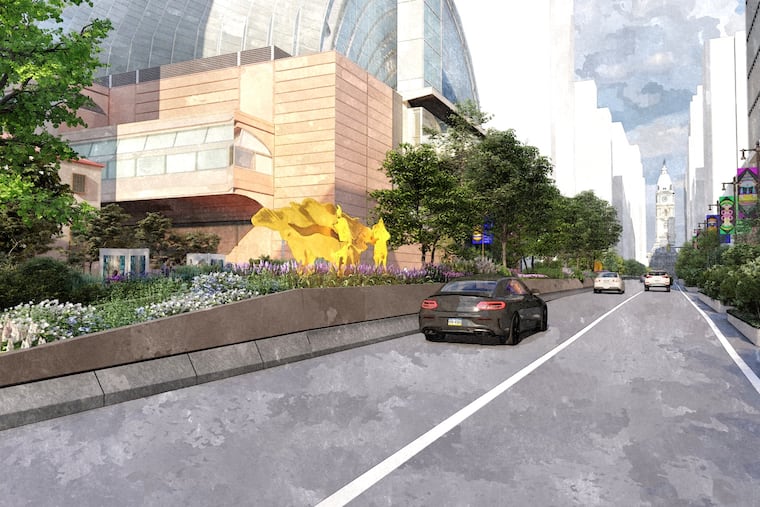
The Broad Street Avenue of the Arts makeover project, which broke ground in January, is inching its way to completion.
The remaking of the median on South Broad Street in front of the Kimmel Center, part of the larger AveArts 2.0 project, will now include the installation of a pair of sculptures by artist Miguel Horn.
The South Philly-based artist, who is behind several public sculptures in the city, including Center City’s ContraFuerte, sought approval for the sculptures’ concept review in a Philadelphia Art Commission meeting on Wednesday.
The sculptures are scheduled to be installed this fall and remain in place for five years.
The Broad Street renovation project involves reconstructing the median into a raised planter, adding landscaping, restoring pavement, and installing pedestals and lighting for the public art. The median construction is scheduled to be completed this month, while Horn’s sculptures will be installed in the fall.
Made of bright yellow powder coated steel, Horn’s sculptures will display a blurred image of moving pedestrians. The concept for the design, Horn said, came from him making Light Detection and Ranging (lidar) scans of buildings around Philadelphia. He began to notice something interesting when people walked in front of the scanner.
“This section of the Reading Terminal Market at Filbert Street was flooded with pedestrians walking by, and these movements of pedestrians across this space created this tapestry of figurative elements, abstraction, and I just fell in love,” Horn said at Wednesday’s meeting.
He then proceeded to go through the scans and select different movements to create the final sculpture design of walking pedestrians.
“This Muybridge-like study of movement for me was the most compelling thing sculpturally I’ve seen rendered on a computer screen in years,” he said, referring to the pioneering photographer best known for creating The Horse in Motion (1878).
Horn’s design did raise some concerns among attendees on Wednesday, including potential sight line blockages for motorists.
In the meeting, he assured that there was no concern for safety. His presentation to the Arts Commission claimed that the sculptures would still allow for a 215-foot sight line of incoming traffic on either side of the median.
“There will not be an interruption to any visual sight lines,” he said.
Design Advocacy Group (DAG) vice-chair David Brownlee, who did not attend Wednesday’s meeting, considers planting trees in the median impractical.
“No one has ever said to me that the problem with Broad Street is there’s no shade in the middle of the street,” he said. “Or that’s the problem with Broad Street is you get out of the street and you look up and see that tower of City Hall.”
Rather than placing trees and sculpture in the middle of the road, Brownlee suggested widening of sidewalks and installing art on each side so pedestrians can view them while walking.
Horn’s concept review for the sculptures was approved by the Arts Commission, with a final review expected at a later date.
The AveArts 2.0 project aims to beautify Avenue of the Arts into a cohesive streetscape. The plan is to renovate all 10 blocks between City Hall and Washington Avenue at a cost of $15 million per block.
Funding for the project is expected to be a mix of public money, corporate and individual donations, and foundation support.
“I find this to be a reclamation of our public space through this figurative artwork,” Horn said. “I’m constantly trying to find opportunities to bring the human experience to the forefront of these public spaces.”
A previous version of the article misstated the median project’s timeline. It will be completed this month.