Long vilified graffiti art finds an unlikely gallery in Suburban Station
250 graffiti artists have each created works that respond to the semiquincentennial, and that includes building a replica of a SEPTA BSL train car.
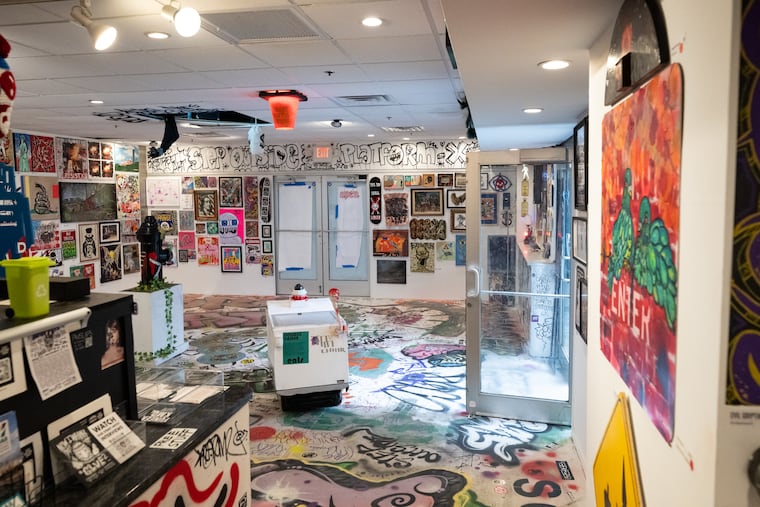
On entering Suburban Station from the 16th Street entrance, one is welcomed by a vast, bare-walled concourse punctuated by empty retail spaces.
And then you turn right.
A painting made to look like a subway car stands out against the blank concourse. The inside is entirely covered in graffiti, along with paintings, drawings, and mosaics. Not an inch of space is bare.
Organizers and artists greet people as they come in and share stories about their street art journey.
A room in the exhibit looks like the inside of a SEPTA BSL train car, orange seats and all.
This is “Platform X,” a new era of graffiti art, organized by Step Outside, an artist-led program that transforms existing spaces into graffiti havens.
“We’re all street artists and we care about this more than anything,” said the artist who goes by the name Doomed Future. “There’s not much opportunity in galleries to showcase graffiti and street art here in Philly. We want to have our own thing here.”
Doomed Future works alongside Step Outside organizers Philmadelphia, Inphltrate, Zucati Zuce, Raw G Zero, Ianismymiddlename, and RoboQ4. Because graffiti is considered criminal mischief under Pennsylvania law, the artists did not want to share their real names for this article.
SEPTA representatives reached out to Doomed Future in January and asked them to take a look at the vacant spaces for rent in Suburban Station for a potential exhibit. The artist decided to rent a space from a real estate agent.
“Street art’s grimy — it’s real, gritty, dirty,” Doomed Future said, “and so is the subway.”
A more rebellious Semiquincentennial
“USA 250″ is the theme around which 250 artists imagined their graffiti art.
One piece, American Religion, depicts Benjamin Franklin with a crown of thorns and the words “In God We Lust” above his head, certainly a switch from the patriotic depictions of the Founding Father we’ve seen for the Semiquincentennial.
Other pieces present a more rebellious yet optimistic view. Love Is Not Dead by Banjax the Balaclava depicts a bunch of angry figures holding anarchist flags in front of City Hall, with a match burning between two traffic cones at the center.
“The thinking behind it was that there’s been a lot of burnout and frustration, particularly with folks that have been active in the street, fighting against injustices,” said Banjax. “I think it’s important to bring the message of love into these spaces as much as there is rage. As things get harder, continue to heat up, I want to remind people of that love is at the core of what we do.”
“Platform X” is Step Outside’s fourth showcase after a year of operation, with this one put on in collaboration with the nonprofit United Street Art (USA). United Street Art is dedicated to advancing and highlighting street art and graffiti. Most of the artwork is for sale, with all profits going directly to the artists.
“Supporting the artists is our main mission. We’ve been doing free shows before, and this is our biggest one,” said RoboQ4 aka Robb Quattro, executive director of USA. “This is a big, long-term investment for us and we’re ready to continue doing more shows beyond this one.”
Establishment vs. antiestablishment
Graffiti, as an art form, is inherently antiestablishment, and the establishment still does not receive it well.
At the start of the year, the city announced the Gateways to Philadelphia project. In collaboration with Mural Arts and Pennsylvania Horticultural Society, it invests $11.5 million toward beautification initiatives, including landscaping, new murals, and graffiti removal.
“I can understand some people saying some graffiti is an eyesore, but there’s a lot that’s not,” said contributing artist Satan, who has been making graffiti art for over 40 years. “This is helping me as an artist grow.”
The show has been received glowingly by visitors, who have been invited to add to the art themselves. People have drawn on the walls with chalk, spray painted their own tags, and left stickers anywhere there was room.
On Father’s Day, there was a father-son duo putting their own graffiti on the wall, said artist and organizer Inphltrate. “That was really cool to see,” she said. “This is a safe haven for not only street art and graffiti, but for any person who is creative who needs an outlet. You are safe and accepted here.”
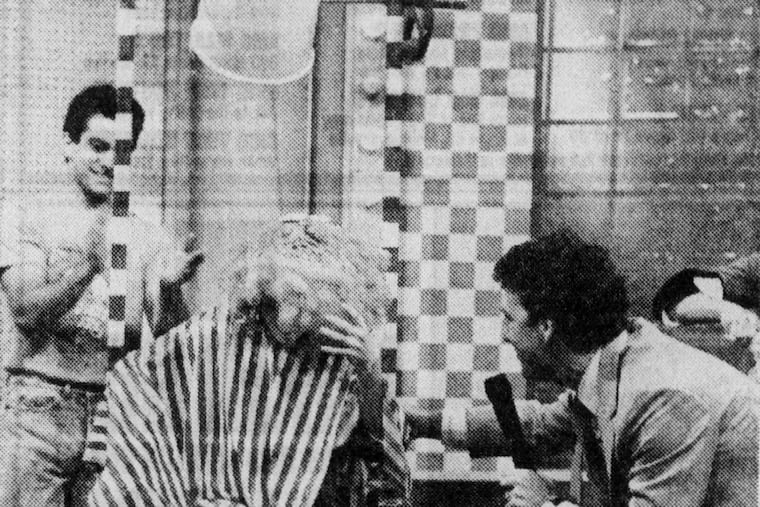
“Writing our names, I didn’t look at it as art. We were vilified,” said wallwriter Lewis Pittman, also known as Lewis or King Lewis in the street art scene. “I’m glad I’m still above ground to see the evolution of this culture. I’m glad it’s accepted as an art form.”
Pittman is one of Philadelphia’s original “wallwriters,” which is what graffiti artists called themselves in the 1970s. Pittman, along with wallwriters like Cool Cone and Cornbread, helped popularize the now iconic Philadelphia “gangster” handstyle, defined by tall, condensed letters.
“I remember Sunday nights going to Fern Rock, writing on all the buses and trains,” Cone, aka Cone ICP, said. “On Monday morning, nothing but my name came down Broad Street.”
After the USA 250 show closes, Step Outside plans to put on a Then and Now-themed showcase in August at Platform X, showing the evolution of street art. Incorporating and paying respect to the OGs who popularized the art form is a necessity for their exhibits.
The deep history of Philly graffiti
As a teenager, Cone founded Imperial Casanova Persuaders (ICP), one of the country’s original graffiti clubs, known for tagging public transportation. They helped originate the “wicked” variant of the Philly gangster handstyle, which puts a more wild, energetic spin on the lettering.
“They could look at us as being the start of murals, too, since a lot of stuff started in Philly. But we don’t get the recognition because a lot of people don’t speak on it,” he said. “In American history, we’re one of the best kept secrets.”
Philadelphia, with its thousands of murals, is billed as the “Mural Capital of the World.” Mural Arts Philadelphia, the country’s largest public arts program, started off being a part of Philadelphia Anti-Graffiti Network in 1984.
Cone, like many graffiti artists, had several run-ins with police officers in the 1970s, getting targeted for wallwriting. Today, he travels the nation, speaking at museums and various art events, recognized as a trailblazer in street art history.
ICP’s symbol, a capital “I” with two dots on the side, can still be seen tagged around the city and even in Platform X.
“You’re not going to stop the wallwriters,” Pittman said.
Closing receptions for the “Platform X” USA 250 show are Friday, July 10, from 5 to 10 p.m. and Saturday, July 11, from 1 to 10 p.m. The exhibit will stay open for the rest of the summer.
Platform X is located in Suburban Station down the steps on 16th Street between Market Street and JFK Boulevard in Center City, Philadelphia. More information on stepoutsideshow.com and @stepoutsideshow.