Is the best Minimalist art collection in the world sitting in a Rittenhouse Square townhouse?
The home of a Tylenol heir, who passed away in 2025, houses works by the greatest artists of minimalism — Sol LeWitt, Donald Judd, Dan Flavin — and often the best pieces from each.
In November 2023, Henry “Hank” McNeil Jr. had a problem.
He was buying something new for the dining room in his 8,806 square-foot Rittenhouse Square townhouse that would displace the family Christmas tree.
He called Jake Quinn, his friend and real estate manager, at 11 p.m.
The tree, the men decided after much deliberation, would move out of the room and to the landing space right outside.
The reason for the tree’s displacement was an almost 10-foot-high Minimalist sculpture, Hanging Structure 24 D (1991) by Sol LeWitt, who led the conceptual art movement during the 1960s and 1970s.
McNeil, son of Tylenol magnate Henry Slack McNeil, died in the townhouse in July 2025 at age 81, leaving behind one of the best collections of Minimalist art in the country, if not the world. Christie’s will be auctioning major pieces from the collection in May at its New York location.
The dining room LeWitt, one of the several in the McNeil residence, hangs across the room from where Carl Andre’s 66 Copper-Carbon Corner (2006) sits on the floor. There is a blue and brass Donald Judd piece hanging on a wall, a George Nakashima dining table sitting in the middle of the room along with six low-back armchairs by Sam Maloof, who made chairs for several American presidents including John F. Kennedy, Jimmy Carter, and Ronald Reagan. Silver pieces from Henning Kopel and Minas Spiridis are placed conspicuously throughout.
“It’s Minimalism, but in a way that we haven’t seen Minimalism before,” said Johanna Flaum, a vice chair of 20th- and 21st-century art at Christie’s.
Minimalism, she said, is often associated with cold, industrial spaces like galleries and museums. “What we get in this house, and what is so incredible, is that it establishes a real way to live with the greats of Minimalism,” Flaum said.
Not only did McNeil live in the townhouse with all this art and his children, he also raised Labrador retrievers for the sport of field trials.
Growing up, there weren’t too many rules around the art, said Calder McNeil, Henry’s daughter.
“My dad loved a Judd piece. Anodized steel with a metal varnish. One day, a tiny handprint appeared on it,” said the younger McNeil, 27, laughing. “And my dad’s like, ‘OK, let’s see whose hand fits.’ My hand was a little too big. And Cole [her younger brother] said, ‘Maybe it was the dog.’”
She was just learning how to write at the time. She fished out a Post-it note their father kept on his desk for the rest of his life.
“You did it, Cole,” it read in a toddler’s scrawl.
Calder McNeil said she was named after Alexander “Sandy” Calder, but also after “this character in the movie The Chase. The protagonist was played by Marlon Brando, who my father loved.”
Henry McNeil also sometimes tried “this kind of reverse psychology,” she said. “He said, ‘OK, the rule is we can touch everything once.’ So he got us some tiny little gloves and we put them on and touched a few pieces. That worked.”
The siblings never touched the art again.
Five greatest artists of Minimalism in one room
On a recent rainy Thursday, a sliver of light entered the second floor through the glass skylight. This was the family’s living room and gallery space filled with the who’s who of Minimalism and their best, rarest pieces.
“It was always clear to us that the second floor is a special space,” said Cole McNeil, 25. “We had my dad’s bedroom, my bedroom, Calder’s bedroom, and the arts’ bedroom on the second floor. You know, you don’t mess with the arts’ bedroom.”
He was named after Thomas Cole, the artist who founded the Hudson River School art movement. But also after Cole Younger “because my dad loved outlaws and cowboys.” His middle name is Rushton, the maiden name of his mother, Leslie.
“But my dad had planned on it being LeWitt, so I’d be Cole LeWitt.”
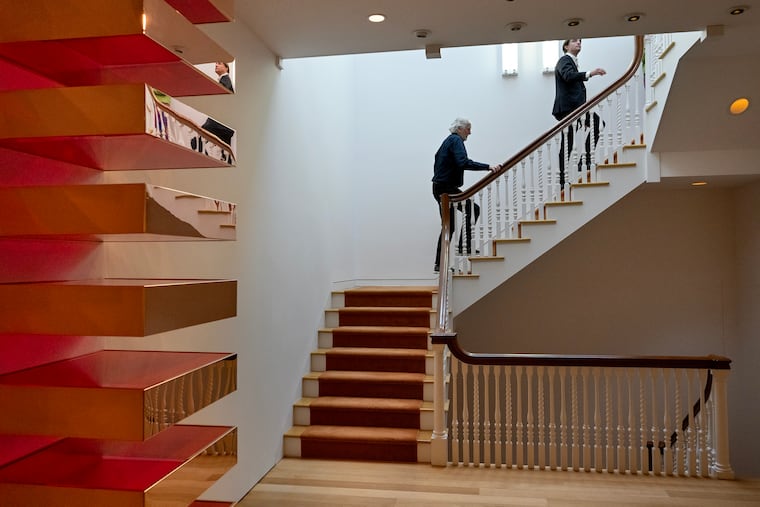
A pyramid structure by Cole McNeil’s almost namesake stood in the gallery while the sunlight fell on a Donald Judd “Stacks” sculpture from 1969 in copper and red Plexiglas. Geometric stacks were Judd’s most popular forms, but the one in McNeil’s living room is “historically important,” Flaum said.
“Think about the medium and the color within the stacks as a sort of hierarchy, and copper is right at the top of the totem pole,” said William Featherby, junior specialist of post-war and contemporary art at Christie’s. “Because not only is it a fundamental universal element, it is imbued with its own color. It’s neither silver nor gold.”
“Growing up, the Judds were my favorite,” Cole McNeil said. “And whenever a new one came in, I was so excited. Because I knew who he was, I knew what his works were. I could tell you he is the one with all the boxes and the squares.”
Of the 44 early Stacks, Featherby said, only four are made of copper and five feature the color red. “But there’s only one that has those two in combination, and that’s this one,” he said pointing to the right wall of McNeil’s living room, as the light red Plexiglas glowed in its aura and the cubes of copper cast a fan of shadows on the wall.
Some of those shadows touched Carl Andre’s Steel-Zinc Alloy Square (1970) — 50 steel and 50 zinc plates arranged in a pattern, almost like a rug. Andre invited viewers to walk over his sculptures.
“Going through the family albums, I found some funny pictures from Christmas when we’re in the dining room, and I had a train running through a Carl Andre sculpture,” said Cole McNeil.
Here, the Andre glowed under the yellow fluorescent light of Dan Flavin’s The Diagonal of May 25, 1963 (to Constantin Brancusi) (1963).
“This is literally the very first purely fluorescent artwork ever made by any artist ever. [Flavin has] an edition of three. This is number one in the edition,” Featherby said.
“[McNeil] really had this recognition of what is historical and important and at the same time, [looked at] color, material, beautiful objects,” Flaum said.
In a corner of the room sits yet another LeWitt; as if the hanging grid in the dining room had grown through the ceiling like an errant tree. The patterns on the walls could seem like chic wallpaper, but Flaum quickly corrected that assessment.
They are all wall drawings by LeWitt.
One such drawing (Wall Drawing #1112, 2003) is a rectangular riot of colors contained in a square — “There’s seven coats of paint on each one of those different rectangles,” Quinn said — while the adjoining wall is quieter, with “10,000 10-inch lines.”
The installation of the wall drawings, Cole McNeil said, were “always a huge event in our house.” People from the LeWitt estate would come in and install the wall drawings, following a very strict set of instructions.
“I remember I got to put up one line, maybe two. She guided me and Calder. That was very special,” he remembered.
There are more Judds, more Lewitts and Andres, a Nakashima low table, a Poul Kjærholm side table, and two Richard Tuttles in the gallery and adjoining office.
Against the common wall sits Two-Part Invention (1967) by Richard Artschwager, who started out as a furniture maker and, after a fire burned his workshop down in the 1960s, decided to, “in an act of ironic rebellion, make useless objects as art,” Featherby said. “He would fashion these uncanny structures out of plywood that almost looked like furniture, but had zero function.”
“You look around, and you’ve got the five greatest artists of Minimalism, and you’ve got the best example of each one, all in the same room,” Featherby said.
“His vision for the collection was singular,” Calder McNeil, who works in an art gallery in New York City, said of her father. “Seeing how particular he was about choosing what to include in the collection. It’s impressive to see how discerning he was … to hone in on one movement and really create the best collection of those works. I feel like that takes so much skill and time and consideration.”
McNeil, Quinn said, was “constantly moving things around because he had bought something new and something old was leaving.”
“He was always in this pursuit of refinement,” Flaum said.
“We’d come home from school and go, ‘Oh, wait, where did that go?’ We got that firsthand account into how collecting worked,” Calder McNeil said.
Even the bathroom has a Picasso
The LeWitt wall drawings reappear upstairs, in the family’s bedrooms. Calder’s and Cole’s childhood rooms stand with Matisses and Alexander Calder mobile replicas, which won’t be for sale in the auction.
Cole McNeil grew up obsessed with sports and would often visit friends’ homes fitted with basketball hoops. “And our house was all art. It didn’t make me feel better than anyone, probably made me feel worse. I was like, ‘God, they get to have the coolest house, they have a basketball hoop!”
(When he finally got a basketball hoop for his bedroom, he quickly learned how to play without hitting the bright LeWitt wall drawing.)
The primary bedroom, used by Henry McNeil, is bathed in a bright yellow — a Sol Lewitt wall drawing complemented by Judd’s Untitled (Suite of Drawings) from 1976 — 15 drawings on bright yellow paper, framed identically in wood.
Even the bathroom has a Picasso.
On that bedroom’s side wall glows Flavin’s Untitled (to Don Judd, colorist) 2. Executed in 1987, the T-shaped light sculpture is the second of an edition of five, of which four were fabricated.
Flavin, Judd, and LeWitt — peers who hung out in the same 1960s New York art circle stand united in the bedroom of a collector whose interest in Minimalism was inspired from spending time in that city around the same time.
After graduating from Washington and Lee University and the Wharton Business School at the University of Pennsylvania, McNeil started visiting New York often in the 1970s. “And it was really the time where, in downtown New York, if you were out and about, you’d meet all these now famous artists,” said Calder McNeil.
That’s how he met Andy Warhol and Jean-Michel Basquiat, and then Judd and Andre.
McNeil started collecting art in the mid-1970s and co-owned New York’s Protetch-McNeil Gallery until 1984. After that, he opened the Vanguard and McNeil Galleries in Philadelphia. In 1996, he completed reclaiming and restoring a 75-acre abandoned clay quarry into what is now the 600-acre Winslow Farm Conservancy in Hammonton, N.J.
A legacy of art
McNeil sent Calder and Cole to Springside Chestnut Hill Academy because of the school’s excellent arts program. When asked to create a miniature of an artwork for a school project, Calder chose Fred Tomaselli. McNeil kept that replica in his office. When she fashioned a sculpture out of Styrofoam, her father had it cast in bronze.
Both siblings grew up interacting with artists and seeing strangers looking at their father’s art collection.
People would often stop on their way to the Barnes Foundation and request to tour the house and see the dining room with the Nakashima, the office with Maarten Bass’ Real Time Sweepers’ Mantel Clock (2019), and — most importantly — the family’s living room and gallery.
“That really opened my eyes to how important it was, like the importance of art itself. Seeing the appreciation for it from outside of our household was what really made me realize this was special,” said Calder.
When Cole drew something, McNeil would take the art to a professional framer. The siblings have galleries in the house — full of childhood artwork; invaluable and therefore not up for auction.
“The great thing about growing up around art is that people inspire you, the stories inspire you, the esthetics, the beauty … everything inspires you. My thoughts were provoked by art,” said Cole McNeil, who remembered creating a series of abstract art using Sharpies and Post-its.
Letting go of the art pieces that shaped their childhoods is bittersweet for the siblings, but it is something their father wanted, they said.
McNeil’s collection is expected to achieve “in excess of $30 million,” per Christie’s estimates.
“It’ll really hit me when it’s gone, when the house is just empty. We are lucky to be able to keep some work. But we’re young, we can’t keep storing things like art. You know, art doesn’t deserve to be stored like that,” Cole McNeil said, as he fought tears.
He loves Minimalism but has gone on to find a love for the abstract artist Wassily Kandinsky.
“I hope this experience makes me better in the future, makes me work hard in law school, so I can go buy my own art, my own Kandinsky,” said Cole McNeil, who is preparing for his LSAT, “So I can fill my future family home and give my kids the same experience I had.”
“Defined Space: The Collection of Henry S. McNeil, Jr.” will be on view at Christie’s, 20 Rockefeller Plaza, New York, N.Y., ahead of the May 20 auction.