The ‘rediscovery of the century’: How a modern masterpiece lay hidden in Philadelphia for almost a century
There is an 'Europa,' by the Czech modernist painter Josef Šíma on view at a gallery in Brno. But there was also a nearly identical secret one in Philadelphia.
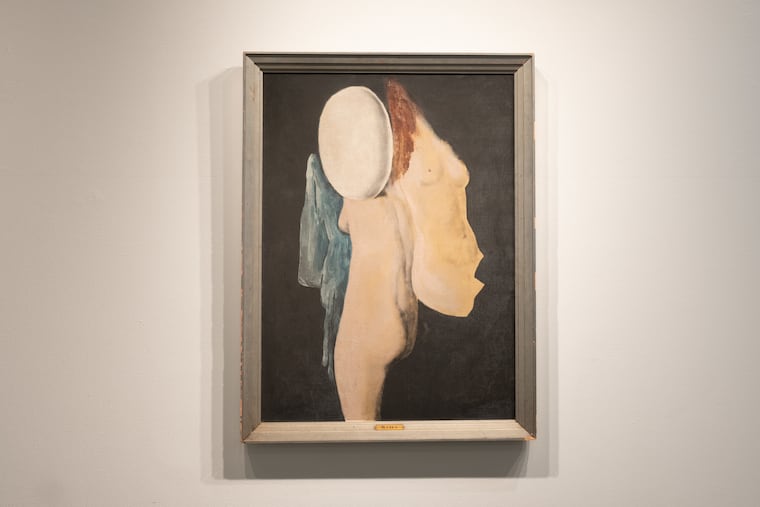
When the Philadelphia-based auction house Freeman’s drew out an inventory of the esteemed family collection of Robert Sturgis Ingersoll, a late president of the Philadelphia Museum of Art, they documented several paintings from notable American and European artists.
There were Sigmund Joseph Menkes’ Girl with Goat, Ossip Zadkine’s Maternité, Arthur Beecher Carles’ Lounging Nude.
And a 1927 painting titled Europa, considered to be one of the most important works by the Czech artist Josef Šíma.
Everything seemed to be in order, but soon after the catalog was made public, the auction house heard from Czech art experts.
The only known version of Europa, they said, was currently hanging at the Moravian Gallery in Brno.
Was it possible, the experts wondered, that another version existed, and had lived quietly in Philadelphia for almost a century? A near-twin that no one knew about?
A year later, the auction staff can confidently say: Yes. The painting is an authentic Šíma that they believe is the prototype of the one in the Czech Republic.
Its existence was previously unknown to the art world.
“We had checked many books, and this painting was referenced, so we thought it was the same painting, which is what people had assumed for close to 90 years,” said Raphaël Chatroux, head of impressionist and modern art at Freeman’s.
“We withdrew the painting [from auction] when it became quite flagrant that we needed to research it more, to study it more, just to authenticate it,” Chatroux said.
After a monthslong investigation in Prague, Europa returns to the auction block this week in New York with an updated price estimate of $300,000 to $500,000 — significantly higher than last year’s estimate of $50,000 to $80,000.
Experts told Chatroux it could sell for up to seven figures.
Rare find in Philadelphia
Though considered a prodigy in his home country, Chatroux said, Šíma is not a well-known name outside of the Czech Republic and France, where the modernist painter lived for most of his life. By 1927, when he created two versions of Europa, he was at a critical point in his career, intersecting with surrealists in Paris but also developing his own artistic and literary group called Le Grand Jeu (the Great Game).
The painting depicts two nude and headless torsos facing opposite directions on a black background, with a large oval egg where one’s head would be, partially divided by what looks like brown hair.
“In a way, this painting acts as a sort of poetic reinterpretation of the Big Bang, of the creation of the world, hence the black background, the sort of chaotic matter from which life is born,” Chatroux said. “The egg is an important symbol for Šíma. First, it’s an obvious symbol for the universe, but the second symbol associated with the egg is unity. … His aim, really, is to recreate on canvas the original, ‘the primordial,’ as he says, unity of the world — that very sacred, but forgotten, moment when mankind was one when they were in the egg.”
Soon after Šíma completed the Europa works, he sold one to renowned American collector Bernard Davis, who brought it to Philadelphia in 1928. The Ukraine-born textile manufacturer was known for championing Eastern and Central European modern artists in the American art world.
When Davis sold his Rittenhouse home in 1952, Ingersoll purchased the work. At that time, Ingersoll was president of the Art Museum. He eventually amassed a star-studded collection with works by Pablo Picasso, Amedeo Modigliani, and Constantin Brâncuși.
“He always was interested in collecting art — he had an eye for that. We’d go over to his house and it was absolutely amazing,” said Julia Ingersoll, 60, Robert Sturgis Ingersoll’s great-granddaughter, who lives in Bryn Mawr. “He made such an impression on me. He was just the consummate gentleman, a big, very tall man with a waxed mustache and monocle — just incredibly intense.”
Julia Ingersoll said she and her siblings grew up surrounded by art, as some of that collection was passed down through generations. Though she did not know much about Šíma in particular, she remembered seeing Europa hanging in her father’s office in his home outside Wilmington for the last 20 years.
“My father [Robert Sturgis Ingersoll III] never realized the historical significance of it,” she said. “It is an unusual piece by itself, but with everything that he had going on around it — the fact that it didn’t stand out was also just a testament to the weird variety of arts that my dad had.”
An investigation in Prague
Robert Sturgis Ingersoll III recognized that his collection was full of treasures and he wanted the majority of it to go to auction, he told his children before his death two years ago.
“It was my father’s choice, because he was very careful about having fairness,” Julia Ingersoll said. “He was like, ‘There’s no way that I’m going to have you guys look at the art and decide what you want me to [divide up] amongst you. If it’s going to auction, that’ll be the fairest way.’”
Ingersoll and her three siblings honored his wishes and worked with Freeman’s, which led to the news of the rare Šíma resurfacing. Unlike other artworks that came with dozens of pages about the history and provenance, little else known was about Europa aside from the artist’s name and the year it was made.
“That’s what’s so funny, because [my father] was meticulous, and he loved to tell stories. With so many of the pieces of art, there’d be a story of each piece that he had, and he’d write a bit about the pieces from the family,” Ingersoll said. “With this [Europa], there was, like, nothing.”
After receiving so much interest in the painting last spring, Chatroux told the family that it could be a potentially big discovery; the next step would be to send the work to Prague for experts to compare it with the museum’s version.
Chatroux was nervous about transporting the painting overseas, as there was a chance that it could have possibly been seized by Czech authorities, given Šíma’s national importance. So he secured a temporary visa for the artwork with a clear expectation of a return date.
At Prague’s Trinity Art Research, art historian Rea Michalová and conservator David Frank put the two paintings side by side and conducted various forensic tests using X-rays and tests with ultraviolet and infrared technology. The experts found that they had the same quality, sharing paint colors and technique.
Both pieces bore Šíma’s signature, which was difficult to see clearly because he etched his name into the canvas. Even more stunning: Both artworks had hairs from the same paintbrush still mixed into the paint.
“It’s just a painting that breathes Šíma, and that’s not something that you can copy — he’s extremely hard to copy,” Chatroux said.
Michalová called it “the rediscovery of the century,” according to the auction house.
When the verdict came in January, the Ingersoll family was happy to hear the good news.
It just so happened that when Chatroux called, Julia Ingersoll was driving by the Art Museum, thinking about her great-grandfather.
“The world is full of surprises,” she said. “I’m just thrilled that people who have studied this artist deeply have this opportunity to see a piece that they never knew existed.”
For Chatroux, who led the auction of the Ingersoll family’s many masterpieces, Europa proved an exciting challenge as well as a fascinating journey.
“It turned out to be the star of the collection,” he said.
“Europa” will go on auction at Freeman’s New York salesroom on Wednesday.