The Kimmel Center loses one of its founding resident companies
The Chamber Orchestra of Philadelphia cited the rising costs of performing at the venue
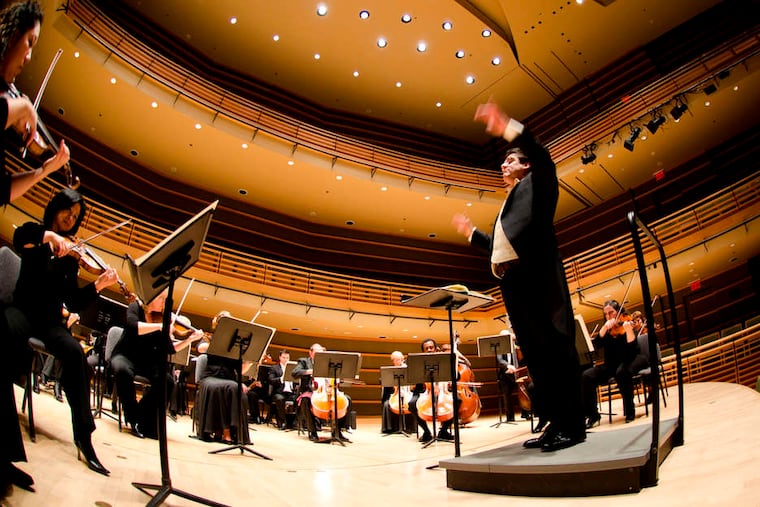
The Kimmel Center has lost one of its founding resident companies. Citing the expense of performing at the city’s largest arts venue, the Chamber Orchestra of Philadelphia announced Friday that it had decided to vacate the Kimmel after a 24-year run.
The decision, shared in an email to the group’s patrons and others just two weeks before the start of the chamber orchestra’s season, was a unanimous one by the board, the announcement said.
“The escalating costs of performing at the Kimmel are diverting resources from other critical needs of the organization, and one thing we will never compromise is the quality of the music we play or our ability to remain on a sound financial footing,” read the chamber orchestra’s announcement, which noted that other non-Kimmel expenses had also risen.
Anne Hagan, the group’s executive director, said it had become “difficult for us to keep up with payments” for Kimmel base rent and the other costs of performing there, even though Philadelphia Orchestra and Ensemble Arts management had been generous in terms of a timetable for making payments.
The group had been a resident company at the Kimmel’s Perelman Theater since the arts center’s opening in 2001.
POEA released a statement Friday saying it understood that the Chamber Orchestra of Philadelphia “is experiencing challenges that many nonprofit performing arts organizations are facing. Their contributions have enriched our theaters and Philadelphia’s cultural landscape, and we have valued our long and collegial relationship with them. We remain committed to ensuring our venues are welcoming homes for chamber orchestra performances well into the future. Our doors will remain open to the Chamber Orchestra of Philadelphia when they are ready to return.”
The group’s 2025-26 concerts were already planned to be split between the Kimmel and other venues. Now, concerts previously slated for the Kimmel will be held at the Church of the Holy Trinity on Rittenhouse Square, the Pennsylvania Academy of the Fine Arts, and the Philadelphia Film Society.
Hagan said that the change in venues would reduce the group’s production line-item expense by about $70,000 — a substantial savings on a total annual operating budget of about $1.2 million.
David Hayes, the ensemble’s music director, said that the savings will give the group a chance to “really work to build community with our audiences in ways we haven’t been able to and take some more artistic risks that are going to cost money.”
At the Perelman, base rent is just one component of the bill. The production needs of each particular program can have a dramatic impact on additional costs. “The second you add sound, lighting, the cost goes up and up and up,” Hayes said. He would like to do a special project in 2028, for instance, around the 200th anniversary of Schubert’s death, but it would have been “incredibly expensive to do at the Perelman.”
Beyond this season, the chamber orchestra is “excited by the prospect of taking up residency in a newly renovated Center City venue by the 2026-27 season,” the group teased in the announcement, without disclosing the space’s identity. It listed, among the new space’s qualities, “great acoustics, fresh amenities, and a scale that conforms perfectly to the intimate experience of chamber orchestra performance.”
Hagan declined to identify the new space, but said it was “near Broad Street” and held about 500 seats.
Asked whether the chamber orchestra was truly done at the Kimmel, Hagan said she thought it was, “as a permanent, full-subscription [user], at least for the foreseeable future.”
She said right now the money is better spent on the art — works like Alfred Schnittke’s Concerto Grosso No. 1, which is on the November program.
“It uses a piano and harpsichord, and the harpsichord has to have amplification, and you have to pay someone who knows how to prepare the piano. We have Adolphus Hailstork writing a piece for us. That’s where we want to put our investment.”