Daniil Trifonov shines in solo recital at Marian Anderson Hall
The pianist's intimate playing transported the audience from the grandiosity of the orchestral hall to the warmth of a private living room.
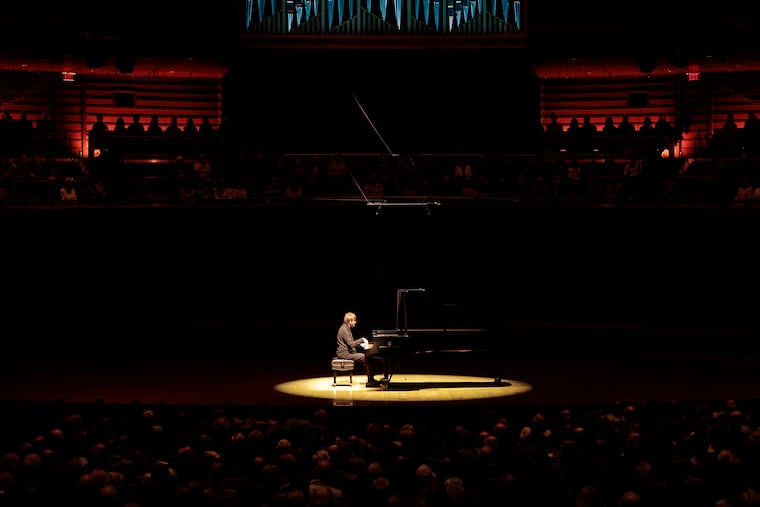
On Wednesday evening, Daniil Trifonov returned to the Kimmel Center’s Marian Anderson Hall. It was a homecoming of sorts for the pianist, after he soloed with the Philadelphia Orchestra at the opening of last season, and released his most recent album, My American Story (North), in October, which includes a live recording of Gershwin’s Piano Concerto in F with Yannick Nézet-Séguin and the orchestra.
The recital program was framed by Tchaikovsky, opening with the composer’s youthful Sonata in C Sharp Minor, Op. 8 and closing with a work from the composer’s later years, a concert suite from the ballet Sleeping Beauty. Between these two large-scale works, Trifonov presented a selection of six waltzes by Chopin to close the first half, and opened the second with Samuel Barber’s virtuosic Piano Sonata in E Flat Minor, Op. 26. While the outer works by Tchaikovsky offered a kind of aesthetic closure to the two-hour-long program, the genre of the waltz unified the otherwise contrasting repertoire.
It was in the gentle lilting of these waltzes, and at other moments of musical introspection, that Trifonov’s sensitive and imaginative playing was at its peak. While the bombastic first theme of the Tchaikovsky sonata, or the declarative prologue of the Sleeping Beauty suite satisfied in their dynamic, it was in moments of quiet and of tenderness that the music seemed to blossom. In such passages, such as the “Andante” movement of Tchaikovsky’s sonata, the adagio love theme of the Sleeping Beauty suite’s penultimate movement, and throughout the Chopin waltzes, Trifonov played with a suppleness of phrasing and breath that was mesmerizing.
This was particularly true of his performance of the Chopin, which was so intimate that one felt transported from the impersonal grandiosity of the orchestral hall to the warmth of a private living room. In this space, Trifonov conjured twirling couples swaying gently in time to the three-four meter, but seen from afar as if through the clouded glass of memory, and tinged with the soft pain of melancholy.
After a standing ovation and intermission, the program’s second half began with Barber’s sonata, a staple of the 20th century American piano repertoire. While Trifonov did not record the Barber for his recent album, it is easy to imagine its presence on this program as a product of his dive into midcentury American identity. Its presence provided a nice nod to Philadelphia, for it was just down the street at the Curtis Institute that Barber spent his formative years and later returned to teach.
In Trifonov’s performance of this demanding work — which contains a sly, off-kilter waltz in its fleeting second movement — he showed himself to be a master of transitions, savoring the drama of the retransition before the dramatic recapitulation of the sonata’s opening theme. The third movement, marked “Adagio mesto,” formed the emotional core of the work, and even the recital, which Trifonov interpreted with devastating pathos. In the sonata’s final movement Trifonov’s measured interpretation, while impressive in the clarity of his articulation and voicing, might have benefited from the imaginative freedom present in his approach to more introspective moments, such as Chopin’s waltzes or Barber’s Adagio mesto. Still, his technical virtuosity was on display, and at the movement’s finish, the audience leaped to their feet for a standing ovation.
This applause was cut short by Trifonov’s quick transition to the final work on the program, the voice of Tchaikovsky the elder and Tchaikovsky the dramatist, in a rendition of the 11-movement concert suite from Sleeping Beauty, transcribed for piano solo a century following the ballet’s premiere by fellow Russian pianist Mikhail Vasilievich Pletnev. In this virtuosic fairy tale, each of the movements amounts to a kind of character piece, and here Trifonov’s impressive control of gesture illuminated each new character clearly and in many cases with a gentle humor, from dancing pages and Puss in Boots to Little Red Riding Hood.
After a raucous mazurka that closes the suite, the evening concluded with two encores. Speaking briefly, Trifonov dedicated the first to a mentor who had recently died, and after more spirited applause brought him back to the stage, he performed one last waltz: the “Prelude No. 7 in A Major” from Chopin’s 24 Preludes Op. 28.