Longwood’s carillon is turning 25. Cue the Taylor Swift and Pink.
Longwood Gardens is celebrating the 25th anniversary of its Dutch-made carillon with live performances featuring everything from Disney songs to Taylor Swift, Pink, and classical works.
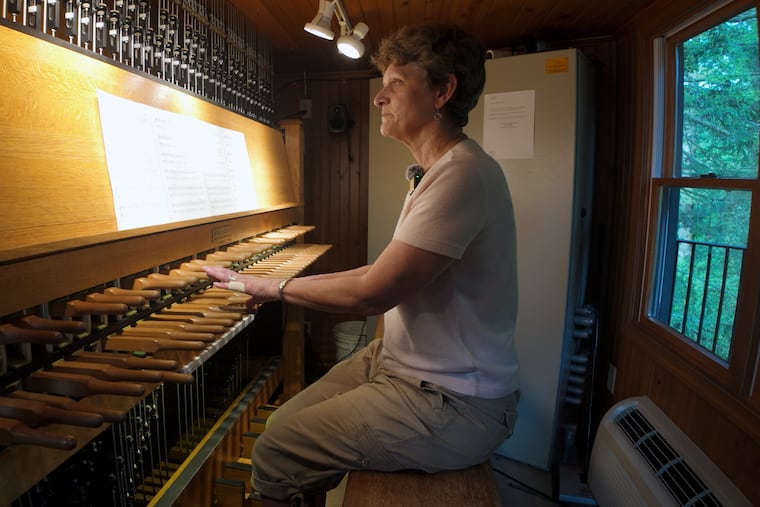
The carillon is a musical instrument whose beginnings lie in the Low Countries of the 16th century, in what is today Belgium and the Netherlands.
So what kind of music will Lisa J. Lonie be playing this weekend on Longwood Gardens’ carillon to help celebrate that instrument’s 25th anniversary?
“They wanted a child-friendly program, so I’m playing some Disney music,” said Lonie, “and then for the tweens, I’m playing Taylor Swift and Pink.”
This is not the kind of Swiftian encounter you can have on iTunes. The charm of Longwood’s carillon (which was in fact made in the Netherlands) is the experiential aspect of it, not to mention the surprise.
“People go [to Longwood] primarily for the fountain or the flowers, and then they get this bonus of hearing this atmospheric music throughout the day. I think of it as a giant wind chime,” says Lonie. “You may be on the other side of the gardens, but then you hear the bells just wafting through the air.”
This weekend, the experience will be intensified. The hourly bells emanating from Chimes Tower are typically automated, but Lonie and other carillonneurs are playing the instrument live in a variety of repertoire with augmented forces Saturday and Sunday. Visitors will be able to climb to the top of the tower to examine how the instrument works, and to catch panoramic views of Longwood.
Geeking out over the mechanism behind the sound and what it takes to produce all those peals might surprise some, says Lonie.
“It’s not beautiful to watch. It’s a physical instrument — your hands and feet are going. We could be drenched from head to toe, and we have to get ourselves up in the tower. At Princeton, where I also play it’s [about] 150 steps. You have to be fit for sure.”
It’s a mere 82 steps to Longwood’s instrument.
There, the player sits before a kind of keyboard, as an organist or pianist does, but the notes are triggered by hitting a series of “batons,” each one corresponding to a bell. Low notes are played with the batons or, like an organ, on foot pedals.
Making the music musical, though, involves more than just striking a baton.
“We are taught just like any other professional musician how to make phrases, to take pauses and fermatas [held notes],” says Lonie. “The instrument is controlled by variation on touch. If I want to play loudly, I will take that baton and depress it for its full inch and do it forcefully.”
Lonie became a carillonneur when, at age 13 or 14, she first heard the instrument at Washington Memorial National Carillon in Valley Forge, when she was playing the handbells.
“I was completely smitten, and that evening I told my mother I didn’t want to ring handbells anymore. I wanted these big bells.”
She started lessons even before her high school years, and after college studied with Frank Law and Frank DellaPenna at the Washington Memorial carillon.
That carillon is one of nine in the region — an area that is “one of the largest concentrations, if not the largest, in North America” for carillons, she says.
Longwood’s instrument is marking 25 years, but Chimes Tower was built long ago — in 1929, by gardens’ founder Pierre S. du Pont. It originally housed 25 tubular chimes, and, later, electronic imitation bells. A 32-bell electronic carillon was played from the mid-1950s through 1981, when the tower fell silent until 2001. The present instrument was built by Dutch firm Royal Eijsbouts and inaugurated on May 28, 2001.
Carillonneurs often perform pieces originally written for other forces. But there’s a respectable original repertoire for carillon, including works by John Cage, George Crumb, and, in 2018, Jessie Montgomery. The instrument also has some impressive local compositional credentials. Samuel Barber, Gian Carlo Menotti, and Nino Rota wrote for carillon when they were students at the Curtis Institute of Music, said Lonie, who will play works by the three at a recital June 7 at Princeton University’s carillon.
But not every work can be played on every carillon. The number of bells varies from instrument to instrument. “When you have 25 bells, you can’t play something written for 58 bells,” says Lonie.
“But at Longwood” — with 62 bells — “you can play all of the repertoire,” she says.
Barber or Crumb, and Pink, too.
The Longwood Gardens carillon is featured with special programs Saturday and Sunday from 11 a.m. to 8 p.m. at Longwood Gardens, 1001 Longwood Rd., Kennett Square. 610-388-1000, longwoodgardens.org.