‘Lord of the Rings’ lands at the Philadelphia Orchestra, but the magic remained in the music
Elves and hobbits made up an orchestra performance that, in our critic's years of concert going, had the audience break into the most applause and hoots of approval.
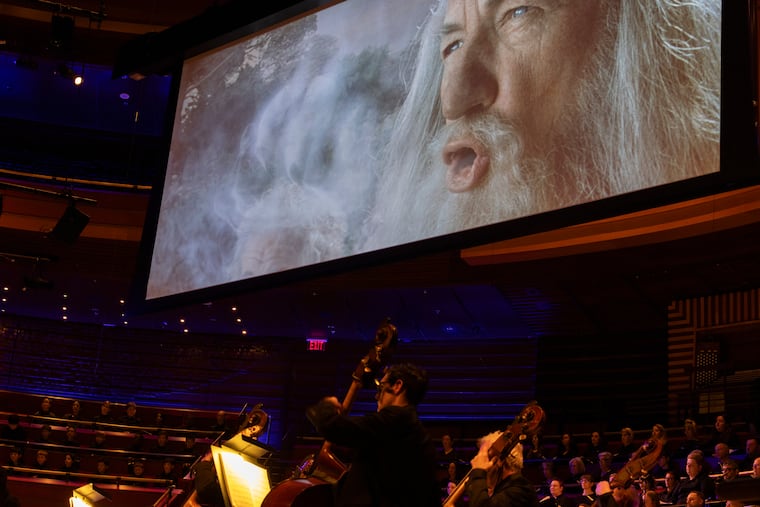
It was the kind of night at the orchestra when any good hobbit could show up in a Bilbo Baggins waistcoat and feel right at home. Previously human ushers had suddenly sprung elven ears. And the action on stage involved a twisty, unlikely tale of a magical gold ring whose purpose seemed to be to exploit the flaws and weaknesses of those who encounter it.
The Philadelphia Orchestra’s presentation of The Lord of the Rings: The Fellowship of the Ring Friday night in Marian Anderson Hall was one of those cross-cultural experiences that ricocheted with surprising power. Two subcultures, each with its own specialized language — classical music and the fandom around J.R.R. Tolkien’s world of wizards, dwarfs, and the dark forces — intensified the other.
For anyone keeping score in the ongoing battle for younger audiences in classical music, Friday was a night when it seemed everyone in the hall was 31 years old and deeply engaged. Never at an orchestra performance have I heard the audience break in so many times with applause and hoots of approval.
Of this happy synergy, the orchestra sold out all three performances, with tickets topping out at more than $250 a pop.
Not all of the orchestra’s live-to-screen presentations have justified themselves musically, but here, Howard Shore’s score was a canvas both vast (about three hours of music) and colorful.
If there’s a single label for Shore’s musical language, it’s Celtic Craggy — with notable excursions into the bellicose, the sentimental, and moods more subtle. The great value of hearing a great orchestra live in dialogue with the screen is in the emotional epiphanies, moments where the music tells you something the dialogue and action alone can’t.
The sound engineering on this night favored the music over the dialogue, and smartly so.
The other beautiful dynamic at play: You didn’t have to walk into the hall with any prior knowledge of classical music or Middle-earth nomenclature to feel the experience. This level of communication is simply embedded deep in being human.
The definition of human becomes hazy in the 2001 installment of Peter Jackson’s film trilogy. But time and time again, the musical score homed in on the universal goodness and countryfolk sincerity embodied in instruments. Two different soprano tin whistles (one in C, the other in D), whose very pitch and storytelling inflection were skillfully stretched by orchestra flutist Erica Peel. Hornist Jennifer Montone perfectly conveyed what it feels like to be a lonely leader in the Council of Elrond scene.
The percussion section was a city in itself, conjuring folk sounds on the bodhran drum, and the anvils of war (struck by musicians on, essentially, flat sheets of steel).
Anvils? The quest for a magical ring? Dwarfs, warriors, and flawed characters? Tolkien drew on some of the same sources that Wagner did in his Ring Cycle, and while Shore’s score might have a Wagnerian touch here or there, the larger influence was Carl Orff, whose Carmina Burana became the musical DNA of video games and car commercials.
Colossal forces brought both precision and brutality, particularly in the repeating combination of driving percussion, screaming brass, and blocs of choral sound amassed for battle. With Ludwig Wicki conducting, the Singing City Choir and Philadelphia Boys Choir — both quite strong — provided chaos and balm. Vocalist Kaitlyn Lusk and chorus were the gentle healing we needed to hear after Gandalf’s death.
The good thing was, when you tired of watching yet another wave of fiendish Orcs getting clobbered, you could always turn your eyes to the stage, decode the instrumentation, and imagine for yourself an entirely different narrative. This is the enduring promise of orchestral sound on any night at the orchestra.
No additional magic needed.