A Philly art teacher wants people to stop spreading lies about MOVE. So he started a comic series.
Forty years after the MOVE bombing, Southwest Philly's Pete Coyle wants to tell the 'full and complete story' about the often misunderstood activist organization.
For years, Philadelphia art teacher Peter Coyle has shared cartoons inspired by his life with his students. He often uploaded them online and gifted physical copies of his work to fellow teachers and friends.
Now, the Southwest Philly native has focused his attention on MOVE, the Black anti-racist activist organization whose members lived in West Philadelphia, leading a back-to-nature lifestyle and shunning modern technology. Its clashes with neighbors and law enforcement led to the murder of a Philadelphia police officer in 1978 and then in 1985 the destruction through a police incendiary device of a MOVE rowhouse that resulted in the deaths of at least 11 members or their children, along with the destruction of 60 homes after fire spread through the block.
Forty years on, after reading countless books, news articles, and academic papers about the organization and the ideology of founder John Africa, born Vincent Leaphart, Coyle is working on a new project.
“I’ve been living and breathing this research,” Coyle said.
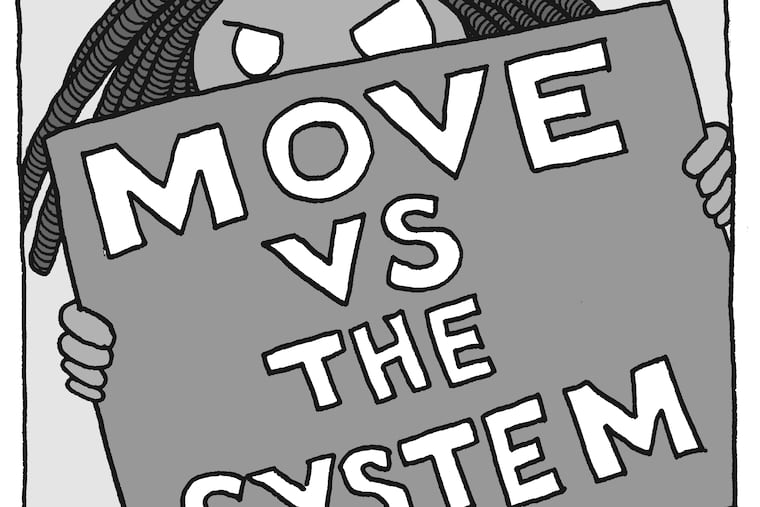
Last month, he debuted a webcomic series, “MOVE vs The System.” Its biweekly episodes illustrate the organization’s inception and philosophical underpinnings, clashes with local authorities, and the lead-up to the 1985 bombing.
“I still can’t believe this is something that happened here,” he said. “There’s no getting around the fact that the 1985 bombing is one of the most horrible acts of violence perpetrated by the police and government in my lifetime.”
Coyle describes his style as simplistic, but it’s one he believes will bear the weight of the “real and serious” emotions and messages linked to MOVE.
“There’s a lot of journalism out there about MOVE. I want to take all those parts and put them into one story. And as a cartoonist, this is the way I can do that.”
Throughout the series, Coyle’s minimalistic drawings illustrate MOVE’s extensive activism, its contentious and complex relationship with the police, and how outsiders’ discriminatory views and philosophical indifference warped the public image of the group.
The first entry transports readers to the group’s 1972 protest at the Philadelphia Zoo. The characters hold signs that read “Animals Don’t Have Lawyers,” noting MOVE’s disdain for animals being in captivity.
The often profane dialogue between protestors and spectators leans on the convictions and frustrations shared by MOVE members, and the urgency many felt in the early years of the organization’s fight for civil and animal rights.
The juxtaposition of the simple sketches with the heavy history makes the series an accessible revisiting of the MOVE history.
The challenge, Coyle said, was threading all the research, past news clippings, and accounts together for a singular narrative.
“I think it’s important to give a voice to MOVE members and the children who have grown up and been vocal about the abuse and the cult-like atmosphere,” he said. “I feel like that’s a new part of the story that’s just beginning to be told.”
Coyle intends to tell a “full and complete story.”
“When you look at what’s being said and what the facts are, there’s a lot of myth-making on both sides.”
By the end of the series, Coyle wants to clear up long-held misconceptions about MOVE and stop the further spread of misinformation.
The decision to publish bite-size, biweekly episodes online was to make way for others to contribute to the project. Though Coyle is confident in his work and research, he is also open to shared dialogue and the exchange of verifiable information with past or current MOVE members.
In time, he plans to transfer the online comic into a physical zine, allowing readers to ingest the full story as a whole.
“I want people who have first-hand experience to see this work before it goes to print, and to possibly correct me or give me their point of view,” he said. “Most of my research has been from print, and what people have written about, which isn’t always accurate. I plan on putting the work out there as I do it, so people have a chance to respond to it.”
Coyle said he made this decision because he has seen the spread of inaccuracies about the organization. For example, a podcast by the Canadian Broadcasting Corporation claimed that John Africa performed jazz alongside the likes of John Coltrane. After digging into decades-old documents, books, and archives, Coyle found out that neither John Africa nor Vincent Leaphart was a jazz musician who played with Coltrane.
“I didn’t want to go into spreading more inaccuracy,” Coyle said. “I wanted to give people the opportunity to question what I’m creating.”
The communal approach, he hopes, increases engagement, informs younger audiences, and answers questions held by people already aware of the organization.
“I hope that by telling it as a narrative, it brings in new people to the story, and helps people who think they know the story to look at it again,” he said. “It’s been told through journalism, but telling it through narrative will reach a different group of people.”
Coyle said there is no end date for the comic series just yet. As plans evolve, he will continue to shed light on the organization’s history and its connection to Philly, both then and now.
To read “MOVE vs The System,” visit supertizer.org.