Whatever is going on in the world, there’s still Mozart. And the Philadelphia Orchestra and Symphonic Choir performing his ‘Requiem’
Mozart's music has a cleansing and enveloping quality and under Harry Bicket, the 'Requiem' sounds like a religious rite.
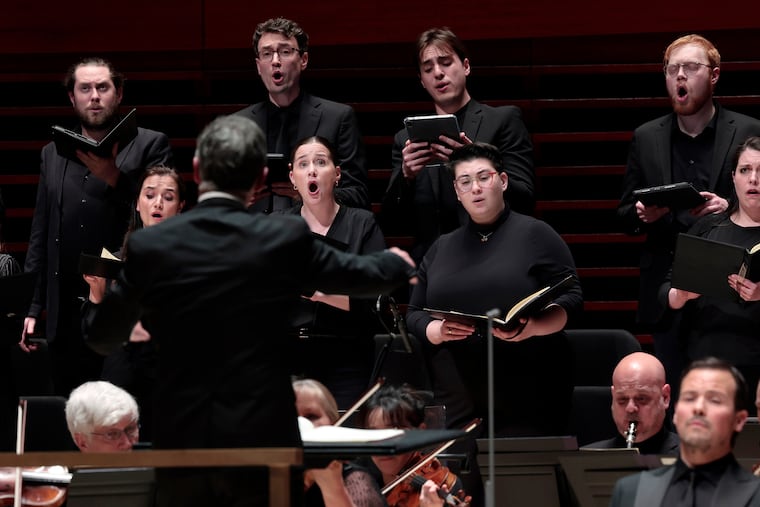
The concert components were nothing radical. Mozart’s beloved Requiem with Philadelphia Orchestra and Symphonic Choir, a quartet of first-class soloists, and a debut from the esteemed early-music conductor Harry Bicket (replacing the indisposed Jane Glover).
Yet when rearranged, these components had a new audience on Thursday at Marian Anderson Hall. The running time was half the usual length, starting at least an hour earlier in the evening (6:30 p.m.) with some tickets at half the usual price.
In New York, this is called a rush-hour concert. In Philadelphia, it’s a worthy experiment.
The hall was full and listeners — including a sizable student group visiting from Boston — were receptive and clearly new to classical concerts. The barometer was the healthy between-movement applause from as much as a third of the audience (a reaction that doesn’t happen with seasoned listeners) plus a warm ovation at the end.
The Mozart Requiem subscription series — to be heard for the rest of the weekend — will include the composer’s Symphony No. 40. But having just the Requiem for rush hour was a somewhat provocative choice.
After-work music wants to be calming or more abstract. This Requiem’s “Dies Irae” movement — the Day of Judgment and written by the composer as he was dying — hits closer to home these days. Yet the music’s cleansing and enveloping quality, plus hearing one of the greatest composers without his usual external charm — created an across-the-centuries communication that instills equilibrium.
Whatever is going on in the world, there’s still Mozart.
Performances of the Mozart Requiem can have a dangerous edge, but not this one. Bicket’s decades spent in British early music circles (and bringing New York up to speed with convincing performances of rarely-heard Handel operas) meant that Thursday’s concert had a smaller, more historically-authentic sound world; one that’s a bit far from the modern opera-house drama that one often hears in Philadelphia.
Vibrato was low for both singers and instrumentalists. Tension came more from the core of the piece rather than from the surface. Tempos didn’t linger. Words were projected but not particularly underscored.
This was a religious rite, not a confession.
The Philadelphia Symphonic Choir — positioned on the stage floor rather than in the conductor’s circle — needed a few movements to find its legs, sounding underpowered amid the “Dies Irae,” but was heard in fuller strength by the “Rex tremendae” movement.
Among the excellent soloists — Lauren Snouffer, Elizabeth DeShong, and Brandon Cedel — tenor David Portillo was especially notable for his focused tone and fine articulation of the text.
There was an un-gussied plain-Jane straightforwardness to Bicket’s reading, the main drawback being that one heard, more than usual, why the unfinished Requiem’s completion by Franz Xaver Süssmayr is often disparaged: The movements he completed don’t really conclude, but just stop.
Well, Süssmayr was there while Mozart was dictating from his deathbed, which counts for a lot.
Footnote: The trombone’s prominent role starting with the “Tuba Mirum” was once thought to be a misjudgment. Now, one better understands that in the 18th century, trombone symbolized otherworldly forces. Thanks to the low-vibrato transparency of this performance, trombone was also more of an ongoing under-the-surface presence, adding a welcome, seldom-heard layer to the music.
Repeat performances: 8 p.m. Saturday, and 2 p.m. Sunday at the Kimmel Center, 300 S. Broad St. Tickets: $73-$252. philorch.org or 215-893-1999.