Opera Philadelphia’s newest offering may sound familiar but no one quite knows what it’s really about
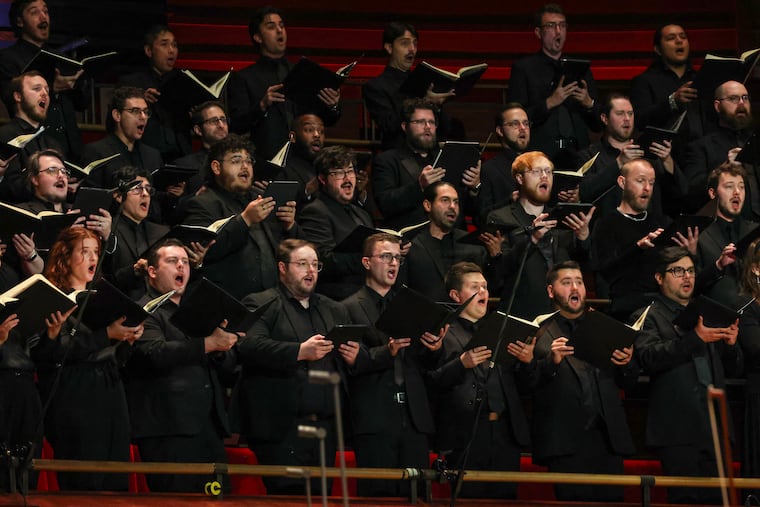
It's a fairy tale about those who sleep, those who stay awake, and those who want to go back to sleep. And it's mostly sung by the chorus.
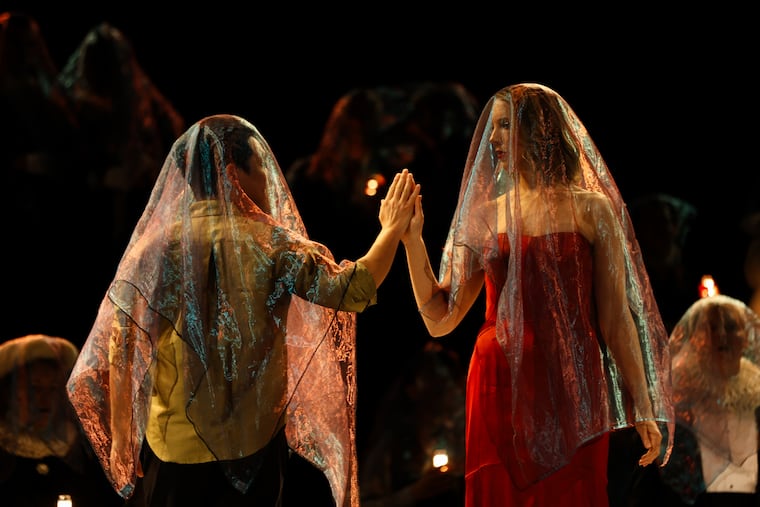
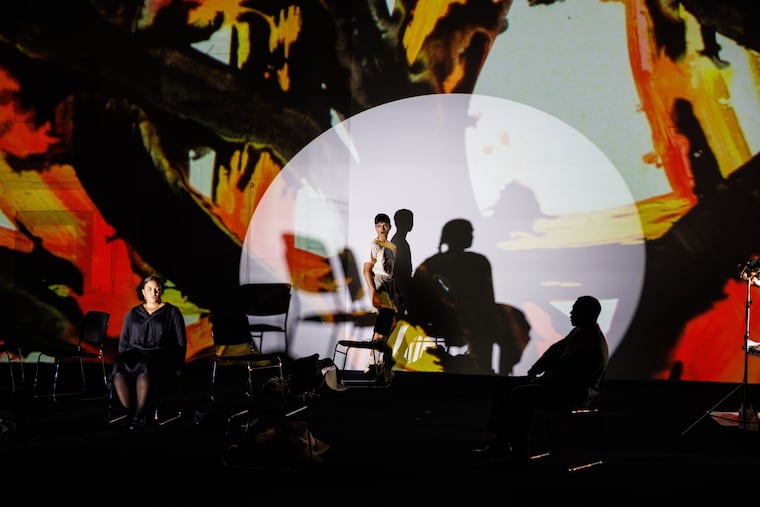
Opera Philadelphia is producing something that’s invitingly familiar on the surface. But beyond that, even the production team is asking, what exactly is Sleepers Awake, which premieres this week at the Academy of Music?
Vaguely described as a choral opera, it has few precedents that the Opera Philadelphia team can name. Yet each day of rehearsal moves the performers closer to establishing the piece’s theatrical identity.
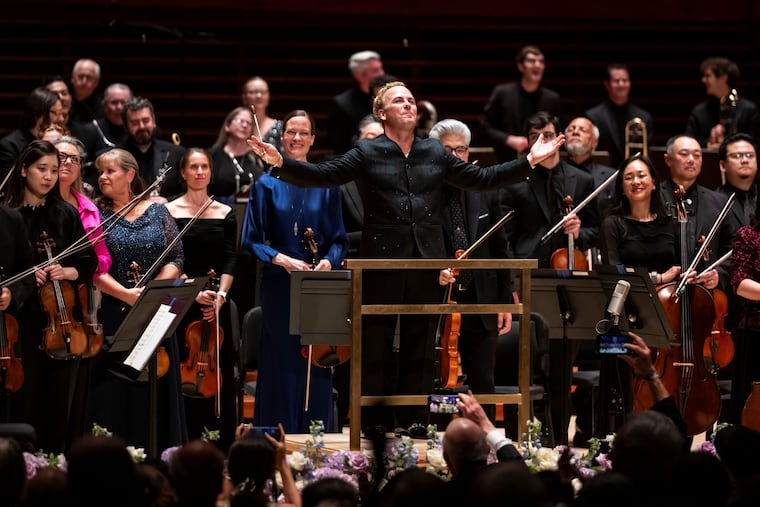
“We’re still working. We’ll work to the end,” said music director Corrado Rovaris. “In this piece, the chorus sings 70 or 80% of the opera. Usually it’s the opposite.”
Sometimes operating as a group, sometimes as a group of individuals, the chorus tells a version of the Sleeping Beauty story about a princess cursed to sleep 100 years. It has many variations with odd-fitting components including entire societies that sleep during a cursed century but wake up less than impressed by the world they find. And that includes the beauty herself, with the typical Prince Charming replaced by The Stranger, who is enigmatic but nonetheless sincere.
Audiences shouldn’t be surprised at bumping into sleepwalkers in the lobby as part of the atmospheric staging.
“Is this paradoxical world a puzzle to solve, a trap to escape, or simply a mystery to inhabit?” asks composer Gregory Spears in the program notes. He drew on a Sleeping Beauty version dating from the World War I-era by Swiss writer Robert Walser (1878—1956), an eccentric with a cult following whose work sometimes had microscopic words crowded onto tiny papers.
The Opera Philadelphia chorus members are full of questions that director Jenny Koons can’t always answer definitively, but gives them an idea they can interpret themselves — within certain limits.
“The opera follows fairy-tale logic, which is its own logic, but mashed up with dream logic, which is expansive,” she said.
Sleepers Awake is a major departure from Spears’ most famous piece, Fellow Travelers, which has become one of the most widely performed modern operas since its 2016 premiere, and is currently enjoying a 10 anniversary, multicity tour.
That depiction of the 1950s McCarthy-era “pink scare” — witch hunts directed at gay men — demanded a linear, naturalistic score in a similar vein as Tosca. This new piece, however, was conceived by Rovaris and Opera Philadelphia general director Anthony Roth Costanzo, while hearing Spears’ The Righteous (2024) at Santa Fe Opera, whose choral writing left them wanting a theater piece dominated by those sounds.
Philadelphia has been something of a good luck town for Spears, a Virginia-born, New York-based composer. Only two years out of Princeton University, Spears was in Philadelphia workshopping his first major opera, Paul’s Case, which made a strong impression and was named among the best of 2009.
Spears has an extensive history of choral music, having written a Requiem as well as a well-received major work for the Crossing’s The Tower and the Garden (2018). That piece for the Crossing provided the foundation for Sleepers Awake.
If Spears, 48, seems remarkably confident while rehearsing this new work, it’s thanks to last year’s workshop with the same organization that hatched Fellow Travelers — Opera Fusion: New Works, a collaboration between Cincinnati Opera and the University of Cincinnati College-Conservatory of Music.
And not having seen the famous 1959 Disney film Sleeping Beauty, he has no worries about living up to it.
Among the elements that came together in Sleepers Awake are Spears’ admiration for the Tchaikovsky ballet Sleeping Beauty, his longtime interest in Walser’s work (who wrote three iterations of the tale), plus the strong influence from John Adams and other minimalists — a language more suited to the imaginary world of Sleeping Beauty than to the brutal realism of Fellow Travelers.
The kind of rhythm that comes out of that minimalist influence can have a great cumulative impact but is especially challenging to choruses.
“It’s pattern based, and the patterns are shifting in unpredictable ways, which is part of the story,” said Spears. “And once the piece starts, it just goes.”
After five days of rehearsal, Koons took the temperature of the Opera Philadelphia chorus members by asking for one word describing their mental and vocal states.
“Excited,” “Overwhelmed,” “Tired,” were some of the answers.
After all, they’re not just singing, but acting.
“There’s a big difference between standing and singing difficult music and asking yourself ‘Who am I? And why am I here?’” said mezzo-soprano Maren Montalbano. “I love it, but I like to do hard things. I’m here for it!” (She also has the advantage of having sung The Tower and the Garden with the Crossing).
The story about multiple realities of a fast-asleep world may draw comparisons to The Matrix but is fundamentally different. The Walser versions, Spears says, take place in a single-reality terrain in which the characters sleep — or not.
Rest assured, the score (as heard in rehearsals) is anything but sleepy. How did Spears avoid that pitfall?
“They [the characters] are only asleep at two moments in the opera. Most of the time they’re talking about being awake but wanting to go back to sleep,” he said. “It’s more interesting to think about sleep than it is to be asleep.”
“Sleepers Awake,” April 22, 7 p.m.; April 24, 8 p.m.; April 26, 2 p.m., Academy of Music, 240 S. Broad St., 215-732-8400 or operaphila.org