Review: Orchestra in extremes: Radical new concerto meets classic on rough draft
The Philadelphia Orchestra paired the world premiere of composer Tyshawn Sorey with an original edition of Anton Bruckner’s Symphony No. 3.
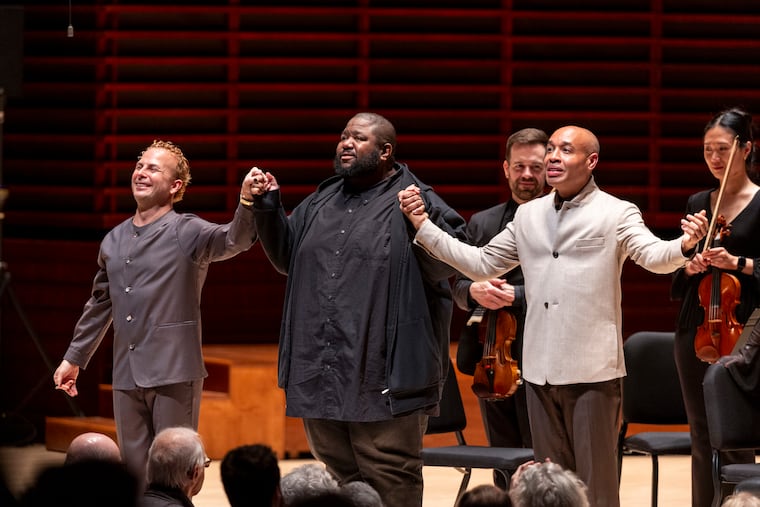
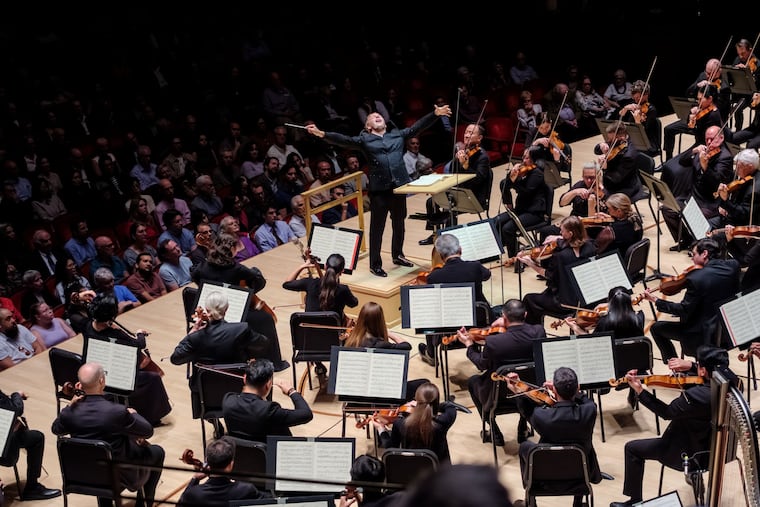
The quietest piano concerto imaginable met one of the louder, most unruly symphonies in the repertoire at Friday’s Philadelphia Orchestra concert — and both emerged alive and well.
Question is: Was any mutual revelation to be had at the Kimmel Center by pairing the world premiere by Tyshawn Sorey with an unmediated original edition of Anton Bruckner’s Symphony No. 3 — each piece separated by 150 years? There was some overlap — though music/artistic director Yannick Nézet-Séguin gave such a smart, charming spoken introduction that you wanted to hear the ear-bending program, whether or not it made obvious sense.
Sorey, 45, is of the most honored composers of his generation (Pulitzer Prize, MacArthur fellowship, University of Pennsylvania faculty appointment) and thus has unspoken permission to take the Philadelphia Orchestra outside the symphonic mainstream. In contrast to the stark, emotionally direct “Cycles of My Being” (2018) — emblematic of the Black Lives Matter movement, written while Opera Philadelphia composer in residence — Sorey has cut a wide swath through the worlds of free-form jazz, alt-classical and left-behind modernists. Most recently, he has embraced the ethereal, trance-inducing music of Morton Feldman (1926-1987), adding his own harmonic richness in one of his strongest works to date, the hour-plus “Monochromatic Light (Afterlife).”
As with Feldman, Sorey’s new piece isn’t called a concerto; the dedication is also the title, For Marilyn Crispell, for Piano and Orchestra. My title would be American Haiku for Piano and Orchestra. The spare, meticulously composed piano writing was never far from the forefront, and given particular clarity by pianist Aaron Diehl‘s incredibly concise mode of expression. When oft-repeated simple motifs morphed into other ideas, the effect was momentous. The orchestra was mainly used for atmosphere, though nothing close to the Philadelphia sound was evident with timpani quietly rumbling, alto and bass flute used as a partly cloudy haze, and vibraphone framing the sound picture. Strings were heard in blocks of chords that stabilized this sensory deprivation experience.
Great? Good? Obscure? I listened in a nonjudgmental state of acceptance, which is how I listen to Feldman (thanks to Philadelphia’s Bowerbird concerts of his music). Modern composers have been accused of moving ahead too quickly, leaving worthy compositional methods not fully explored. Sorey, to his great credit, is not letting that happen.
Footnote observation: Was Sorey having a secret competition with the Bruckner 3rd? Bruckner was known for his rhetorical pauses, but Sorey’s were longer and came with specific timings. On the soft vs. loud front, Sorey’s stated range is ppppp to ffff. Bruckner’s was ppp to fff. Sorey’s fortissimos are flashpoint. Bruckner’s are pronouncements.
Any symphonic journey through the alternating ecstatic, despairing, and folk dance elements of Bruckner is worth taking. In this edition of the 1873 original version of his Symphony No. 3, entire movements can be a different piece of music from the final version. Other familiar elements are shuffled around in different places. It’s a parallel symphonic universe. If not handled with special care, the symphony could be accused of loitering. Not all the components fit together. Thanks to his history with this edition, Nézet-Séguin ironed out most of the kinks; he and the orchestra exuded conviction at every turn.
The final movement, even in a performance as heroic as this, became almost comically repetitive as the composer filled out his prescribed structure by what sounds like a cut-and-paste job of what had come before. Also, brakes hadn’t been invented yet, but Bruckner slammed on them repeatedly. I escaped without musical whiplash.
The program will be repeated at 8 p.m. Saturday at the Kimmel Center. Tickets: $29-230. Information: philorch.ensembleartsphilly.org or (215) 893-1999