Philadanco’s spring residency is a mix of old and new dances filled with improbable lifts and impossible balances
Titled "Explosive," the program celebrates the company's 56th year with four works. The oldest, from 2003, is the boldest.
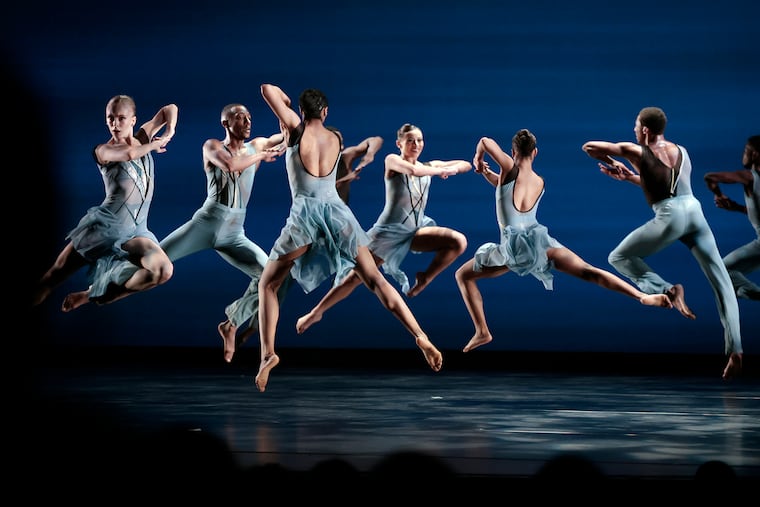
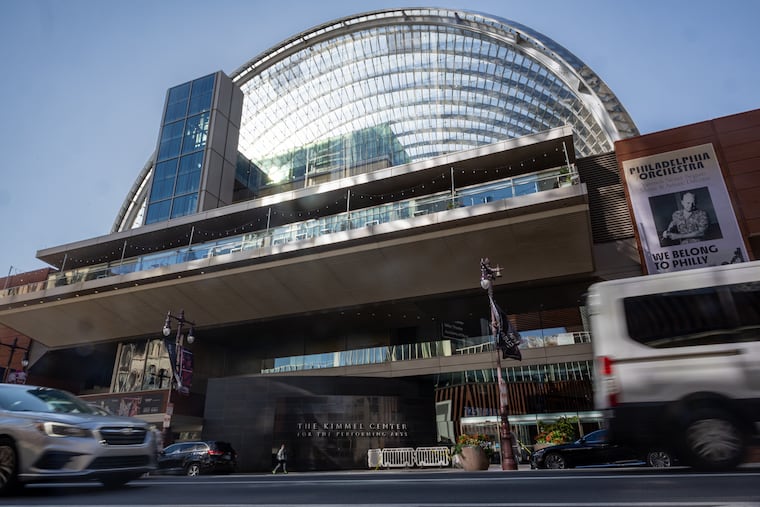
“Explosive” aptly describes Philadanco’s current program at the Perelman Theater.
To celebrate its 56th year, ’Danco is presenting four works by a quartet of award-winning choreographers — ranging from world premieres to a popular classic.
In many ways, the oldest item on the bill — Blue, created by Christopher L. Huggins in 2003 — is the boldest. Led by the always-impressive William E. Burden, this work showcases a group of nine male dancers, offering each a distinctive solo while also demonstrating their ability to perform complex unison sequences with precision.
Although Blue is nearly a quarter-century old (and with apologies to modern-dance pioneer Ted Shawn, who established his troupe of male dancers back in 1933), it is still unusual to see a choreographic work with no women.
Program notes indicate that Huggins’ theme here is “the journey to adulthood [for men],” so the movement and the costumes — also designed by Huggins — reflect complex, sometimes contradictory, stages in a man’s life.
The dancers first wear long, full-skirted, tunics with dark blue pants; next, they appear bare-chested, wearing the same pants with suspenders; finally, all nine men are clad solely in white briefs.
Performed to avant-garde music by Arvo Pärt, Ryuichi Sakamoto, and Steve Reich, the movement in Blue progresses from slow, sustained floor work and lifts to sensuous undulations of the back and hips, and dynamic references to boxing and other forms of self-defense.
Huggins also has a clever way of ending certain demanding solos by having the dancers stop abruptly, glance slyly at the audience, and casually walk into the wings.
One of the two world premieres on this program is Temple Without Prayers, choreographed by Roderick George, who is also credited with the costumes (long-sleeved black leotards, with black trousers for the men and bare legs for the women); it is performed to an original music compilation by Lotic.
Long-limbed Aliyah Clay is a powerful and dramatic dancer whose solo introduces the piece; there are also notable passages featuring other company members, including Addison Hill, currently in her first season with the company.
Unfortunately, the overall impact of the work is diminished — at least, for this viewer — by some too-literal touches, such as dancers crossing themselves or clasping their hands in prayer, and the frequently portentous music, plus Nick Kolin’s lighting design, which involves a great many lightning flashes and dramatic, diagonal shafts of light.
Nicole Clarke-Springer created the evening’s second world premiere: Passing Through Stillness, with music by John Adams and costume design by Anna-Alisa Belous.
The initial tone of this piece is lyrical, established by the diaphanous ice-blue dresses the women wear, with short skirts and irregular hems, detailed in silver and black (the men’s sleeveless tops and trousers use the same color scheme). The dancers show off their considerable balletic chops and, as the piece progresses, their ability to work cleanly at increasing speed.
The stage becomes progressively more crowded and rhythms more frenetic; at several points a small group of dancers crosses the stage diagonally, leaping through another group of performers doing different steps.
Clarke-Springer invents many challenging, exciting movements, which ’Danco members execute with skill and panache. These include an astonishing sequence in which several men lift their female partners — who remain standing — by holding the women’s flexed feet (how the latter manage to keep their balance is a mystery), and an exquisite, extended duet danced by Kaylah Arielle and Nathan E. McNatt Jr.
This composition is also a rare example of the effective use of stage smoke: the effective lighting design — again, by Kolin — allows dancers to exit mysteriously upstage, seeming to disappear in the theatrical fog.
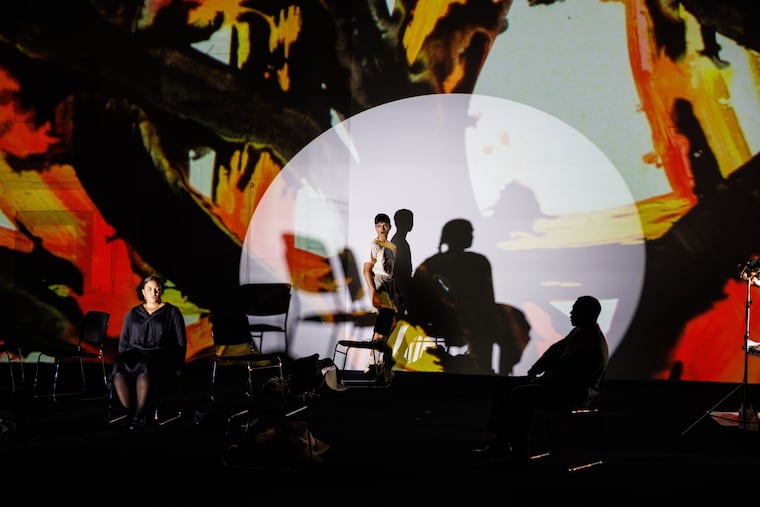
The program begins with a fascinating work choreographed by Thang Dao, to a compilation of music from eclectic sources (Ezio Bosso, Lee Sin, Shye Ben Tzur, and Johnny Greenwood). In Without Witness, Dao finds innovative ways to use a single line of dancers — arranged across the back of the stage, walking slowly toward the audience, sometimes in silhouette. He also exhibits an enviable ability to balance group work with solos and duets.
The 10 performers in this piece excel at improbable lifts, impossible balances, and unexpected entrances and exits. There are too many outstanding individual performances to cite here but Erin Banks, a diminutive woman so flexible that she seems to have no bones in her body, is exceptional.
PHILADANCO!: “EXPLOSIVE! — Bold New Works on the Rise,” through April 19. 2 p.m., Perelman Theater, 300 S. Broad St. Tickets $40-63. (215) 387-8200; ensembleartsphilly.org.