Philadelphia Ballet’s Beatrice Jona Affron is moving on to New York City Ballet
She didn't win her first audition in 1992, but Affron ended up staying 33 years. She has been the longest-serving artistic leader in the company's history.
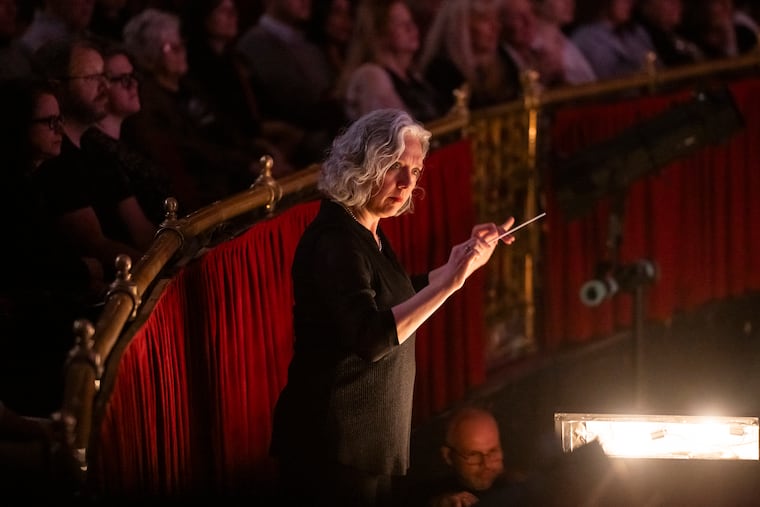
In the ballet world, artistic directors come and go and dancers are a perishable commodity. But at Philadelphia Ballet, there’s always been Beatrice Jona Affron, or so it has seemed.
Now the company’s music director is leaving. Affron is taking up the post of associate music director at New York City Ballet as of Aug. 1, both ballet companies announced Monday.
She is the longest-running artistic leader in the Philadelphia Ballet’s history, a spokesperson said, at 33 years. In that time, the company’s fortunes have swung wildly — from organizational turmoil, to the launch just last month of a sparkling new home on North Broad Street.
“It’s really remarkable she’s stayed with us this long,” said ballet CEO Shelly Power, who called the conductor “just a dream to work with.”
Affron has been a recognizable presence on the podium — leading the ballet orchestra in world premieres, classic storybook ballets, 20th-century scores, and likely hundreds of performances of The Nutcracker, and through her brilliant-white aureole of wavy locks.
She has also worked off the podium raising the visibility of music as integral to the art form, writing erudite, accessible program notes about the music and composers, and launching the careers of emerging conductors through an apprenticeship program established in 2021.
“She took an interest in the organization as a whole. She was not someone who came in, conducted [a program], and left,” said Power.
Affron, 58, said only a small handful of posts elsewhere would have tempted her to leave Philadelphia Ballet. But a combination of professional reasons and personal ones — her daughter and parents are in New York — prompted her to take the leap.
“They put on 60 different ballets per year, which is just extraordinary, and which is dreamy for a conductor,” said Affron. “I thought, wouldn’t this be a great challenge to be in this unique environment where there is so much turnover and so many ballets and so much coming at you? That doesn’t exist anywhere else.”
The audition process at New York City Ballet was rigorous, as it promises to be at Philadelphia Ballet for finding her successor. Affron tried out with the New York company in Justin Peck’s Everywhere We Go with music by singer-songwriter Sufjan Stevens, as well as Tchaikovsky’s score of The Sleeping Beauty in Peter Martins’ full-length production.
In February she conducted the premiere of the 500th original ballet created for NYCB — Alexei Ratmansky’s The Naked King with music by Jean Françaix.
The piece was “extremely challenging for the orchestra, and she handled it with aplomb and finesse and professionalism, and I was blown away,” said NYCB music director Andrew Litton.
The associate director “does most of the work” at the company, Litton said; duties include not just conducting performances, but also working with rehearsal pianists, hammering out the schedule grid with conductors, and seeking the music director’s approvals.
“Basically she will put everything together, and it’s a lot of work. And she comes to us with all this incredible experience,” Litton said.
Affron replaces Andrews Sill, who is retiring, NYCB said.
Philadelphia Ballet artistic director Angel Corella notes Affron’s special connection with the orchestra, dancers, and audience, and said she will be “very, very difficult to replace.”
“It’s important that we take our time and we choose the right person for the position,” said Corella.
The challenge is in the logistics of lining up guest appearances by candidates with the ballet’s performance schedule and a sufficient variety of repertoire. Affron will lead next season’s October run that includes Balanchine’s Stars and Stripes, and some performances of The Nutcracker, while the company brings in a slate of guest conductors from which the next music director might be chosen.
The search will be national and perhaps international, said Power.
“We will start to invite people to conduct and work with the orchestra. We don’t know how long it will take — six months, nine months, or a year and a half. It depends on who is available to come in,” she said.
The criteria won’t be strictly musical since ballet conducting is distinctly different from regular orchestral conducting. What makes sense musically doesn’t necessarily work well for the dancers.
Corella says he remembers one production of La Bayadère in New York where the conductor “completely destroyed the dancers.”
“When he should have gone fast, he went slow. When he should have gone slow, he went fast, he held for a long time when a dancer was up in the air. A lot of conductors don’t lift their eyes to see what’s going on stage, and to coordinate that is actually quite complicated. You have to learn the skill.”
Affron’s run at Philadelphia Ballet is all the more remarkable given the fact that she didn’t actually win the audition she took for the post of assistant conductor in 1992. She was one of three finalists, and the job went to someone with more experience.
“And I thought, ‘that was a fun adventure,’ and went on with my life. I had just graduated. Then a few months later I got a call saying, ‘Are you still interested?’ It didn’t work out with this other person.”
She became assistant conductor in 1993, then resident conductor, and, in 1997, music director.
Affron was green when she arrived. A Yale graduate, she was fresh out of graduate school at the New England Conservatory of Music. And in graduate school, “you’ve done very little conducting,” she said, since, unlike other musicians, you don’t always have your “instrument” — the orchestra — at your disposal.
“Everything I know I learned in that organization with that orchestra,” she said of Philadelphia Ballet, “and so my gratitude is enormous.”
When Affron was new, ballet leader Roy Kaiser “gave me the time to learn the job, which is so rare.” She learned from more seasoned guest conductors like Ballet West’s Terence Kern.
It was Kern who mentored her in Romeo and Juliet, whose most recent run at the Academy of Music Affron ended Sunday, and, it turns out, is the piece that concludes her final full season as music director. (She keeps the music director title through the end of her Nutcracker performances in December.)
“It’s very much handed down from one generation to the next,” said Affron of ballet conducting. “And all that happened for me in Philadelphia.”
That it started here tinges her departure with some sadness. “It has been nothing but a welcoming and positive experience,” she says.
“On the other hand, I think it’s somebody else’s turn to lead this fantastic orchestra and these fantastic dancers. I like the idea of literally passing the baton to another conductor.”