17 Duchamp pieces are gone from view at the PMA. Where did they go?
While “the strangest work of art in any museum” is still on view, other Duchamp pieces have made their way to New York City. But only for a while.
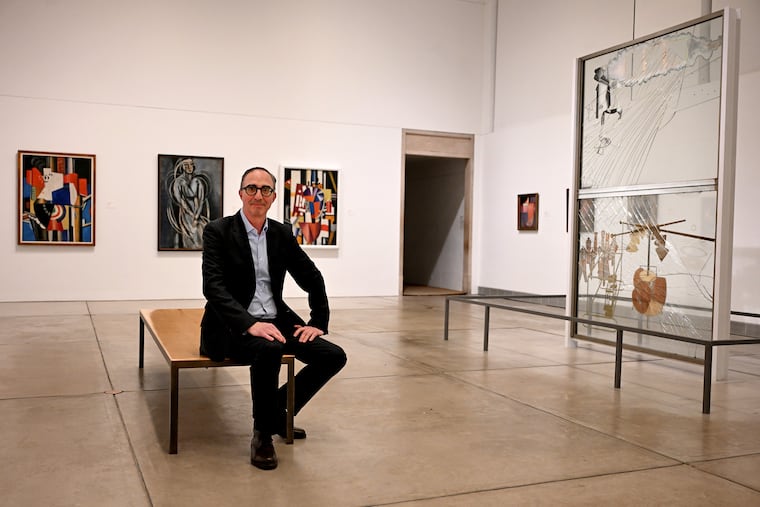
The Philadelphia Museum of Art’s major gallery devoted to Marcel Duchamp has always been a source of shock. Nestled at the end of the museum’s north wing, it’s a shrine for modern-art pilgrims seeking contact with a mysterious 20th century figure who helped to redefine what qualifies as art — which is to say, just about anything.
But visitors to the space today may be jolted by what it doesn’t contain.
Gone is Nude Descending a Staircase (No. 2), the 1912 modernist take on the human body in motion that made Duchamp’s reputation as the art world’s bad boy. Conspicuously absent is one of the gallery’s most notorious residents: Fountain, a seemingly ordinary white porcelain urinal whose entry into the visual lexicon has delighted or enraged art fans for decades.
Seventeen works by Duchamp are gone from this gallery alone — a total of 92 items from the PMA’s permanent collection — and their absence in recent weeks has perplexed visitors.
But the disruption in the way the main Duchamp gallery has appeared for decades is temporary. The vanished works are on loan to the Museum of Modern Art, where they will join the first North American Duchamp retrospective in more than 50 years. The MOMA show opens April 9, and in October, the Duchamp works return to Philadelphia, where the exhibition runs for more than three months.
A related Duchamp retrospective organized by the Centre Pompidou will be on view from March to July 2027 at the Paris museum.
Losing that many works to MOMA meant leaving a major hole at the PMA, which, as holder of the largest collection of Duchamp materials anywhere, draws Duchampians from far and wide. And so Matthew Affron, who stewards the Duchamp Collection at the PMA, decided to turn back the clock.
Now and for at least the next several months, the Duchamp gallery will evoke the way the artist and others installed it in 1954, with some of the very same works.
Instead of being a single-artist collection, the new hanging presents Duchamp’s work in conversation with those of his contemporaries — Picasso, Juan Gris, Piet Mondrian, Georges Braque, and others.
The installation spotlights Duchamp’s relationship with the PMA, which was like no other. The museum was a particularly fruitful meeting of artist, curator, and collector; and that relationship paid dividends. Many of the works in the current temporary show, “Marcel Duchamp, Curator,” were originally acquired by major collectors Louise and Walter Arensberg with help from Duchamp.
“Duchamp had a sideline as a kind of independent broker or dealer in works of art and helped the Arensbergs acquire many works not only by himself, but by many other artists who he admired,” said Affron, the museum’s curator of modern art, “so he had a hand in acquiring some of those works.”
The show “acknowledges his very important role in helping the Arensbergs, first of all, to put together their collection over 30 years and then helping to install the collection here once it came as a gift,” said Affron.
Some Duchamp works haven’t gone on the road, and could not have done so easily.
The Bride Stripped Bare by Her Bachelors, Even, also known as The Large Glass (finished in 1923), still towers over the room, firmly anchored into the floor. (The replica of the work realized by artist Richard Hamilton will be part of the MOMA show.)
And Duchamp’s most inscrutable work remains in its darkened lair.
After making his mark on the avant-garde, Duchamp turned his attention to chess and, as far as the world knew, spent the last 24 years of his life playing tournaments and engaging in chess theory. But after his death in 1968, it was revealed that Duchamp had been working in secret for two decades in his New York studio on his last major piece, which he intended for the Philadelphia Museum of Art.
A 25-year-old assistant curator from the PMA named Anne d’Harnoncourt arranged for the work’s acquisition and oversaw its installation, and the museum unveiled it in 1969.
The work — with the elaborate name of Étant donnés (Given: 1. The Waterfall, 2. The Illuminating Gas) — is more experienced than viewed. Visitors walk into a dark, empty space where they may notice a set of crude wood doors framed by a brick arch. It takes a closer look to realize that there are two peepholes in the doors.
Through the peepholes, beyond a break in a brick wall, is a sculptural tableaux: a nude woman lying in a verdant landscape, her legs spread, lifting a gas lamp in the air with one arm.
Arcadia or crime scene? Nothing explains it.
Artist Jasper Johns proclaimed it “the strangest work of art in any museum.”
The “sexual frankness” of the piece, Affron says, concerned the museum at first.
“When they were thinking about how to launch it with the public, they didn’t want a scandal and the [Duchamp] family also didn’t want a scandal,” he said. “And so what they decided to do was have a completely quiet opening. Now, it’s said that attendance doubled at the museum in the first week, so it clearly made an impact.”
At that same time, d’Harnoncourt redid The Large Glass gallery, turning it into a monographic Marcel Duchamp gallery, “and that’s how it’s been since then,” Affron said.
For all of the startling firepower of Étant donnés, some museum visitors walk past its niche without realizing it’s there.
D’Harnoncourt, of course, went on to become the museum’s director. After her death in 2008, the gallery was renamed — but what name? It’s either the Anne d’Harnoncourt Gallery or the Galerie Rrose Sélavy (“Rrose Sélavy” being Duchamp’s female alter ego), depending on where you are standing in relation to a lenticular gallery label flickering between one name or the other.
To this day Étant donnés and The Large Glass have remained, like two great suns exerting gravitational pull on smaller works around them.
The current, temporary setting — putting Duchamp alongside his contemporaries, plus additional works by other Duchamp siblings in an adjacent gallery — emphasizes both what Duchamp had in common with other artists of the day, and how radical a departure The Large Glass was from their work.
“Duchamp was aloof from that art world, but he was not completely separate from it,” said Affron. Within it, “he carved a very special place.”
There is innovation in the artists lining the walls of the d’Harnoncourt/Galerie Rrose Sélavy, in the works of Picasso, Léger, Mondrian, and others. But, says Affron: “They were still part of a continuum, and they were thinking about some of the same questions that their predecessors were thinking about in terms of how you compose an image and how you get creative about the means of representing things.”
The Large Glass, on the other hand, breaks two-dimensionality by using a transparent (glass) canvas. Duchamp deploys some conventional materials, but also startlingly nontraditional ones, like electricians’ tape, a motif from an optician’s chart, and dust.
“It doesn’t express his own hand. It doesn’t express his own feelings,” says Affron. “He took these hard materials which he associated with modern world machinery technology and he experimented, mixing them with paint to try to step away from that precedent into who knows what.”
“Marcel Duchamp, Curator” and “Duchamp Brothers and Sisters” — works of Jacques Villon, Raymond Duchamp-Villon and Suzanne Duchamp — and The Large Glass and Étant donnés are ongoing (Galleries 281, 282, and 283) at the Philadelphia Museum of Art, 2600 Benjamin Franklin Parkway. philamuseum.org, 215-763-8100.