An audience member cheered loudly during Tuesday night’s Lang Lang concert. Was it appropriate behavior?
"Definitely," our critic says. Expressions of enjoyment belong in classical music. Especially at concerts with the Philadelphia Orchestra
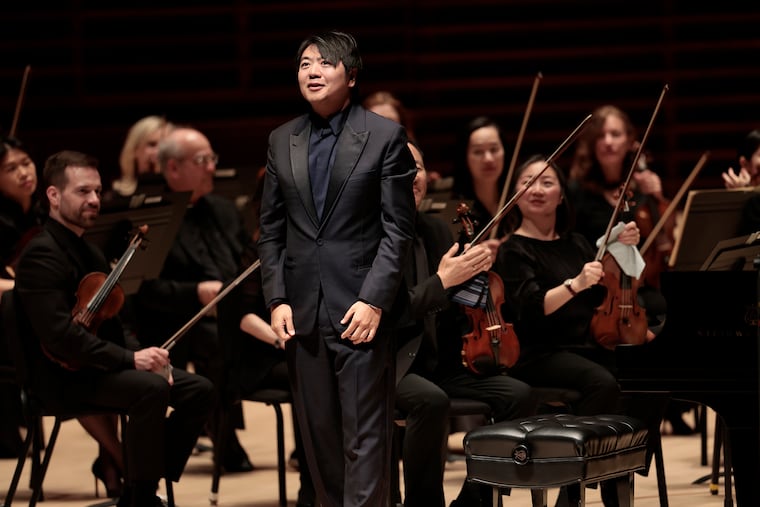
Should the Philadelphia Orchestra be greeted like rock stars more often?
The Brahms Symphony No. 2 that concluded Tuesday’s benefit concert for the musicians’ retirement fund was going especially well at Marian Anderson Hall when, between movements, a delighted listener shouted “Yeah!”
“Yes,” replied music and artistic director Yannick Nézet-Séguin, perhaps surprised but unruffled, and then taking the opportunity — charmingly, unlike, say, Riccardo Muti — to explain that Brahms conceived multi-movement works as a single whole.
He continued with one of the more exciting, well-played Brahms performances that I’ve heard from this team.
Such programs tend to be low on risk and high on glitz, and the one-off pension benefit concert felt celebratory from the beginning. The house was full. Lang Lang had played the Beethoven Piano Concerto No. 4 and was extravagantly received. So the audience was revved up to begin with.
But was the passionate outburst appropriate?
Artistically speaking, definitely.
Any spontaneous reaction to a fine Brahms symphony performance is likely to happen as evidence of great enjoyment. The performance was that good — not the smooth-as-silk approach of many conductors but one in which every phrase had its own identity that clearly grew out of what came before.
There was a Bach-like sense of inevitability that somehow circumvented predictability.
But we live in dangerous times. Audiences are unusually vulnerable when in an enclosed theater.
The Metropolitan Opera on Monday opened Innocence about a school shooting and some listeners identified so closely that they left in tears. Most concert halls have witnessed the occasional heart attack. In Philadelphia, political protests have interrupted performances.
Why limit expressions of enjoyment to summer concerts?
Lang Lang often receives a “native son” welcome, having studied at the Curtis Institute and lived in a cramped Spruce Street apartment with his parents and a very grand piano.
Among his many concert appearances here, he has often confirmed his status as an artist of integrity. He has also overshadowed that with showmanship, playing in extremes (fast, slow, loud, soft). In Beethoven’s most reflective concerto, both his sides were apparent.
Where the concerto speaks with low-key directness, Lang Lang made the music shout in bright neon colors. Melodies tended to swoon and rhythms attacked.
Often, one heard considerable imagination behind this rethinking of the music. The second-movement lament — often said to be Orpheus pleading for the life of Eurydice — was more like a requiem for the world.
But his exaggerations have a way of dulling the senses. Maybe he could go to Overinterpreters Anonymous?