The Philadelphia Orchestra is returning to China, even as U.S.-China relations are strained
Visits like this are “even more important in unsettled periods like we’re in right now,” says the orchestra’s leader.
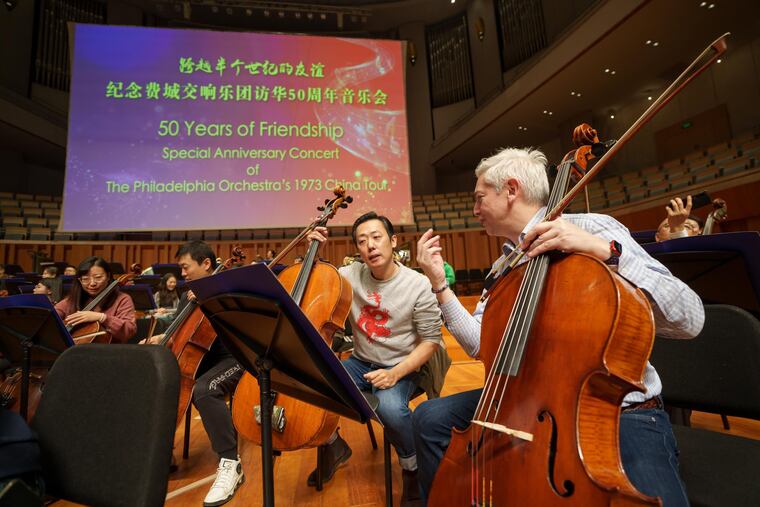
While U.S.-China relations may be in a state of flux and conflict over trade and other matters, the Philadelphia Orchestra is moving full steam ahead on a program of cultural diplomacy in China that began more than a half-century ago.
The orchestra on Friday announced that it is sending a group of 10 musicians to China in October for concerts and other activities, including a performance at the U.S. embassy in Beijing.
In addition, plans are underway for the entire orchestra to return to China in the fall of 2026 as part of a larger tour of Asia, and for Chinese musicians to visit Philadelphia this winter.
“We have a very long history of connecting with the people of China,” said Philadelphia Orchestra and Ensemble Arts president and CEO Ryan Fleur. “It remains important for us to keep that connection, and it’s even more important in unsettled periods like we’re in right now to be able to have something that’s known, something that’s straightforward. It’s calm.”
Over nine days starting Oct. 10, the group of five violinists, three violists, and two cellists will visit Beijing, Shanghai, Hangzhou, and, for the first time, Qingdao, the city of 7 million on the Yellow Sea Coast.
That tour stop grew out of an encounter at this year’s Philadelphia Flower Show.
The Chinese city mounted an exhibit — “Qingdao, a City Full of Charm and Vitality” — at the flower show, and after Fleur filled in representatives from Qingdao about the orchestra’s history in China, they extended an invitation to visit. Qingdao is also known for being the home of Tsingtao Brewery, maker of the popular pale lager.
The Philadelphia musicians will perform in a side-by-side concert with musicians of the Qingdao Symphony Orchestra at the Qingdao Grand Theatre in Beethoven’s Symphony No. 6 — one of the works performed by the Philadelphians during their first visit to China in 1973.
It was during the Nixon administration and China’s opening up to the West that the Philadelphia Orchestra made history as the first American orchestra to visit China. The tour, led by conductor Eugene Ormandy, brought with it considerable ceremony, including a concert attended by a group of high-level dignitaries led by Madame Mao, who had requested Beethoven’s “Pastoral” symphony. She sent orchestra members home with cassia seeds collected from her garden.
For the upcoming October visit, the orchestra is hoping to establish a relationship with David Perdue, who was sworn in as the U.S. ambassador to China in May and who “we’ve heard is very supportive of cultural exchanges,” said Fleur. “We look forward to working with the team over there. That connection is very important. Regardless of the administration, the last few ambassadors have been very supportive.”
Heads of state, too.
“Half a century ago, the orchestra’s historic China tour marked a thaw in China-U. S. cultural exchange, which was a very important part in the normalization of the two countries’ diplomatic relations,” wrote Xi Jinping, president of the People’s Republic of China, to Matías Tarnopolsky, POEA’s president and CEO at the time, in 2023.
Since its first visit in 1973, the orchestra has been an “active cultural envoy, playing an instrumental role in strengthening China-U.S. ties,” Xi said.
The Philadelphia Orchestra’s most recent full-ensemble China visit was in 2024.
Some details of the October mission by 10 musicians are still coming together, but in addition to performances, work with music students and other activities are expected. In Philadelphia this January, Philadelphia Orchestra assistant conductor Naomi Woo will lead the ensemble and Chinese soloists in a Lunar New Year concert in Marian Anderson Hall, and musicians from the Central Conservatory of Music in Beijing will perform the next day in the Perelman Theater.
There is no official aspect to the orchestra’s upcoming visit to China, “though it is endorsed by the U.S. government, meaning that they support it,” said Fleur.
“We are not political when we’re traveling; we let music do all of the speaking. But we see it again and again — it brings entities together that wouldn’t ordinarily be speaking with each other, and that in the long run is only good, especially in the world we’re living in today.”