Philadelphia Orchestra builds up all the color and majesty one could hope for in Handel’s ‘Messiah’
With the Philadelphia Symphonic Choir, the highly compelling performance is likely to be even stronger on subsequent performances on Saturday and Sunday.
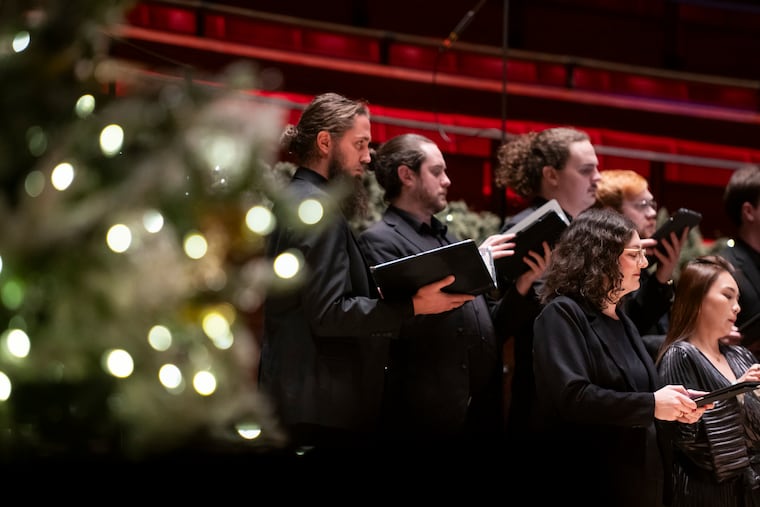
Making Handel’s Messiah a major occasion — rather than a mere Christmas revisitation — is close to impossible, though not at the Philadelphia Orchestra’s Friday opening of a three-performance Kimmel Center run.
For years, the orchestra imported one guest conductor after another.
Now, Messiah is led by artistic director Yannick Nézet-Séguin, who began as a choral conductor in Montreal and happens to have the inside track on excellent solo singers, thanks to that little old opera company where he also works 80 miles up the road.
It was a highly compelling performance that’s likely to gain more strength on Saturday and Sunday.
Handel’s epic mosaic of 52 arias, recitatives, choruses, and instrumental interludes has changed enormously over the years; shape-shifting from Victorian grandeur to lean, faster performances more in keeping with the 18th century in which this masterpiece was born.
With the 40-voice Philadelphia Symphonic Choir rather than the cast-of-hundreds Mormon Tabernacle Choir (which recorded the piece with the Philadelphia Orchestra in 1958), Messiah is now relieved of extraneous sound, and reveals more of its once well-hidden essence.
Nonetheless, well-matched soloists — vocally and stylistically — are too much to hope for in this busy season, though enjoying their differences among them was definitely possible.
Tone, agility, diction, and meaningful vocal ornaments were all of a piece with the much-honored British soprano Lucy Crowe, the most seasoned Handelian among them, which was also evident in the way she made upward vocal leaps (normally just a technical feat) charged with emotion.
The least likely Messiah soloist was also one of the biggest names, baritone Quinn Kelsey, whose every Verdi and Puccini role at the Metropolitan Opera is full of new dimensions. Yet Handel’s vastly different skill requirements were also reasonably well in hand. His distinctive theatrical alchemy came alive in recitatives, and ultimately, in his final aria “The Trumpet Shall Sound” (the trumpet itself being capably played by Travis Peterson). Intricate vocal writing once prompted slowed-down tempos to ease vocal discomfort — which is now heard as a sign of defeat.
Instead, Kelsey lightened his voice and maintained both the tempo and the integrity of the music.
Similar moments were heard from the popular Polish countertenor Jakub Józef Orliński, who has plenty of Messiah mileage though his voice is evolving toward a deeper, richer sound ― heard especially in “He Was Despised” ― suggesting his future lies in less athletic repertoire. He also has a way of swaying to the music. Whether it’s calculated stagecraft or the inspiration of the moment, his already-strong stage presence doesn’t need it.
Tenor Frédéric Antoun seemed a bit Messiah-weary (it’s a busy season) suggesting that his pitch will be steadier and vocal ornaments more spontaneous in future, more rested performances.
Choral sections — the most beloved parts of Messiah — are often sung for their considerable effect but were treated to detailed coloring of the words, underscored by sympathetic treatment of the accompanying instrumental writing. This element, not often heard in quickly assembled Messiahs, played a major part in giving this performance an air of occasion.
As is sometimes the case in Nézet-Séguin choral outings, his use of light, shade, quietude and force can be puzzling. At such points, the myriad inflections can seem fussy, or more about creating an overall musical contour than making a rhetorical statement.
At times, it all becomes clear in the long term.
Example: The “Hallelujah” chorus was more meaningful than bombastic, perhaps to keep the following music from seeming anticlimactic. Then, the final “Amen” chorus at the end of the piece felt suitably conclusive with all of the color and majesty one could hope for.
The fact that the Philadelphia Symphonic Choir (Joe Miller, director) was able to execute many minute details — plus projecting superb vocal blends that concluded several choruses — shows how the group has emerged into a first-class ensemble.
Word to the wise: Even longtime Kimmel Center goers are advised to leave extra time to navigate Philadelphia’s holiday traffic and sometimes-delayed public transportation. I emerged from the City Hall subway stop in such a state of lateness that I attempted to hijack an Uber discharging passengers at the Ritz-Carlton. It didn’t work.
Other latecomers and I got to Marian Anderson Hall on foot just as concertmaster David Kim arrived onstage. Whew.
Subsequent performances of Handel’s “Messiah” are Dec. 13, 8 p.m., and Dec. 14, 2 p.m., Marian Anderson Hall, 300 S. Broad St., Philadelphia. Tickets: $29-240. philorch.ensembleartsphilly.org