Philadelphia Orchestra opens its 126th season with glitz, rhythm, and defiance to Trump
Yuja Wang, Yannick Nézet-Séguin, and the orchestra came together to make music and laud Philadelphia's resistance to homophobia and xenophobia.
The Philadelphia Orchestra should turn 125 more often.
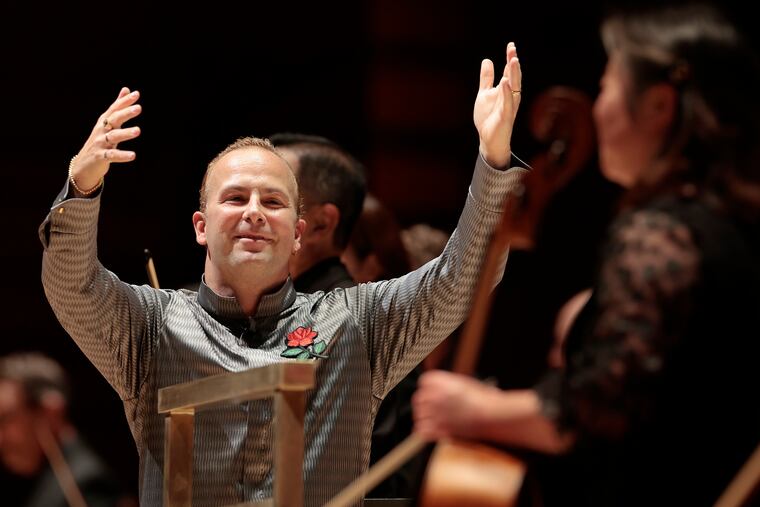
That anniversary was commemorated in the opening-night celebration reception and gala dinner on Thursday at the Kimmel Center. And it became quite an adorability-fest for the well-heeled, near-capacity audience at Marian Anderson Hall.
But not without a risk or two — politically and musically.
Light programs are typical for a heavily-sponsored event — the reception, concert and dinner packages were as high as $50,000 — and only one of three composer names (Ravel) had strong familiarity.
Amid the usual thanks and congratulations, the pre-performance speech by music/artistic director Yannick Nézet-Séguin didn’t ignore the major shifts in Washington. He pointed out that Philadelphia continues to be a comfortable place for gays and Canadians (himself and husband Pierre Tourville, to name two), prompting the loudest and longest ovation of the evening.
Later, when introducing the program’s first composer, Nézet-Séguin identified Arturo Márquez as having lived near “the Gulf of Mexico,” not conceding to Pres. Trump’s wishes to rename that body of water.
Unity — a quality not-so common now — was clearly established at Marian Anderson Hall, along with a sense of home. With much upheaval elsewhere, Philadelphia, it seems, remains Itself.
Of course, galas also require glitz.
Star pianist Yuja Wang walked onstage in a gown that, from a distance, appeared to consist of many tiny mirrors. Musically, though, Wang did no deflecting. She has long put a distinctively introspective imprint on Ravel’s Piano Concerto in G.
The piece is so tightly written that just playing the notes can be good enough. But much thinking and dreaming goes on in this concerto — the exact nature of which has long been a mystery. As singular as his language was, Ravel’s personal life was long considered to be unknown. The piano’s opening solo interludes are as introspective as the composer could be — a quality that Wang’s performances have often accentuated. The new wrinkle is how softly she let the profound serenity of the middle movement unfold, as if the music was telling secrets.
Her encore was Kapustin’s dense, dizzying Toccatina.
Having grown up in the Philadelphia area, composer Julia Wolfe has been a periodic visitor, stretching mainstream audiences with her gleefully adventurous, minimalist-based music.
Her 2023 orchestral work Pretty — a Philadelphia Orchestra co-commission that was reprised on Thursday — is one of her atom-splitting pieces, in which tiny musical particles explode with more rhythmic energy than one ever imagined.
What does it have to do with prettiness? My ears draw a blank, but who has time to think about that?
Heard just as a piece of music, Pretty is a 25-minute unbroken span, an ultra-propulsive flying wedge that’s penetrating and commanding with simple motives sandwiched into a complicated boiling mass.
Even with feet firmly planted in minimalism, Pretty almost feels epic: Just when you think it can’t go any further, it does, and kicks into a higher gear. And it gets better with repeated exposure. The Philadelphia Orchestra sound gives the piece stature, though in future outings, I hope Nézet-Séguin will give a more nuanced sense of how the music adds, subtracts, and then adds one orchestral choir after another.
Márquez’s Danzón No. 2, which dates to 1994, is a thoroughly engaging orchestral showpiece with plenty of substance, as it progresses from one rhythmically-inviting episode to another.
Nézet-Séguin has always exhibited a special skill at grasping the manner of music from many nationalities — and did so here. You’d never guess that he has had an unusually heavy week at the Metropolitan Opera, having conducted the world premiere of The Amazing Adventures of Kavalier & Clay on Sunday, and then starting a run of Don Giovanni performances on Wednesday.
Although the orchestra is celebrating its 125th anniversary, this is the opening of its 126th season. And if one is taking stock on the occasion of the orchestra’s 125th anniversary, current circumstances look blessed and stable in comparison to the centennial a quarter-century ago.
Among audiences, any music written after 1950 was usually bad box office. In 2000, leadership was in question with the impending retirement of Wolfgang Sawallisch, who was suffering from then-undisclosed illnesses. The charismatic Simon Rattle had backed away from extravagant pleas to come here permanently. With the opening of the Kimmel Center, acoustics were questionable, and nobody was sure why. Though the orchestra itself had many attributes, rhythm was not among them.
But now, with Danzón No. 2, it was clear the Philadelphia Orchestra’s “got rhythm.”