Medicine bottles, capsules, razors, and combs come together to honor Philly’s pharmaceutical history
A renovated museum at the Philadelphia College of Pharmacy is now open
Philadelphia is a true city of firsts, and the field of pharmacy is no exception.
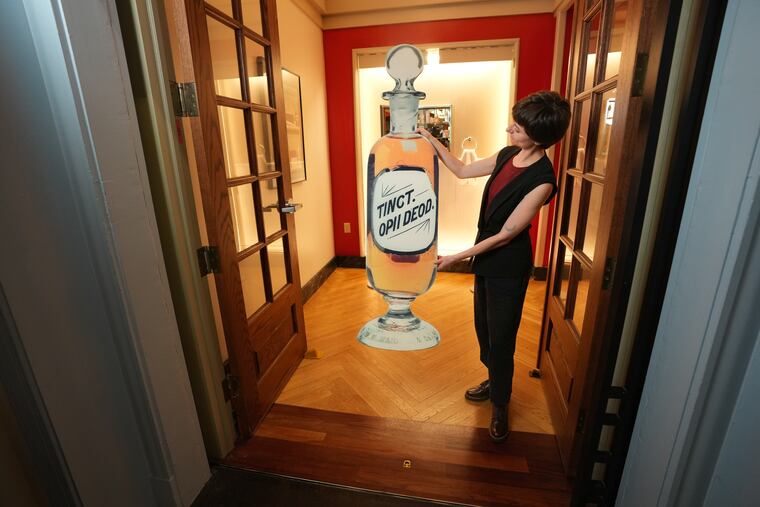
The Philadelphia College of Pharmacy was the first pharmacy college in North America. And for 30 years, the historic Greco-Roman-style building in West Philadelphia has been home to the Marvin Samson Museum for the History of Pharmacy, named after the president of Samson Medical Technologies in Cherry Hill.
After suffering water damage due to flooding from its mechanical room, the museum underwent months of renovation. The space is reopening on Friday with a patched-up ceiling, new lighting, fresh paint, and the location’s first-ever art exhibition.
Back in 1995, coinciding with the 175th anniversary of the school’s founding, Samson transformed an old college bookstore into a library of historical finds, which eventually took shape as the museum.
Among the museum’s first items were old prescription bottles, European-made medicine containers, early medical technology, and other artifacts collected by Samson through the decades.
“If a drugstore was going out of business and I saw a sign, I would say, ‘Hey, can I clean out your basement?’” he said.
“I wanted to talk about how important Philadelphia and this region are in the pharmaceutical industry. We had companies like [McNeil Pharmaceutical], which is part of Johnson & Johnson. We had Wyeth Pharmaceuticals, we had Merck, we had SmithKline, and a number of major pharma companies in this area.”
After seeing a painting from artist Lee Dubin, Samson decided to fashion the 1,000-square-foot space in the style of an early 20th-century apothecary, complete with a metal ceiling, oak floors, shelves, and compartments.
It was exclusively used to highlight local pharmaceutical companies, botanicals, and medical illustrations. After the museum was closed to the public for months, the the museum’s programming is being given a face-lift by collections manager and assistant curator Emma Gunuey-Marrs.
Its first art exhibition, “Indications,” debuts Friday.
With artist-in-residence Teresa Cervantes at the helm, the exhibit “playfully draws on traditions of apothecary craft, pharmaceutical marketing, and visual art,” its description reads. It will feature 17th-century European armorial pharmacy bottles, warped medicine capsules, and reproductions of Mesoamerican figurines that were used in medicine ads. \
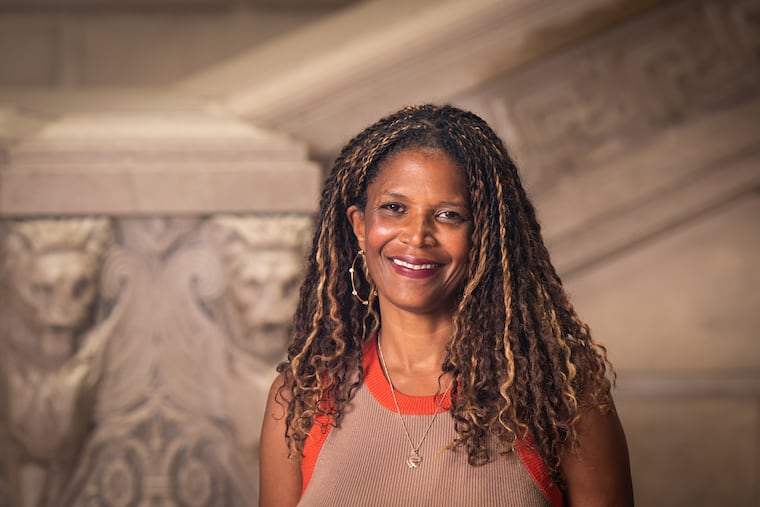
Cervantes, a Temple graduate currently based in North Carolina, first visited the museum with Gunuey-Marrs in 2023.
When the idea of an art exhibition floated around, Gunuey-Marrs invited her back to campus for research and object-based work. “I saw a lot of overlaps between her work and everything we wanted to do at [the museum],” Gunuey-Marrs said.
“I’m thrilled to cross paths with pharmacists and scientists,” said Cervantes. “I think our fields have a lot to offer each other, and I’m excited for the kind of conversations that will be brought up through this exhibition.”
Among Cervantes’ original works are seven drawings of medicine cabinets, which were drawn from images taken at Saint Joseph’s University (the Pharmacy College merged with the university in 2022). SJU students and faculty allowed Cervantes to take images of their medicine cabinets, their combs, razors, moisturizers, Q-tip containers, and medication bottles.
The photo sessions often got “awkward,” Cervantes said. She then printed the images on matte photo paper and rubbed chalk pastel over them for a distorted and “playful” realism look. “Almost like drawing in a coloring book,” she said.
The exhibit also includes a collection of pharmaceutical company pens, hair brushes, and objects related to healthcare and well-being. She even lent her contact lenses for display.
Cervantes said the museum’s new direction is made possible lagrely because of Gunuey-Marrs’ creativity and motivation to amplify the museum’s history.
“I think [Gunuey-Marrs] has done so much with her role,” Cervantes said. “She’s got a desire to activate the space and make it useful for students, but also for Philadelphians with this relaunch and transition.”
Samson is confident more visitors will be encouraged to delve deeper into Philly’s pharmaceutical roots.
“It’s great because it will create more interest,” Samson said. “I’m sure we’ll go back to doing pharmacy just because of where it’s at, but this is a good change. Some things do better than others. That’s why museums change their exhibits. I think it will create new interest to new people. There’s no negative side to it.”
“Indications” is on display through Nov. 29 at Griffith Hall Gallery, Saint Joseph’s University, 5600 City Ave., Philadelphia, Pa. www.sju.edu