Beatrice Rana, ‘among the finest pianists out there,’ in Philadelphia recital debut
It’s said that Debussy paved the way toward the more modernistic Olivier Messiaen. In Rana’s hands, Debussy went beyond that.
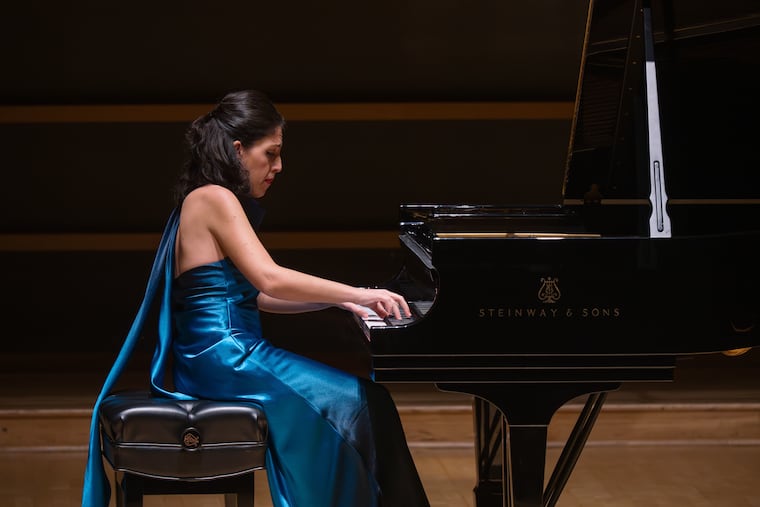
Pianist Beatrice Rana brings special energy to everything she touches, but at her Philadelphia Chamber Music Society recital Monday, she was best with music that’s unexplainable.
In contrast to the graphic storytelling in ballet excerpts from Prokofiev’s Romeo and Juliet and Tchaikovsky’s The Nutcracker (transcribed for piano), she also played less-heard pieces showing Debussy at enigmatic levels of abstraction in his late-period Etudes (Book II) and Prokofiev in his slash-and-burn (but politically hazy) Piano Sonata No. 6, Op. 82.
The 32-year-old Rana has built up much goodwill from her Philadelphia Orchestra appearances, but it’s still remarkable that the full Perelman Theater audience (in her PCMS debut) seemed as absorbed as could be when the always-strange Debussy etudes grew ever stranger.
Rana didn’t solve the music’s mysteries but intensified them. This isn’t nature-painting Debussy with poetic subtitles that set the scene for what follows. Here, subtitles are about pianistic technical problems. Some interpreters try to mold the etudes into an integrated musical statement. Rana’s colorist sense brought Debussy’s shapes and forms into extremely sharp focus.
Though chord patterns and dramatic gestures are identifiably from the composer’s other pieces, Rana wasn’t afraid to reveal the music almost as a series of non sequiturs, leaping out in many directions — in ways that were free of any precedent.
It’s said that Debussy paved the way toward the more modernistic Olivier Messiaen. In Rana’s hands, Debussy went beyond that. One was bathed in bafflement. Understanding the music was clearly overrated. Composer Jean Barraqué called the Book II etudes an “auditory anthology.” Sounds good but implies strict organization. To these ears, the etudes feel improvisatory, but too brilliantly inventive to be created spontaneously.
Prokofiev could be effortlessly melodic but opted in his Sonata No. 6 (1940) for rough-hewn thematic buttresses, such as the downward-pointing three-note exclamation that accommodated all manner of harmonic explorations. The sonata became its own kind of auditory anthology. Familiar Prokofiev earmarks echo here and there — the Love for Three Oranges march and harmonies suggesting what was then called Orientalism — but were employed as part of the composer’s complicated interior reaction to wartime Russia.
No wonder the piece lacks a firm harmonic bedrock and that the final movement is truly music in collision with itself — treated to Rana’s gleaming, diamond-hard bass notes and treble so delicate you can’t believe it maintains such carrying power.
The encore — Scriabin’s Etude in C-Sharp Minor — and the aforementioned ballet excerpts were suitably characterful, though the “Dance of the Sugar Plum Fairy” from The Nutcracker warrants a word: How often does one stop to imagine how such an odd being would look and dance? Rana gave the fairy an edge that suggested something more demonic than cute — maybe closer to the original E.T.A. Hoffmann tale on which it’s based.
Fine. Rana can probably convince me of anything. Is there any doubt that she is among the finest pianists out there?
Next concert in the PCMS piano series: Emanuel Ax, Jan. 6 at 7:30 p.m. in the Perelman Theater, Broad and Spruce Sts. The concert is sold out, but contact the box office to join the wait list. pcmsconcerts.org, 215-569-8080.