Piffaro presents ‘exuberant’ Christmas music but with hurdy gurdy, theorbo, bagpipes, and more
With the Tenet Vocal Artists, “Ein Kind Geborn” presents exuberance without brass, flash or modern Santa Claus mythologies, and from an era when the loudest man-made sound was church bells.
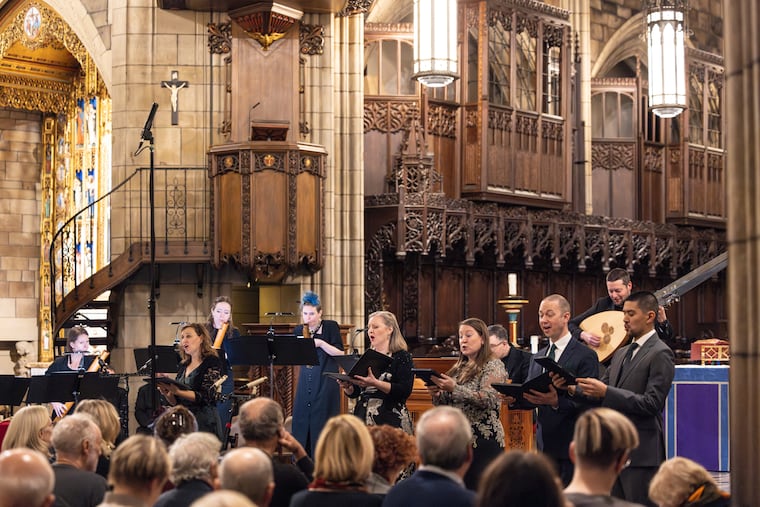
NEW YORK — Christmas concerts are God’s gift to early music groups such as Piffaro (Philadelphia’s Renaissance wind band). Audience love taking refuge in holiday exuberance from what we imagine as a better, centuries-ago past.
The Thursday concert of 17th-century German music titled “Ein Kind Geborn” (A Child is Born) ― the first in a string of performances that includes Philadelphia and Wilmington ― had Piffaro fruitfully collaborating with New York’s Tenet Vocal Artists, whose finely-etched sound and deep musical comprehension make their concerts drop-everything-and-go occasions.
The partnership with Piffaro’s recorders, theorbo, and bagpipes (gentle ones) was a sound feast ― of and for a particular sort.
The question is: Are audiences ready for the kind of uncommercialized, predominantly devotional Christmas concert that many say they long for? It was exuberance without brass, flash, or modern Santa Claus mythologies, and from an era when the loudest human-made sound was church bells. One’s ears must adjust.
The brainy crowd Thursday at Church of St. Vincent Ferrer definitely took to it, with side conversations like “I wanted to hear more dulcians” (an arcane woodwind) or asking why 17th-century German texts “are so stingy with their vowels.” (Who knows.)
Composers included Michael Praetorius (1571-1621), and his durable “In dulci jubilo,” plus lesser-known contemporaries (Johann Walter, Melchior Schärer, etc.)
Devised by Piffaro artistic director Priscilla Herreid, the 75-minute intermissionless program had 18 shortish vocal/instrumental pieces, both in German and in Latin, arranged under subheadings such as “From Silence to Singing” and “Sweet Jubilation.”
Some selections were hymns, such as the famous “Von Himmel hoch” (the audience was invited to sing along); others, in a more sophisticated form known as “sacred concertos.” Composer Praetorius encouraged diverse adaptations of his music, and in that spirit, no two pieces had the same manner of expression.
Some had the five-member Tenet Vocal Artists unaccompanied (they can do that and stay perfectly in tune) or the nine-member Piffaro players (who alternate between a dozen different instruments, including dulcians) in purely instrumental works. Multi-stanza pieces were built and sustained beautifully, progressing from different pairings of voices and varied interactions with the instruments — though within a richly textured 17th-century sound envelop.
Always a highlight in Tenet concerts are sopranos Jolle Greenleaf (Tenet artistic director) and Clara Rottsolk, whose rather different voices create a compelling blend, whether positioned for antiphonal effects across church spaces, leapfrogging in counterpoint, or coming together in ways that create a shifting highlight of composite sound.
When not blending, the other Tenet voices invite one’s ears in low-key ways. This is a long way from Metropolitan Opera singing and is a relief as well as a pleasure.
In other respects, the performances were excellent though the fusion of elements is likely to be better in Philadelphia-area concerts.
There were moments when a particular member of the ensemble would poke out of the texture to lead others to the right musical destination — sometimes necessary in conductorless ensembles.
In general, Piffaro continues to evolve nicely under Herreid’s leadership. Renaissance repertoire is far less standardized than music of later centuries, and the wide possibilities constantly reveal new sounds, both ethereal and with underlying grit — thanks to Piffaro’s inclusion of folky instruments such as hurdy gurdy, the guitarlike cittern and, of course, bagpipes.
“Ein Kind Geborn,” Dec. 5, 7:30 p.m., Church of the Holy Trinity, Rittenhouse Square; Dec. 6, 7.30 p.m., St. Martin-in-the-Fields, Chestnut Hill; Dec. 7, 3 p.m., Westminster Presbyterian Church, Wilmington. $25-$49.
The program will stream online Jan. 15-18 at piffaro.org or tenet.nyc. $18.