Media-based painter Rinal Parikh is redefining Indian folk art with contemporary themes and local imagery
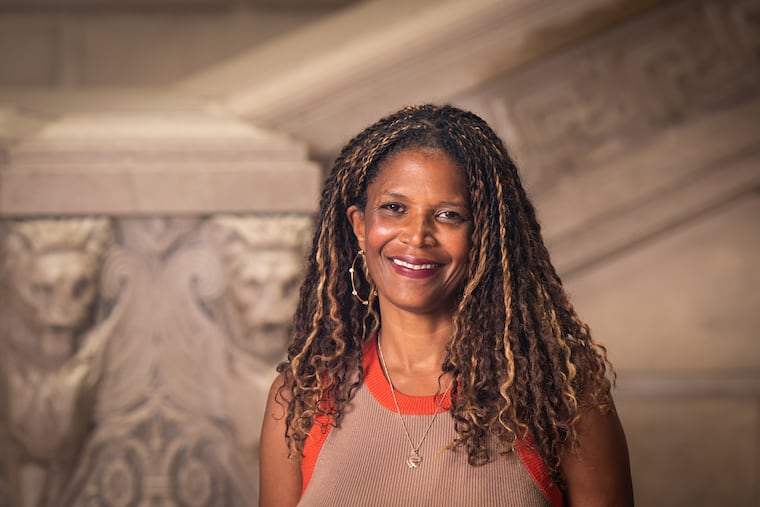
From Parikh's small home studio in Delaware County, she fuses past and present through her paintings, which are rich in texture, color, and meaning.
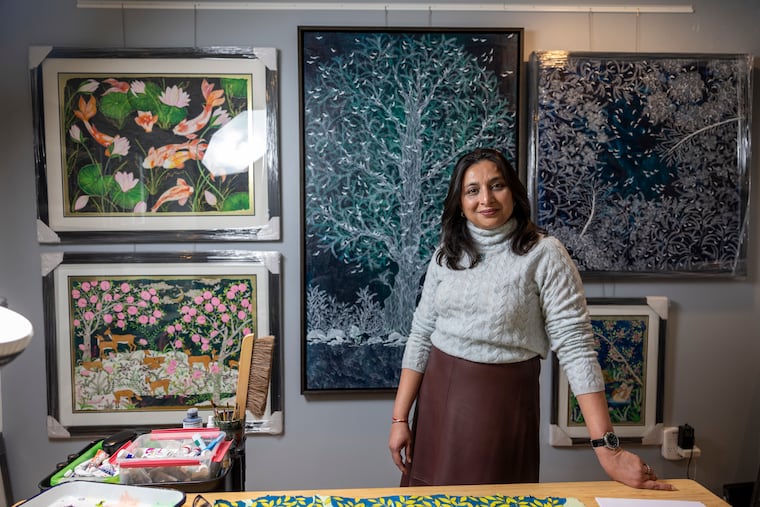
As a blanket of snow and sleet melted into the grass and an early winter fog hung over the Delaware Valley last month, Rinal Parikh’s art studio was a tranquil portal to the outside world.
In her studio, lofty windows look out onto a sprawling backyard. The walls are adorned with Parikh’s paintings, both completed and in progress, and its shelves are stacked with art supplies and mementos.
“What inspires me is my surroundings, and I’m blessed with an amazing backyard,” Parikh said, looking out the window. “That is my main inspiration.”
Parikh is a Media-based painter and biochemist by trade whose art blends traditional Indian folk styles with contemporary themes. Her art, rich in texture, color, and meaning, uses a collection of materials, from sand and fabric to glass, beads, and stucco. She paints with acrylic and watercolors, and creates detailed drawings with thin brushes. Her work fuse her upbringing in India with her current life in Media, an amalgamation of past and present, of here and there.
Parikh, 43, took a circuitous route to becoming an artist. She moved to Philly in 2005 from Gujarat, India, to follow her husband, Bhavin, who had immigrated a few years earlier (the day of our interview was the 20th anniversary, to the date, of her arrival in the U.S.). She enrolled in a masters in molecular biology program at Drexel University, a step toward her Ph.D., and got a job in a lab at Penn Presbyterian Medical Center.
A few years after her move, Parikh’s first son was born with health complications. With no family close by, Parikh quit her job to focus on taking care of her son. He’s now a healthy teenager, she notes.
Seeing that Parikh was missing out on work, her husband made a suggestion: Why not paint something for their new house? That first painting, “Krishna-leela,” now hangs in the Parikhs’ living room, an eye-catching depiction of the Hindu deity Krishna.
When her son was 9 months old, Parikh stopped by an art fair at the Creative Living Room, a community arts center in Swarthmore. She struck up a conversation with some of the women there. A few days later, they called with a question: Would she like to do a solo show?
“I didn’t even know what that means,” she said.
Nonetheless, she agreed. She worked tirelessly for three months to make 20 pieces. She didn’t know where to buy art supplies, so she imported them from India (someone would later point her toward the now-closed Pearl Art & Craft Supplies on South Street). In fall 2009, she displayed her paintings for the first time as a professional artist — and sold her first painting, too. The rest, she said, is history.
Parikh melds together three types of Indian folk art — Warli, Madhubani, and Kalamkari. Warli is a tribal art that depicts day-to-day life in a mural-like format. Madhubani uses geometric patterns and typically reflects celebrations of life. Kalamkari, Parikh said, is “very refined,” a style of art that uses a fine brush to create delicate and detailed line drawings. All three art forms have traditionally been practiced by women.
Parikh feels like she speaks “a global language.”
Though her paintings take inspiration from the traditional Indian folk style, the scenes depicted are not just of India. They’re often of the Philly area, and of the flora and fauna in her backyard.
“I still practice Indian folk art, but the subject matters are very ‘now,’” Parikh said. “The language is still very traditional, but the conceptualization, the visualization, is much more contemporary.”
In her family room hangs “Home,” a 2021 Warli painting of a tree. The background is complex in both texture and color, with blues, browns, and purples peeking out. Hanging from the tree are monkeys, which Parikh said captures the energy of having two boys, now 17 and 12, in the house. (They’re very good kids, she clarifies.)
“I observe my surroundings, I experiment with styles, I do a lot of repetitive patterns, and I tell my story,” she said.
Since jumpstarting her art career, Parikh has become involved in the region’s growing art community. She’s the marketing chair for the Rittenhouse Square Fine Arts Show and is involved with the Community Arts Center of Wallingford.
She said she understands the anxieties of young artists and wants to support the organizations that nurture their careers.
“I was supported by the community, and I want to do the same thing.”
Parikh’s art can be found on her website and her Instagram page.
This suburban content is produced with support from the Leslie Miller and Richard Worley Foundation and The Lenfest Institute for Journalism. Editorial content is created independently of the project donors. Gifts to support The Inquirer’s high-impact journalism can be made at inquirer.com/donate. A list of Lenfest Institute donors can be found at lenfestinstitute.org/supporters.

Inquirer Greater Media