A West Philadelphia couple’s massive art collection will be seen in a two-museum show
Robert Kohler and Frances Coulborn Kohler trusted their gut and personal taste when they bought art. What took shape was a collection celebrating identity, community, and self-expression.
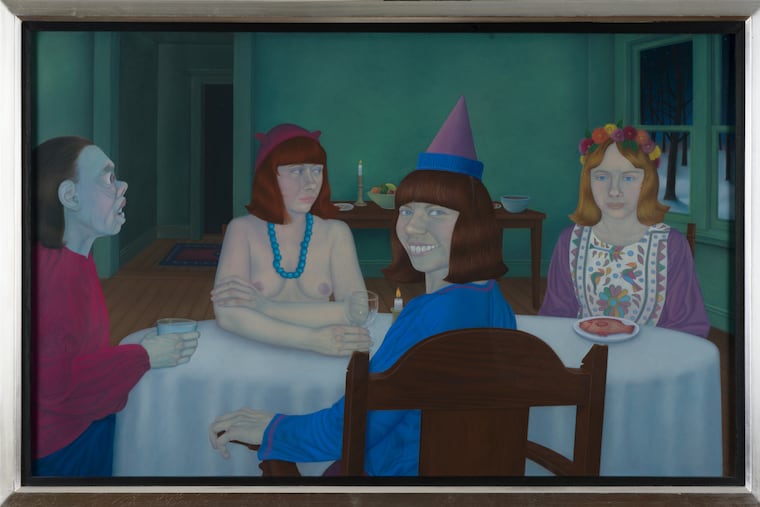
Soon after they had moved to Philadelphia in 1973, Robert Kohler and Frances Coulborn Kohler went to Boston’s Pucker Safrai Gallery and saw Jane Lund’s Party for Myself (1974–75) hanging by the doorway.
Four self-portraits of the artist born in 1939 — with shoulder-length hair — sitting at a table. One of the women in blue looks at the viewer and invites us in with a smile. Another wears a flower crown and sits with a plate of fish. Another is topless except for a blue beaded necklace and a hat with pointy horns. The last one has her hair slicked back and mouth wide open. Her skin is a ghastly blue.
“We hated it! How could anyone choose to live with such a thing, we asked ourselves,” Robert Kohler writes in a recent essay.
Once the Kohlers got to their home in West Philadelphia, they called the gallery. They wanted the painting.
The Lund painting was the first of many the Kohlers would go on to acquire — all featuring human figures. Hundreds from that collection are part of the “Bodies and Souls” exhibition on view at Woodmere and the Pennsylvania Academy of the Fine Arts.
“It stuck in our minds,” Kohler writes of the Lund painting in the same essay, featured in the show’s catalog, “and we independently realized that our strong feelings were a good sign.”
The show’s curator, Robert Cozzolino, who was a senior curator at PAFA from 2004 to 2016, first met the couple when working on another PAFA show in 2006.
“Then I went to visit their house and was blown away by how they collected by their own gut feelings and personal taste,” Cozzolino said. “They weren’t following any trends. They were not paying attention to what the market told them, or collectors. They were using their own eyes and their hearts, and that’s the thing that I think really amazed me.”
Over the years, the Kohlers developed a deep friendship with Cozzolino and, through him, PAFA.
“Rob would, occasionally, bring to my attention art he was thinking of acquiring with Frances, and we would talk about it. They also acquired some things for PAFA,” said Cozzolino.
By the time Cozzolino left PAFA, the Kohlers had already decided to bequeath their collection to the museum.
The Kohlers’ rules of buying
“We had been collectors since the late 1960s, not of fine art, but of art crafts: artisanal objects made or viewed as art,” writes Robert Kohler, who was a historian of science and a professor at the University of Pennsylvania. His wife, Frances, was a science editor. She died in 2021.
(Though related to the family of plumbing fixture giant Herbert V. Kohler Jr., the Kohlers are not part of the foundation that is a major donor to the Brandywine Museum.)
It was a PAFA show — 1981’s “Contemporary American Realism Since 1960,” curated by Frank Goodyear — that pushed the Kohlers to more serious and informed art collecting. That show, along with 1983’s “Bodies and Souls,” organized by New York’s Artists’ Choice Museum, opened the Kohlers to the endless possibilities of contemporary American Realism.
It was “expressionist, fantastic, raunchy, or all-out weird — a visual cornucopia,” Kohler writes.
That’s the style they stuck to acquiring.
The Kohlers mostly bought from galleries. They favored the art of living artists, and when they liked an artist, they’d take a deep dive into their oeuvre to pick their most significant works.
Driven by Chicago gallerist Allan Frumkin’s advice — “Buy the toughest work you can stand” — the Kohlers collected a wide range of artists, from New York, San Francisco, Chicago, Massachusetts, and, of course, Philadelphia.
“We favored art that insinuates itself assertively but nonviolently into our lives,” Robert Kohler writes.
The Kohlers at PAFA
If PAFA sets out to tell the length and breadth of the story of American art, the Kohlers’ collection allows it to tell “a much more expansive story,” said Judith M. Thomas, PAFA’s deputy director of American art.
Their deep collection of regional artists includes the Chicago imagists, the Bay Area figurative movement, and, Thomas said, “then someone like Gregory Gillespie,” who was born in New Jersey, studied in New York and San Francisco, and put down roots in western Massachusetts.
The through line that defines their collection, both Cozzolino and Thomas agreed, is the deep, supportive community that artists form among themselves and with their art.
Names like Chicago’s Gladys Nilsson (b. 1940) appear alongside Philadelphia’s Anne Minich (b. 1934) and former PAFA and now Rutgers professor Didier William (b. 1983), who was born in Haiti.
When put into the brackets of their artistic movements, artists may often seem like people creating only in conjunction with other artists around them, but “Bodies and Souls” and the Kohlers’ collection bring forth networks of cross-regional kinships, said Michelle Donnelly, PAFA’s curator of 20th century art and the John Rhoden Collection.
Nilsson is best known for her work in Chicago, but she lived in Sacramento for a brief period of time. There she met artist Robert Arneson (b. 1930) and became good friends with Roy De Forest (b. 1930) — all artists in the Kohlers’ collection bequeathed to PAFA.
The Kohlers’ gift of Evelyn Statsinger, said Thomas, fills a gap in PAFA’s collection of Chicago artists, and while the museum had Joan Brown’s art, the Kohlers’ collection makes PAFA’s collection “fuller and deeper.”
Figurative art is essentially an insertion of one’s self, a decision to put one’s body (however artistically) in the center of a piece. Queer bodies, aging bodies, people of color, immigrant bodies, bodies pushed away to margins often find a home in this style.
“Empathy and vulnerability is at the center of the Kohlers’ collecting practice,” said Donnelly. “And they were really interested in artists who were turning to themselves and their personal relationships to generate empathy.”
“Ultimately, I think it’s about humanity,” said Thomas. “It’s giving space for people, for artists, to represent humanity and compassion on many levels, and to be vulnerable, but also confident enough to make that statement in your artwork, and that’s inspiring. It’s courageous and it’s very human.”
The Kohlers at Woodmere
The Woodmere Museum is a museum of art by artists from and of Philadelphia.
“Rob and Frances’ engagement with the arts is really an interest in communities of artists and regional communities of artists across the country. And living in Philadelphia, of course, they were engaged with the artists of their city, of their community,” said William Valerio, the director and CEO of the museum.
While the PAFA show gives viewers the national scope of the Kohlers’ collection, the Woodmere show, Valerio said, “tells the local story.” The Kohlers, he said, “are looking at American art as a whole, and they’re looking at Philadelphia’s contribution to the overall narrative and the multifaceted conversations around American art.”
Artist Twins Seven Seven (1944-2011) was born in Nigeria but lived and worked in Philadelphia. His work, therefore, stands at an intersection of Philadelphia and America when drawing out the scope of America’s art and the story it tells about itself.
“Woodmere has collected Twins Seven Seven aggressively,” said Valerio. “And Rob [Kohler] decided there were two works of art that were kind of a pair [Village Life Under the Cocoa Tree (2007) and the undated Village Life Under Palm Tree]. Rob said, ‘You know, PAFA should have a piece by Twins Seven Seven.’ So both pieces were purchased. One came to Woodmere [Palm Tree], one went to PAFA [Cocoa Tree],” said Valerio.
Puerto Rico-born artist Rafael Ferrer (b. 1933), who came to Philadelphia in the 1960s to teach at UArts, also belongs in Kohlers’ gifts to both PAFA and Woodmere. As does Minich.
While the Kohlers’ collection is bequeathed to PAFA, the couple has also gifted art from their collection to Woodmere. But, Valerio said, “to a great extent, they’ve underwritten our ability to acquire works by living artists of Philadelphia. They have almost collected together [with Woodmere] to build the collection of living artists of Philadelphia.”
The Kohlers’ background in science, he said, made them “deeply intellectual people interested in the transformations that they’re seeing in their city daily. And that shows up in the works they collected.”
It also “led them to gravitate toward work that is visually detailed and grapples with natural life cycles with questions of decay,” said Donnelly.
What emerges, thereafter, is a world of artwork that creates a space for everyone — the San Francisco trans artist Craig Calderwood (b. 1987), Minich drawing her aging body, Irene Olivieri (b. 1951) exploring kinship and connection through a human-animal hybrid in Papachongo (2024), and so on.
“What stands out to me, again and again, are artists really unafraid to explore identity… artists really asking, ‘Who am I? How do I relate to the world?’” said Cozzolino speaking from Minneapolis days after President Donald Trump pulled 700 immigration officers from the city.
“It’s not overtly political but it’s about the politics of seeing one another, and seeing yourself and really being able to articulate what matters about identity.”
“Bodies and Souls” runs through July 12 at PAFA’s Fisher Brooks Gallery, Samuel M.V. Hamilton Building, PAFA, 128 N. Broad St., pafa.org; and through July 6 at Charles Knox Smith Hall, Woodmere Museum, 9201 Germantown Ave., woodmereartmuseum.org