Will Temple University and Library Company of Philadelphia become one? Merger talks are nearing completion.
While Library Company leadership assures that the organization will protect its integrity and ethos, some shareholders are not convinced.
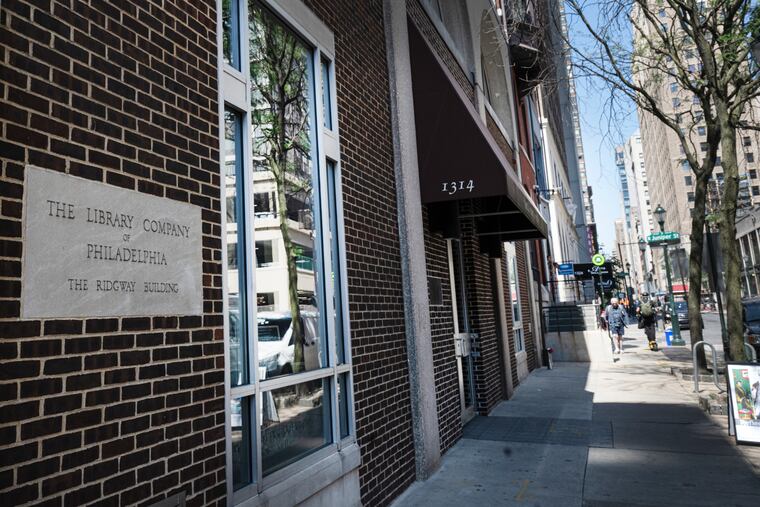
Temple University and the Library Company of Philadelphia are close to nailing down the terms of a proposed merger of the two institutions, Library Company shareholders were told at a meeting Wednesday evening.
But any merger deal would have to pass several more hurdles before becoming final. The boards of both Temple and the Library Company would have to approve it, and the proposal would then be put to a vote for the library’s 500 or so shareholders, attendees of the meeting were told.
The merger would also be subject to approval by Philadelphia Orphans’ Court.
Wednesday’s meeting was a special session called by a group of shareholders following a June Inquirer article reporting the potential merger. The shareholders were frustrated by what they perceived as a lack of communication regarding negotiations between Temple and the Library Company, and, in fact, officials at the meeting continued to decline to discuss the substance of talks, shareholders said.
On Friday, Library Company director John C. Van Horne confirmed that merger talks were close to concluding. He said that key to any ultimate merger terms would be holding onto an organizational identity, so that “when you come in the front door, you’re going to know you’re at the Library Company,” as well as maintaining “the staff, the collections, the programs, the endowments, the ethos.”
“We’ve been around for a very long time,” he said, “so we’re ... just trying to not only protect it but ensure that it survives for the ages, for many more centuries to come.”
Temple officials said they see the merger as a chance to “amplify” the work of both institutions.
“What we collect and what historically is embodied in the Library Company collections fit together in ways that would really enrich our academic programs and extend and develop the already significant research and academic activities at the Library Company,” said Temple dean of libraries Joe Lucia.
In explaining the impetus for the proposed merger, officials told shareholders Wednesday that the Library Company had run deficits in most recent years, and that it would have to eat into unrestricted endowment to continue to operate — and, even then, it would only be able to operate another two to three years.
Spreadsheets from the meeting obtained by The Inquirer showed substantial operating deficits in most years going back to 2017, as well as projections for deficits into 2030.
Asked what it would take for the Library Company to remain independent, officials said that $23 million would have to be raised for endowment, on top of the current endowment, to generate enough money to cover annual operating costs, according to shareholders in attendance.
Van Horne said that raising that kind of money would be “an incredibly steep hill to climb, and probably unrealistic.”
A special fundraising campaign last year to cover shortfalls, and gird finances this year and next, yielded about $4 million, but that level of annual giving could “absolutely not” be sustained on an ongoing basis, Van Horne said.
Still, some said that they would prefer to see the Library Company — founded in 1731 as the first subscription library in the U.S. — continue on its own.
“It goes to the independence and personality of the institution. I can’t imagine it’s not going to change if this goes through,” said shareholder Robert Eskind, who favors an ambitious fundraising campaign to preserve its independence. “You want to see a focused development effort … to rebuild the institution we knew. It didn’t sound to me like there was a concerted effort. The support is out there.”
If Library Company officials were unwilling to talk about the details of a merger — matters such as governance and fundraising — they did tell shareholders that, in talks with Temple, they were insisting on ensuring the integrity of the collection; keeping the current building on Locust St. near Broad as well as the Cassatt House, its residence for visiting fellows; and continuing endowed programs like fellowships in African American studies, women’s history, and visual culture.
Shareholder Cordelia Frances Biddle, an author who has frequently done research at the Library Company, said she doubted that a merger with Temple would leave the institution operating at the same level.
“I don’t see how that’s possible. I’ve seen what happens with other places and I think sooner or later they would find a reason for not keeping it up, and then what would happen? That would be my fear.”
Others cited Temple’s own deficit — a projected $27 million on a $1.29 billion budget for 2025-26 — and wondered whether the Library Company could be confident of the university’s support in the long run.
“I would need to feel confident that it was a strong relationship and a secure one, and right now I don’t know,” said shareholder Anita McKelvey of her potential support for an affiliation with Temple.
The library’s financial circumstances are such that “something needs to happen, and a merger seems to be the most appropriate,” said shareholder Joel Gardner. “As far as Temple goes, I don’t know. Temple has its own library and special collections. How does it all fit together, and can Temple come up with the money?”
One of the reasons for a merger with Temple would be to work with the university’s staff on expanding grants and philanthropic support for the Library Company.
“We’re approaching our 300th anniversary in 2031, which is right around the corner,” said Van Horne, “and we all think that that presents a great opportunity for fundraising, maybe a component of a larger campaign that Temple will be undertaking at some point. So increasing the pie is the goal.”