‘Niceties’ at the McCarter: Two women, and the bitter war among us all
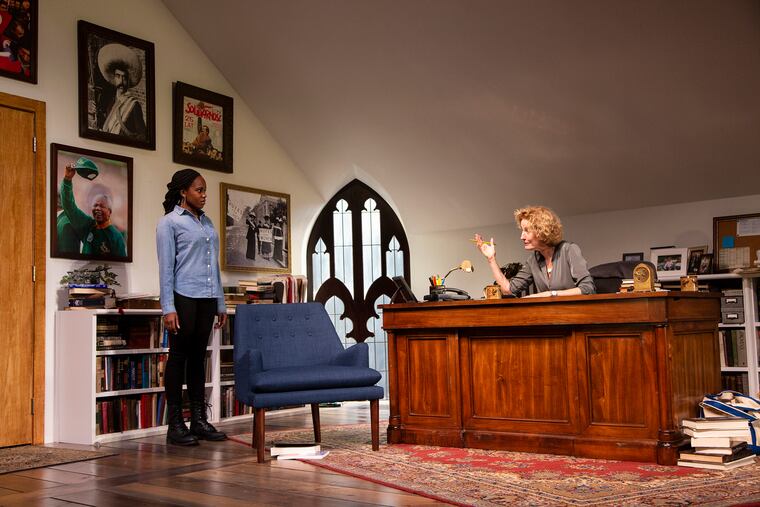
Two women are in a war over power, and over our present cultural state of polarization and angry intransigence. Lisa Banes and Jordan Boatman turn in fine performances, in a play that, despite its flaws, leaves us upset about ourselves and our historical moment.
You want to shake them.
You want to grab first Zoe and then Janine in Eleanor Burgess’ Niceties, through Feb. 10 at the McCarter Theatre in Princeton. “Stop,” you want to say. “Listen.” “No – you’re making a big mistake.” All the things you say, or shout, in an interminable, knock-down-drag-out, world-depends-on-it argument.
But they won’t listen. Zoe and Janine are what they are: deeply intelligent women, hardheaded, self-assured, and (each in her own manner) intransigent. Neither is good at listening; even when they do listen, they do not then move to conciliation. They use your ideas as ammo for a renewed attack. And they are in mortal combat. Jordan Boatman (Zoe) and Lisa Banes (Janine) are both very good, mitigating the drawbacks of what amounts to a two-hour argument.
It’s an Ivy League college in the Northwest in early 2016. Zoe is a student, Janine a professor. Each woman is, I must say, a caricature of the other woman’s view of her. (That’s a fault in this play, it must be said, but Niceties is too worthwhile not to rise above it.) A young black woman with rage, Zoe confuses justice with revenge. She moves quickly to hectoring and obscenity. Yet she also resents her professors seeing her as “a bomb about to go off,” which she certainly proves to be. (I wish that, as written, she had been given more self-awareness.) Janine is a prominent historian, concerned but also airily condescending (although unaware of it), just as blind to some things as she is aware of others. (It seems unlikely she’d be quite this patrician as of 2016, or make some of the blunders she makes; boy, are they bad.)
There’s so much wrong with both. Janine, too, is a member of a minority and has had to fight to get where she is — but she doesn’t get why, nevertheless, she cannot claim equivalence, why claiming it is offensive. She also is too quick to dismiss Zoe’s brilliantly original idea about history.
Zoe wants too much. More than reparations, she wants replacement. “If you’re so afraid of revolutions,” she tells Janine, “you should have worked harder to make them unnecessary.” She keeps telling Janine that “you are not in charge of this conversation.”
A flock of plays has arisen about teacher-student relations. David Mamet’s Oleanna, now at the Walnut Street Theatre, is one; Sarah Treem’s The How and the Why is another. Other than family, this is perhaps our basic model of power relations. The war between Zoe and Janine, with its retaliations, escalations (“You little American baby,” hisses Janine), and consequences, does not primarily concern gender, race, or prejudice (though all are involved). It is a war over power.
Even more, The Niceties is a portrayal of polarization, how entrenched positions do not, and (judging from this play) apparently never can change, and the damage that inflicts, on polarized people and polarized cultures.
Perhaps that is why so many in the departing audience seemed upset. The Niceties does seem unfinished, clearly that’s intentional. If a stroke too long in the first act, once it builds it inflicts real damage, some of it being to us.