Theatre Exile’s ‘Job’ demands a lot of patience, but it all pays off
Set in a therapist's office with just two characters, the production is marked by a taut, unsettling tension that only a few thrillers achieve.
In Max Wolf Friedlich’s Job, now in a blistering production at Theatre Exile, the play begins with a bang. Almost.
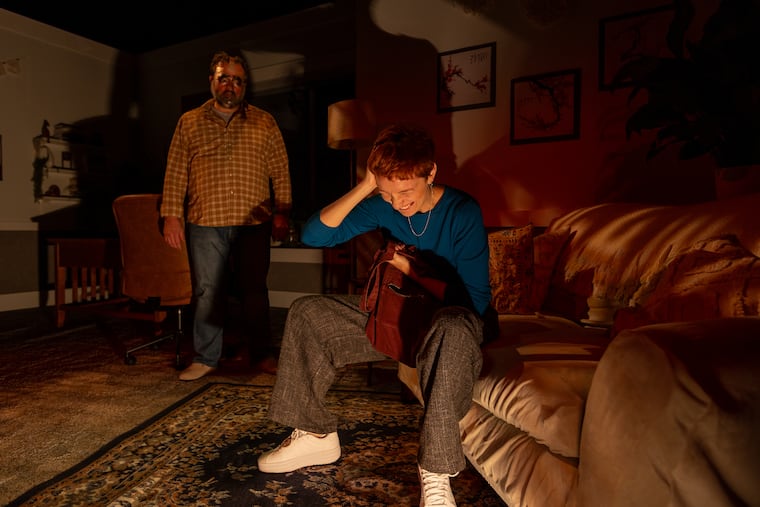
When the lights come up, we see a patient pointing a loaded gun at her new therapist. Jane is on a mission to convince Loyd, a Berkeley-trained psychiatrist, that she should be allowed to return to work at a powerful tech giant in Silicon Valley after she’s been placed on indefinite leave following a public breakdown at the office. Though he neutralizes the immediate threat and convinces her to put the gun in her purse, Jane won’t let him leave the office.
She worked as a moderator to root out heinous and often illegal internet content, and HR requires a doctor’s sign-off before she can go back. But if her goal is to get back to work, why does Jane believe threatening Loyd is the best way to achieve that? What lurks beneath this initial act of violence?
Waiting for Friedlich to peel back the layers of the mystery behind what brings Jane to her breaking point causes occasional aching frustration, but the unveilings are worth the agony of patience.
Job is built on the kind of taut, unsettling tension that most thriller films only dream of having, and director Deborah Block expertly harnesses that energy through strategic blocking and driven pacing. The specter of the gun never leaves us, with Jane constantly moving and futzing with her bag, reminding us this is not a normal therapy session, even if we’re tempted to forget.
Jane controls the room, but Loyd is not without power.
He gets to decide the fate of Jane’s career based on his assessment of her mental well-being. While he focuses on her inner life (and how to get her to let him go), the two discuss the longing and inability to achieve human connection in the modern world, the failings of well-meaning activism, and the nature of evil. Jane resists and resents the excavation, but her equal desires for control and to be understood take over.
Inevitably, the more Jane reveals about herself, the more we learn about Loyd.
Philadelphia theater veteran Scott Greer anchors the production as Loyd, shifting nimbly between the beleaguered, Birkenstock-clad therapist and personalities from internet videos Jane sees in moments of disassociation.
Arianna Gayle dazzles as Jane, a role she is revisiting after serving as understudy when Job played on Broadway in 2024. Jane is a tightly-clenched fist, but Gayle finds ease and humor in the role. This is a feat, given Jane’s frequent contradictions and suppressed anguish.
Nick Embree’s set serves as the perfect backdrop for what becomes a descent into truly gruesome territory. Loyd’s office is the epitome of “crunchy granola therapy” aesthetic: macrame wall hangings, generic Japanese cherry blossom triptychs, plants in wicker baskets, and a sign saying, “healing is not linear.” Lighting and sound (Drew Billau and Andrew Nelson) add ambiance and occasional shock throughout. On the surface, this is the ultimate safe space — until it isn’t.
Job plummets into challenging depths that are stomach-churning and not for the faint of heart, which Theatre Exile’s production nails. However, using mental health — an often misunderstood and stigmatized arena — as a means to explore human depravity is tricky at best, potentially damaging at worst.
By the end of the play, therapy and mental health feel more like devices to achieve a dramatic climax, rather than something to lift up and take seriously. Job should be explored, but not without caution.
‘Job’
(Community/Arts)
A thriller set in a therapist’s office, held together with a taut, unsettling tension. Two characters peel back layers of the mystery, and the unveilings are worth the agony of patience.
⌚️ Through Nov. 23, 📍 1340-48 S. 13th Street 🌐theatreexile.org
Theater reviews are produced independently by The Inquirer without editorial input by their sponsor, Visit Philadelphia.
Disclaimer: Max Wolf Friedlich is the son of Jim Friedlich, CEO and executive director of the Lenfest Institute for Journalism. The Institute is The Inquirer’s noncontrolling majority shareholder.