How Philly’s windows, facades, and fountains all find their way into an artist’s work
A Fairmount ceramic artist sees inspiration and beauty in every street corner.
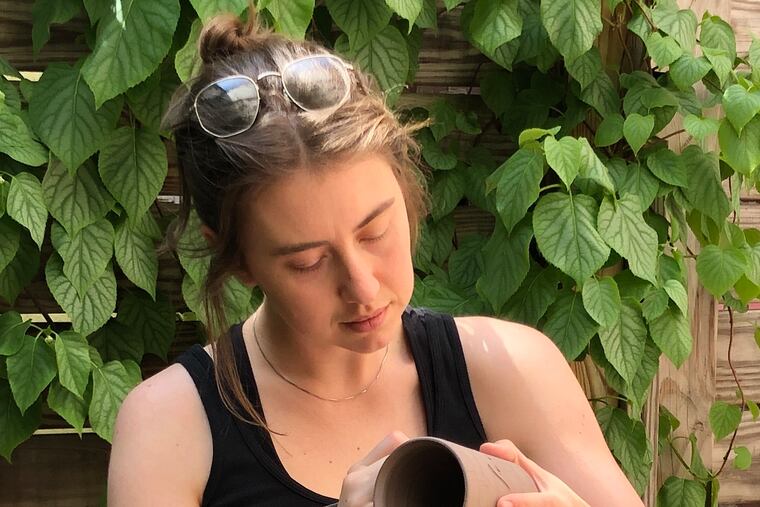
It was a happy accident when ceramic artist Vivian Purcell first explored Philadelphia during a layover with a friend and found lifelong inspiration. After growing up in South Carolina and attending the Maryland Institute College of Art, she first visited the city in 2016.
She moved here in 2019.
The artist, who lives in Fairmount and works out of a studio in Brewerytown, describes Philly as “one of the bigger ceramics hubs in the country” — because of its rich history of pottery production and its abundant natural clay resources. She worked at the Clay Studio as a work exchange artist before striking out on her own, creating work that honors the architecture and natural beauty of Philadelphia.
“Every corner we turned, there [was] another pattern or iron gate or brickwork ornament to discover,” she recalled of that fateful layover. “This city is so wonderfully visually stimulating and can be a bit overwhelming if you’re really taking the time to look.”
For her art, she draws inspiration from the designs seen in bricks and stone facades of buildings. She takes photos of tiles, brickwork, and ornate flourishes on windows she sees in her walks.
“Working with these brick patterns and walking all around the city taking photos makes me feel even more tied to the city I’ve fallen in love with,” she said.
A recent ceramic pot was inspired by the main branch of the Free Library of Philadelphia and mimics the building’s green patina, she said.
“I’m interested in the way the patina has worn down the metal over time and highlighted the pattern. I am trying to get something similar to happen on my pots,” she said.
“In a city as historic as Philadelphia, the majority of the buildings were designed in a time when society found value in beauty itself. To be worthy of being made, objects had to be both functional and beautiful,” she said. When the industrial age hit, the flourishes and ornamentation came to be seen as superfluous. “There was a time where beauty was more important than how fast you could put up an apartment building. When the small details not only mattered, but were the point,” she said.
“In Philly you can still find these traces of [that] history if you are paying attention.”
And Purcell is always attentive.
Her ceramic pots, mugs, and bowls feature patterns of plants and flowers always with a lingering trace of Philly’s architectural history. One listing on her website notes that her “city alleyway backyard” of sorts inspired a pattern of flowers on a cup.
She describes her process as “slow,” a valuable and sadly rare practice today.
“In a world that moves very fast, I want to make something that is meant to be slow. The process of making each pot is slow, with every piece being hand-carved. The user is meant to sit with the work and discover it through touch. … There’s something intrinsically calming about that.”
As she carves patterns onto her pots, she often thinks “about the hand of the person who did the original brickwork carving. It’s a way of working that hasn’t really changed in the last 300 years.”
A distinctive mark of her work is Purcell’s play with texture. Imagine pouring your morning coffee into one of her mugs and tracing the patterns with your fingers. “You can feel all the lovely bumps and ridges of the carving, and isn’t it so nice to be able to feel a drawing?” she says.
When not creating art, Purcell works as the art department studio manager at the Community College of Philadelphia, which is located in the old United States Mint building.
One of its galleries features the work of Gilroy Roberts, a sculptor who helped design the building itself. And another artist she feels a kinship with.
“His workbench, tools, and various sketches are on display and it looks shockingly similar to my own studio,” Purcell said. “We have the same tools and I can see where he tried to make them more ergonomic for long studio days to avoid the dreaded hand cramps.”
Her work is a part of the ongoing Philadelphia Museum of Art Contemporary Craft Show, which showcases the work of 195 artists representing 13 types of artistic expressions.
“We are all connected through this love of craft and of making things by hand. That’s why it’s so special,” she said. “Everyone’s work is so different but there is a commitment to excellence in the arts that brings us all together; a strong belief that everyone should have objects that can live in your home and remind you that not everything needs to be made by a machine.”
Philadelphia Museum of Art Contemporary Craft Show, Nov. 7-9. Nov. 7, 11 a.m. — 7 p.m.; Nov. 8, 10 a.m. — 6 p.m.; Nov. 9, 10 a.m. — 5 p.m. pmacraftshow.org