Lunch with Bach and scary movies with a 1920s organ: Concerts are finding new ways to surprise and delight
Classical groups are playing with format — shorter concerts, earlier curtain times, pop-up performances, and more.
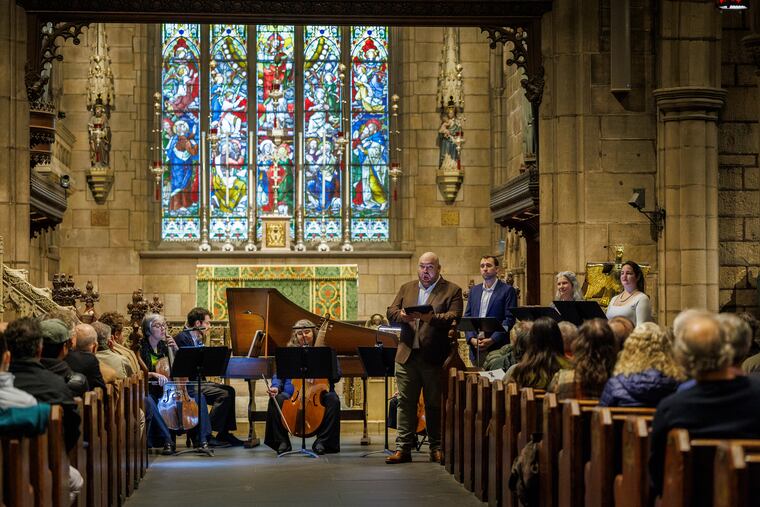
At lunchtime in Center City, you can grab a Shorti at the Wawa. Or you could go for something really nourishing, like a Bach cantata.
The experience is a new one, this series by the Philadelphia Bach Collective — brief, midday, pay-as-you-wish concerts in the middle of town. And not just any concert, but selections from a body of work that shimmers with genius and inspiration.
You don’t have to be religious to be deeply moved by these sacred works. Texts aside, the intimate music leaves plenty of space to search for your own internal, private interpretations.
On Tuesday afternoon just before 1, this agnostic walked up the brick path into St. Mark’s Church on Locust Street and, for a little more than a half hour, all was right with the world. How often does that happen?
The surprise of it accounts for a good part of the impact. Classical groups are playing with format — shorter concerts, earlier curtain times, pop-up performances, and more.
Bach at lunchtime coincided this week with another new series, this one more profane than sacred. The Pipe Up! concerts’ silent horror films launched with organist Ian Fraser playing live to a screening of F.W. Murnau’s mind-blowingly good Faust from 1926.
With a Wurlitzer theater organ conjuring plagues and evil, squalid masses, human foibles, and a good immolation scene or two, the Wanamaker Building’s Greek Hall was as a silent movie theater from the 1920s on Monday night.
The films continue only through Friday, with no more announced for now except a Nov. 10 showing of the The Phantom of the Opera (1925) with Peter Richard Conte playing live to screen in the Grand Court.
Several things are striking about both the Bach and the weeklong film series. That the arts scene continues to reinvent itself even as funding sources become strained is particularly encouraging. Both projects are collaborations — the Philadelphia Bach Collective is a product of Variant 6 and Night Music, and the film series from Opera Philadelphia, Friends of the Wanamaker Organ, and others.
And both are happening on a high level — the kind of thing that, had you experienced it in Paris or Berlin, would make you say you wished we had that back home.
Tuesday’s Bach cantata was Gottes Zeit ist die allerbeste Zeit (God’s time is the very best time), the so-called “Actus tragicus,” and it was a study in how brightly and warmly a small work can glow.
Soprano Anika Kildegaard, mezzo Maren Montalbano, tenor James Reese, and bass Dan Schwartz made for a sharp quartet, varying their colors for expressive meaning, with strong solo and supporting contributions from a small instrumental ensemble.
The Bach series seems to have found its audience, even in this, its second concert; St. Mark’s was fairly full.
The film series in the old Wanamaker’s “sold out” immediately (admission was free, with seating for fewer than 130). The enormous organ in the Wanamaker Grand Court is rightly celebrated, but here, in much smaller Greek Hall, the Wurlitzer was no less effective.
The instrument is from 1929 — minted around the same time as this week’s films — and was brought to Greek Hall in 2007. Tuesday night, organist Don Kinnier played live to The Phantom Carriage, the Swedish film from 1921.
The series opened Monday with Fraser making the most of Murnau’s century-old Faust. The organist made brief nods to Liszt’s Faust Symphony in the opening credits, and then improvised through recurring themes and other material of his own writing as he watched the film.
It’s not a great stroke of originality to conjure big moments or schmaltz on the organ when events on screen dictate it, but Fraser went beyond the obvious. This theater organ has in its arsenal special effects and percussive sounds — a celesta, airy colors, French horns and strings, and more. The single low note and hiss Fraser deployed when Mephisto appeared was as disturbing as it was spare.
Reasserting itself through Fraser’s impromptu scoring was a sweeping gesture that could be heard as the love theme. Humanity may be flawed and fate cruel, but in the organist’s view, as in Murnau’s telling of the Faust legend, love always wins.
Pipe Up! classical silent films with various organists continue Thursday and Friday, and are sold out. “The Phantom of the Opera” with Peter Richard Conte, Nov. 10 at 7 p.m. at the Wanamaker Grand Court, 1300 Market St., is free, no registration required. operaphila.org.
The Philadelphia Bach Collective concerts at St. Mark’s Church, 1625 Locust St., continue Jan. 20, March 24, and May 5 at 1 p.m. philadelphiabachcollective.org.