How are college grads navigating the tough job market? Here’s what some in Philly are doing.
Harnessing AI and attending in-person networking events are some of the ways graduating students are taking their first steps into their careers.
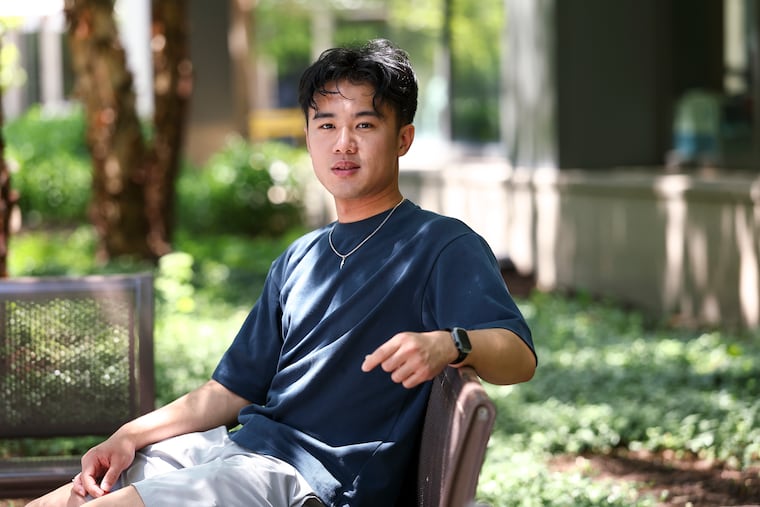
Matthew Soesanto wrapped up his undergraduate biology degree at Drexel University in March and spent weeks applying to research, coding, and pharmaceutical industry jobs this spring. But he wasn’t hearing back from hiring managers.
“It just feels like I’m sending applications to a black hole,” said Soesanto, who will walk in Drexel’s graduation in June.
It left him wondering, “Am I doing something wrong?” he said. ”There’s no feedback.”
Soesanto is one of Philly’s many graduating college students mapping out their careers in a tough job market. Budding professionals are trying to stand out from huge pools of job applicants. They’re embracing the virtual aspects of a modern workplace by showing they can use AI, while also trying to make an impression in-person at networking events.
The hiring rate is down in the past two years, even flirting with Great Recession lows in recent months. Fewer employers are signing up for career fairs, and the unemployment rate for recent graduates is higher than the overall rate for all workers — that’s been the case for a few years.
“Young people are having a challenge right now entering the workforce,” said Jennifer Kebea, president of Campus Philly, which works to keep students of Philadelphia colleges from leaving the area after graduation.
Employers are still hiring, said Kebea, but they’re being more selective. They are increasingly looking for candidates with AI fluency and proven experience.
“This is not a Gen Z issue. It’s a changing labor market,” Kebea said. “Recent grads are entering a market that’s more competitive, it’s more skills-focused, it’s more uncertain.”
Working a job while trying to launch a career
Drexel senior Maggie Jiang felt discouraged about the job hunt when she first started applying to positions several months ago. The marketing and organizational management double major is more optimistic now.
“I’m hearing back from more jobs,” said Jiang. “There was a period where it was like, just me sitting here, hoping.”
Jiang is working as a server at a Malvern restaurant, 30 to 40 hours a week, while she looks for a full-time position. She’s worked in service jobs on and off since she was a freshman.
Students like Jiang who worked while completing school have a better chance of landing a full-time job post-graduation, a recent ZipRecruiter survey found.
“I’m just really thankful that a lot of the service industry hours don’t start until later in the day,” she said. She finished homework during breaks between classes.
Jiang completed high school online during the pandemic. The virtual setting sapped her motivation. So she would prefer a job with some in-person work and opportunities for direct feedback, where she’s not just messaging colleagues online.
“I personally can’t function just being remote only,” she said. “I’d rather be surrounded by a more lively environment with my coworkers.”
New Temple University graduate Jaiden Charles said “hybrid is the golden option,” although she’s open to jobs with other setups.
Charles, who studied public relations and digital marketing in school, works remotely 20 hours a week with 1824, Universal Music Group’s marketing and content strategy arm. She’s been doing the job since her junior year, juggling it with school work.
After applying to some 10 to 15 jobs and internships, Charles had heard back from a few places by mid-May, and got interviews with some of them.
“It does take some time going through the process,” she said. “Especially when you’re trying to graduate from college.”
The value of meeting people IRL
Temple senior Mario Pacheco, who studies mechanical engineering, hopes networking will make him stand out from other applicants. He has one course to finish this fall, but plans to ramp up his efforts to get a full-time job by the time he’s done.
In-person networking is all the more important right now, said Kebea from Campus Philly, partly because hiring managers are flooded with applicants.
Pacheco is also working on getting an engineer certification to beef up his resumé.
“I’m just trying to stay as positive as possible, and trying to do as much as I can to distinguish myself from other graduates,” said Pacheco.
He’s spending the summer interning with the Philadelphia Housing Authority, as he did last year. For 30 hours a week and $17 an hour, he worked on HVAC systems at PHA sites.
“There’s always buildings going up that need HVAC systems designed,” he said. “There’s a chance for there to be plenty of work in that field.”
Looking for AI competence
Employers like IBM and McKinsey are hiring more entry-level positions this year, but those roles are changing with the adoption of AI. The technology is also making some young workers rethink their career paths.
“AI can automate tasks, but it doesn’t develop people and the talent that we need,” said Kebea. If AI leads to fewer entry-level opportunities, Kebea noted, that means fewer people are getting trained in those early jobs, creating a talent shortage in the long term.
For the time being, employers are looking to hire people who know how to use AI and can hit the ground running, said Kebea.
Jiang, the Drexel senior, has used AI in past workplaces, with her employers’ blessing, to help create prompts on social media including LinkedIn. She also used AI to refine her resumé.
Some college students have trepidations around how AI is being used to screen job candidates, Kebea said, but she noted that employers have been using hiring technology to screen applicants for some time. While young people may be tempted to apply to many more jobs in the age of AI, she recommends against it.
“It’s not a numbers game. It’s a quality game,” said Kebea.
Students are both ambitious and anxious in today’s job market, said Kebea, but many are rising to the occasion.
“Gen Z is so pragmatic,” she said. “They’re absolutely still ambitious about their potential in the workforce.”
When the offer comes in
In April, Soesanto, the biology graduate at Drexel, got an offer he couldn’t refuse.
He was running on the Delaware River Trail when he saw an alert on his phone: He was the recipient of a Fulbright award – the prestigious grant to work or teach abroad.
“I was just mind blown, really stoked, really happy, euphoric,” said Soesanto, who in early May was planning to accept.
In September he’ll start 10 months of research in Indonesia studying the symbiosis of a species of fish and their bacteria. The project “is what I’ve wanted to do for the longest time,” he said, but he’s also accepting the offer because of the challenge of landing a job right now.
“It takes a while to get a job,” said Soesanto. “There’s an open door for me, and I’d rather take that one.”

From Jennifer Kebea, president of Campus Philly:
Build experience through internships, campus jobs, volunteering or other opportunities. Employers want evidence that you can apply skills to real-world situations.
Learn how to use AI but don’t rely on it to think for you. Employers still value critical thinking.
Relationships matter. Networking can be intimidating, but career opportunities can be found through those connections. Don’t forget to send that thank-you note.
Don't think your first job defines your entire career. The skills you acquire could transfer to a very different role later.
Think about geography. Where do you want to build a life, and where will you be able to grow professionally?