Can a longtime cable giant become a competitive cell phone carrier? Comcast is betting on it.
Millions have taken advantage of Xfinity Mobile’s free-line-for-a-year promotion. Now, the Philly-based media giant must convince many of them to pay for its fledgling wireless service.
Comcast is expanding its mobile services as it looks to leverage an uptick in wireless demand, offset the departure of cable and internet subscribers, and convince customers with a free cell phone line to pay.
The Philadelphia-based media giant announced Wednesday that Xfinity Mobile now consists of two new flat-rate plans: Mobile Select, which costs $30 per month per line, and Mobile Plus, a premium tier that costs $45 per month per line and includes device insurance and anytime upgrades.
The company called the rollout “Xfinity Mobile’s most significant product expansion” since the service launched in 2017. Executives said it will work in tandem with the free-line-for-a-year promotion, which is credited with bringing in about half of its mobile connections.
The expansion was announced at a strategic time: Many customers’ free lines will end later this year, executives said, and the company hopes those mobile users will stay on and pay for the service.
“In the early cohorts, we have seen a significant majority of those customers rolling to paid [plans], so we feel that will continue as we move forward,” Comcast’s co-CEO Michael Cavanagh said Thursday on an earnings call.
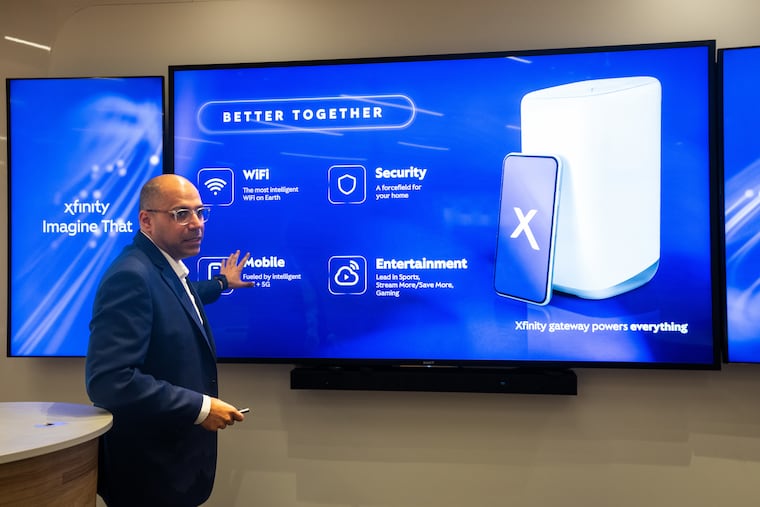
During a visit last week to the Comcast Technology Center, one of the company’s two Center City skyscrapers, other executives were equally bullish on Xfinity Mobile’s potential.
“We are making money on this product today,” said Kohposh Kuda, Xfinity’s senior vice president of consumer product marketing. Mobile customers have proven more likely to stick with Comcast, becoming “two to three times more valuable to us over time.”
“We are creating a value for them, and in turn they’re creating value for us in the market,” Kuda added. “That’s why the growth rate over the last several years has been really strong.”
Last year, Xfinity Mobile netted 1.5 million new wireless lines, its highest-ever annual increase, for a total of 9.3 million lines, according to earnings reports.
In early 2026, Comcast added another 435,000 wireless lines, its highest-ever quarterly jump, according to the latest report released Thursday.
“Wireless accelerated meaningfully this quarter,” Cavanagh said. “Our free line offer continues to perform well and is doing exactly what we intended.”
The company’s 9.7 million wireless lines is up from 7.8 million in 2024 and 6.6 million in 2023.
A Comcast spokesperson said each Xfinity Mobile customer has two lines on average, meaning mobile uptake represents a fraction of the company’s 31 million internet customers. Only new or existing broadband customers can sign up for mobile.
In 2025, Comcast brought in nearly $5 billion in revenue from wireless services and devices, according to earnings reports. The number is also a fraction of the tens of billions of dollars the company generates annually from internet and cable, but it’s trending upward, having risen 16% between 2024 and 2025.
Xfinity Mobile, Kuda said, is a “growth engine” for Comcast, which also makes money from theme parks and movies.
Comcast’s pitch for Xfinity Mobile
Comcast’s strategy centers around what executives call “convergence,” or how all their technology and products can work together for a better customer experience. This integration, they say, benefits the business and its customers.
“Customers just see connectivity as one thing, whether it’s mobile, whether it’s Wi-Fi, whether it’s the network to the home, the network in the home,” said Fraser Stirling, global chief product officer at Comcast. “They just want to be online and they want it to work when they need it to work.”
The pairing of Xfinity Mobile and Xfinity internet is one example of convergence in action, executives said.
Company spokespeople declined to specify how many mobile users were legacy customers and how many were new subscribers, citing competitive reasons.
But “most of the customers are existing Wi-Fi relationships adding mobile,” Kuda said. “We create this unique value for customers that have a relationship with us.”
The pitch for Xfinity Mobile, he said, is that Comcast customers will spend less money compared to other wireless carriers and get more perks.
Customers on both mobile plans can use their phones internationally with no added fees, and they get an automatic speed boost when connected to Xfinity home Wi-Fi or one of the company’s 23 million communal hot spots nationwide. Xfinity Mobile users experience these speed pickups often, executives say, with 90% of data from the network’s devices traveling over Wi-Fi.
As an Xfinity Mobile customer connected to Xfinity Wi-Fi, “you’re getting fast, blazing, gig speeds," Kuda said. “But if you have a friend who has T-Mobile, they’re not.”
As cable declines, challenges lie ahead
So far, Comcast’s Xfinity Mobile push — which includes the naming rights of South Philly’s indoor stadium — has not coincided with a rise in internet customers, though broadband losses slowed in the most recent quarter.
After demand increased between 2010 and 2022, the number of broadband customers plateaued and then dipped slightly over the past few years, according to company earnings reports. Yet internet revenue increased as the average internet customer paid more for their plan, some opting for higher-tier service, according to the reports.
Traditional cable TV customers have fallen off precipitously, the company has reported, from 22 million in 2018 to 11.3 million at the end of 2025 and then to 10.9 million in early 2026.
Cable has become less popular across the industry, but internet demand has surged. Comcast executives say its become harder to attract and retain broadband subscribers due to more competition.
Comcast is trying to keep customers by offering more add-ons, including the Amazon Luna cloud gaming service and a home security system that can detect movement between Wi-Fi-enabled devices.
The mobile space is also “noisy,” with many carriers vying for consumers’ business, Kuda said.
Some of these competitors have acquired large customer bases over decades. As of December, Verizon reported more than 146 million wireless connections, and AT&T reported more than 120 million wireless subscribers.
“One of the big challenges in mobile is trying to convince and get customers to switch,” Kuda said. “We’re using the free line as a mechanism to say, ‘Hey, there’s no commitment.’”
Industry analyst Craig Moffett said Comcast’s latest earnings report showed a “reason to hope there’s a payoff” in the company’s growth strategy.
“Comcast’s bet … is that wireless will help defend broadband,” which will eventually need to grow again, Moffett wrote Thursday in a report. “But wireless will also be a major revenue and profit driver for the company in its own right.”