What Peco’s new CEO has to say about your electric bill, AI data centers, and coal in Pa.
David Vahos, a Villanova graduate, took the helm of the utility in June. He is "thrilled" to be back in the area, but is candid about the challenges ahead.
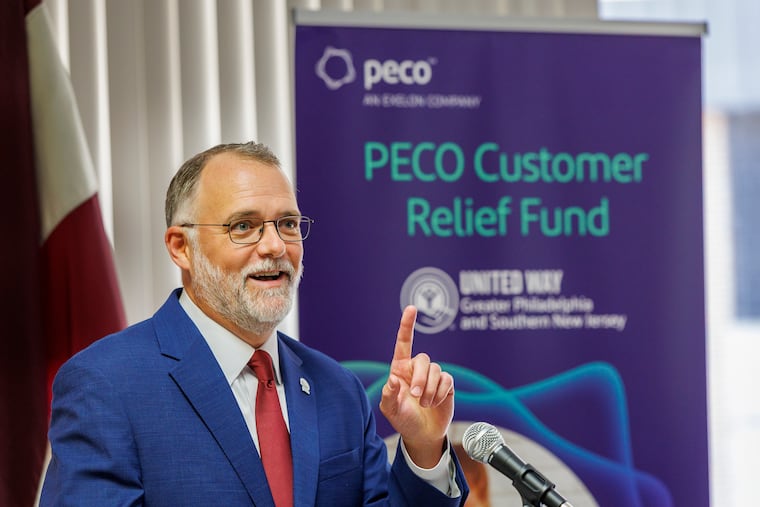
Despite the stresses of his new job as president and CEO of Pennsylvania’s largest electric and gas utility, including customer anxiety over high prices, David Vahos is ecstatic.
“I’m thrilled and humbled to be here,” said Vahos, who brings 30 years of financial and operational leadership to the role. “It really does feel like a community when you come to Philadelphia.”
Vahos comes to Peco from Maryland, having most recently served as senior vice president, chief financial officer, and treasurer of that area’s Exelon subsidiary, Pepco Holdings. But he is no stranger to the Philly region. He graduated from Villanova University in 1995.
He returned to the area to take the helm of Peco in June, jumping right in amid heat waves and summer storm season. And as customers’ bills continue to go up, having risen about 5% on average between January and June.
The company’s new leader, however, said he remains optimistic, motivated by how 1.7 million Philly-area households depend on their service.
“Having that purpose really resonates with me. It resonates more today than it did even when I first got here,” Vahos said. “It really is just an awesome job.”
But he is candid, too, about the challenges ahead.
The following interview has been edited and condensed for clarity.
What are you hearing from customers about their electric bills this summer?
I had a customer come in to me the other day and say, “Hey, I got my June bill, and I’m looking at my July bill, and my bill doubled.” We went through and looked, [and I showed them] “Here’s how much you consumed. You literally consumed twice as much.” When it’s this hot, your bills are going to increase significantly. Because you’re trying to stay comfortable and safe in your home.
AI data centers are demanding so much of the grid that they’re driving up energy prices, according to several recent reports. You came out as recently as June in support of Pennsylvania’s efforts to attract such centers, including the one Amazon is planning in Bucks County. How do you reconcile that desire to support the economic impacts with the expected impact on the grid?
Having a big customer come in helps everyone, right? So we like to see that. At the same time, we are concerned. We want to make sure that Pennsylvania continues to be a state that’s generation-rich, because we’re an exporter of energy today, and data centers will consume that energy in a heartbeat.
In five years, if everything out there gets built, we could be in a situation that looks much more like neighboring states [such as New Jersey, Delaware, and Maryland], where they have a deficiency of generation and they need to import. I don’t want to see Pennsylvania in that kind of model, because it will impact customers from a price perspective. So we need new generation. Pennsylvania needs to build.
A data center is going to take three, four years to get to max load, if it’s a one-gigawatt data center. If someone wants to build a combined-cycle gas-fired plant, which is the most efficient natural gas pump you can build, it’s at least five years. There needs to be a sense of urgency that you can’t wait until all of these data centers get here because it’s going to take five years to solve the problem.
Some New Jersey lawmakers are exploring unplugging from the PJM grid [which transmits electricity to 13 states, including Pennsylvania and New Jersey] and establishing a regional grid. What are your thoughts on that? Do you see Pennsylvania exploring that?
That is a very complicated question, because we’ve been together [with PJM] for so long and it’s so integrative. It’s such a hard thing to untangle.
Pennsylvania isn’t forcing anyone to build [generation] — and I’m not saying they should or shouldn’t — but that was the old model, when we used to have vertically integrated utilities. Then you owned your own generation stacks for your own customers, so you knew you could always supply them. We have moved so far away from that in the last 25 years. I just don’t think it’s as easy as “I’m going to detach from PJM.”
Said another way, I’m not sure that’s going to solve the problem. The problem is we need generation to be built in all of our zones, and I want it to be built here in Pennsylvania.
With President Trump pushing to repeal limits on greenhouse gas pollution, do you think coal will ever regain its footing in Pennsylvania?
It’s hard for me to predict that one. The current administration is pulling back from a lot of those green initiatives. But I’ve been around long enough to know that another administration will come, and [those initiatives] could come right back.
It’s probably premature to say coal is going to come back at scale. Remember, it’s not just a federal mandate. There’s also a state mandate. So states have a lot of control over what kind of emissions they want to tolerate.